
How Is a Yacht Insured During a New Build, Refit or Delivery Voyage?
How a yacht is insured during a new build or refit depends on the stage: the yard's builder's-risk policy usually covers the hull until delivery to the owner, the owner's own hull and liability policy takes over at handover, and that policy keeps running through a refit.
Who holds the risk at each stage, from keel laying to relaunch, with the clauses that decide it.
250 nm
Builder's-risk radius for trials and delivery
30 days
Most builder's risk runs on after trials
Listed operators
Only they may helm a delivery
24 hours
To reinstate a policy that expires at sea
Taking delivery or going into the yard?
Tell us the yacht, the agreed value, the yard and the dates. We introduce the enquiry and written terms come back from the London market.
Definition
Builder's risk insurance is the policy that covers a vessel, and the materials set aside for her, while she is built, launched, tried and delivered. The shipyard usually buys it. It ends when the yacht is delivered to her owner.
Key takeaways
- On the standard London-market form, the Institute Clauses for Builders' Risks 1/6/88, builder's risk ends "upon delivery to Owners" and covers trials and delivery within 250 nautical miles of the yard.
- If delivery slips, the same form extends cover by no more than 30 days after the builders' trials (clause 3).
- The London-market policy wording we hold has no refit clause, no hot-work clause, no builder's-risk section and no delivery-voyage clause. Four other things decide each stage: the duty to report changes, the agreed value, who is at the helm, and whether the yacht is laid up.
- Selling or transferring the yacht ends the seller's policy on the date of transfer (General Conditions and Warranties 4).
- On a delivery voyage, the wording gives no cover when anyone other than a listed operator is at the helm (General Conditions and Warranties 26), and none single-handed unless agreed in writing (28).
- A yacht broker told Boat International in December 2021 that insurers sometimes ask $10,000 to $15,000 of extra premium for refit exposure. That is one broker in one article, not a market rate.
This page is general information, not financial or legal advice. Your own schedule and wording decide what applies to your yacht.
The numbers that decide each stage
250 nautical miles
How far from the place of construction builder's risk covers fitting out, trials and delivery.
Institute Clauses for Builders' Risks 1/6/88, clause 9
30 days
The most extra builder's-risk cover after builders' trials when delivery is delayed.
Institute Clauses for Builders' Risks 1/6/88, clause 3
125%
The cap on what builder's risk pays, as a share of the provisional value, when the final value comes in higher.
Institute Clauses for Builders' Risks 1/6/88, clause 1.3
65 feet
US federal longshore cover does not reach people building a recreational vessel under this length, or repairing any recreational vessel, when state workers' compensation covers them.
33 U.S.C. 902(3)(F), Cornell LII3 months
How long a yard must keep a Marine Chemist's hot-work certificate on file after the job.
29 CFR 1915.14, OSHAWho insures a yacht at each stage of a new build, refit or delivery?
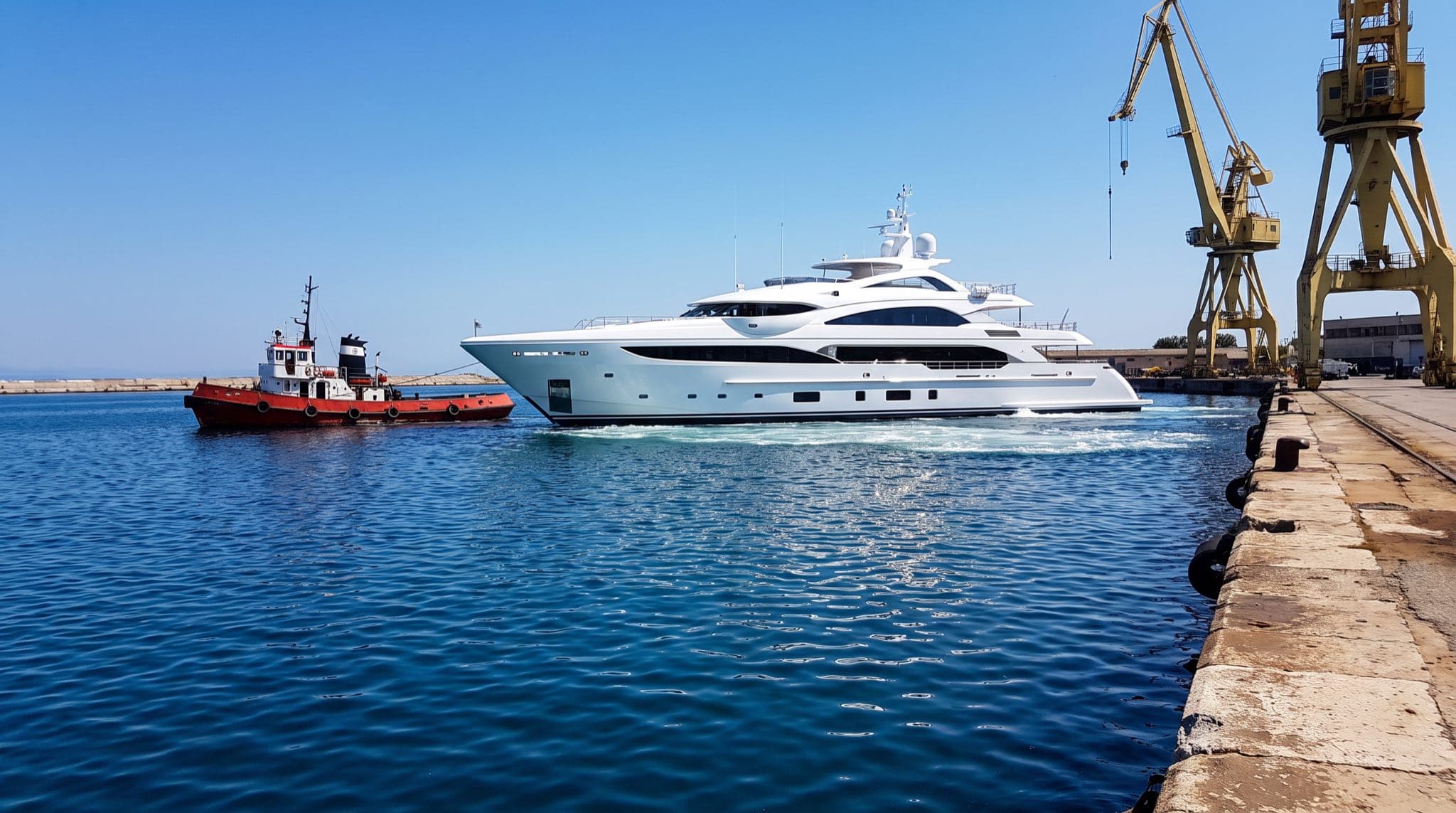
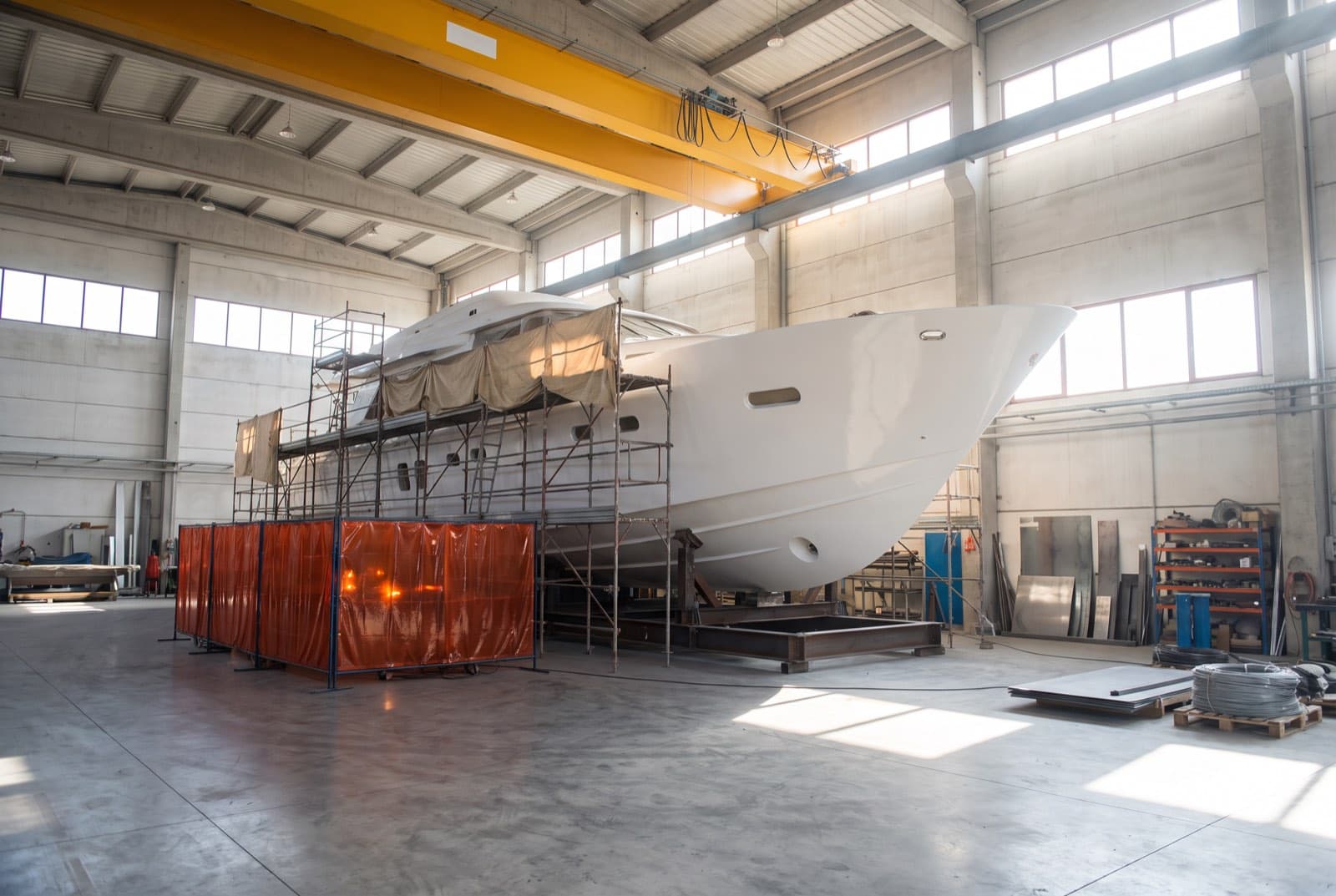
During a new build, the yard's builder's-risk policy usually insures the hull through launch and sea trials until delivery to the owner. From handover, the owner's own hull and liability policy takes over. In a refit, the owner's policy keeps running, and the yard answers only for damage it causes.
Superyacht Times describes builder's risk as "almost invariably secured by the builder". The switch points below come from the standard builder's-risk form and from the yacht wording we hold.
| Stage | Whose policy | What switches it | Clause or form that decides it |
|---|---|---|---|
| Contract signed, keel laid, hull in build | The yard's builder's risk | Start of construction | Institute Clauses for Builders' Risks 1/6/88, both insuring sections |
| Launch and builders' trials | The yard's builder's risk | Trials within 250 nautical miles of the yard | Clause 9 (navigation); clause 5.2 (failure of launch) |
| Handover or closing | The owner's hull and liability policy, bound for that date | Delivery to the owner; on a used yacht, transfer of ownership | Builder's risk "terminate upon delivery to Owners"; General Conditions and Warranties 4 ends a seller's policy at transfer |
| Delivery voyage | The owner's policy | The captain and route must match the schedule | General Conditions and Warranties 26 (listed operators) and 1 (appropriate crew) |
| Refit or yard period | The owner's policy, plus the yard's own liability cover for the yard's negligence | Report the change before work starts | Insuring Agreement notice duty; the product summary (IPID) asks for structural alterations |
| Sea trial after a refit | The owner's policy | A listed operator and an appropriate crew | General Conditions and Warranties 26 and 1 |
Sometimes two policies respond to the same loss, say the owner's hull policy and a contractor's policy. Under General Conditions and Warranties 15 of our wording, the hull policy then pays only its share. It does not pay in full next to the other one.
What does builder's risk insurance cover while a yacht is being built?
Builder's risk insures the yacht and the materials allocated to her while she is built, launched, tried and delivered, usually on a policy the shipyard buys. On the London-market form, trials and delivery are covered within 250 nautical miles of the yard, and cover ends on delivery to the owner.
What the Institute Clauses for Builders' Risks 1/6/88 actually do:
- Value (clause 1). The insured value is the final contract price or the building cost plus a margin, whichever is greater. If it ends up above the provisional value, the indemnity is capped at 125% of the provisional value.
- Delay (clause 3). If delivery is late, cover can run on, but never beyond 30 days from the end of builders' trials.
- Launch (clause 5.2). If a launch fails, the form pays the extra cost of completing it.
- Faulty design (clause 8). The form pays for damage that a design fault causes elsewhere in the yacht. It does not pay to replace the faulty part itself.
- Navigation (clause 9). Fitting out, trials and delivery are covered within 250 nautical miles of the place of construction. Beyond that, cover is "held covered at a premium" to be agreed.
- End (both insuring sections). Cover terminates "upon delivery to Owners" if that comes before the provisional period ends.
In the US, the American Institute of Marine Underwriters publishes its own builder's-risk form, AIMU 13K-1, which values a total loss at the yacht's stage of construction.
What it does not do: builder's risk is cover for physical loss and damage, and it does not pay out if the yard goes bust. The law firm HFW names shipyard insolvency as a separate problem, says the policy's terms and placement should fit the build contract, and notes that an owner may arrange the cover itself, an option it calls often overlooked.
What does builder's risk cost? We could not verify any published marine builder's-risk rate, so we do not quote one.
| Builder's risk (Institute Clauses for Builders' Risks 1/6/88) | Owner's yacht policy (the London-market wording we hold) | |
|---|---|---|
| When it ends | "terminate upon delivery to Owners"; at most 30 days after builders' trials if delivery slips (clause 3) | The period on your schedule; ends on sale or transfer of ownership (General Conditions and Warranties 4) |
| Where the yacht may go | Within 250 nautical miles of the place of construction for trials and delivery (clause 9) | The navigational limits on your schedule |
| Value | Final contract price or building cost plus a margin, capped at 125% of provisional value (clause 1) | The agreed value on your form, for partial and total losses |
| Defects | Damage caused by a design fault is covered, the faulty part is not (clause 8) | "Manufacturing or design defects including latent defects" are excluded |
| Who may operate | The form sets no list of operators | Only "those listed as operators" (General Conditions and Warranties 26) |
| Contract liability | Collision liability and protection and indemnity sit within the form | "Liability assumed by you under any contract or agreement" is excluded unless agreed in writing before any loss |
The yacht cover this page describes is for yachts up to $5M. For a superyacht build above that, we introduce the yacht to a specialist London-market superyacht broker, and the firm that arranges your cover is named in the documents you receive. See superyacht insurance and how it works.
Clause summaries are for orientation only, not legal advice. The policy issued for your build decides the terms.
When does the owner's own yacht policy have to start?
Bind the owner's hull and liability policy for the moment title passes. Builder's risk ends on delivery to the owner, and on a used yacht the seller's policy ends at transfer of ownership under the wording we hold. There is no gap in which someone else's policy still covers you.
General Conditions and Warranties 4 of our wording reads: "If you sell or pledge the insured vessel or transfer ownership in any way, whether in part or in full, this insuring agreement is terminated from the date of such transfer."
Three paperwork clocks start at handover, where these clauses are on your schedule:
- Proposal Form Clause. A satisfactory signed proposal form must be agreed by underwriters within 14 days of attachment.
- Photograph Requirement. A photograph of the yacht must reach underwriters within 14 days of the attachment date.
- Survey. Where a survey is a condition of cover, it must be received and approved within 45 days of inception, and its recommendations complied with within 30 days of the survey date (General Conditions and Warranties 17). See survey requirements for insurance.
On a crewed new build, the owner often employs crew before handover. Superyacht Times reports that pre-delivery cover for owner-employed crew working in the yard is typically placed three to four months before handover.
Sea trials: on a new build, trials sit inside the builder's cover. On a brokerage sale, the seller's policy covers the trial until ownership transfers, and the buyer's own policy responds only if the buyer's skipper is a listed operator on it. Defects found after handover go to the builder's warranty, because our wording excludes "Manufacturing or design defects including latent defects".
Is a delivery voyage covered by the owner's yacht insurance?
Yes, if the route sits inside your navigational limits and the person at the helm is a listed operator. The wording we hold gives no cover when anyone else operates the yacht, none single-handed unless agreed in writing, and it warrants an appropriate crew. Report a delivery before the yacht leaves.
Our wording has no delivery-voyage clause at all, so it excludes nothing by that name. A delivery has to meet five conditions instead.
| Check before the captain casts off | Clause | What to send |
|---|---|---|
| The delivery captain is a listed operator | General Conditions and Warranties 26: "There is no cover under this agreement for any loss or damage or liability incurred when the vessel is being operated by anyone other than those listed as operators". Where the Captains Resume Clause is on the schedule, the resume, loss record and licence must be agreed before cover attaches | The captain's name, resume, licence and loss record |
| The crew is right for the passage | General Conditions and Warranties 1: the yacht must be "appropriately crewed" | The crew list for the passage |
| The route is inside your limits | The navigational limits on your schedule; the product summary (IPID) lists "Ocean and Canal Crossings" as insurable, which means they can be agreed, not that they are automatic | The route, ports and dates |
| Nobody is sailing single-handed | General Conditions and Warranties 28: no cover single-handed "Unless otherwise agreed, by us in writing". The Single Handed Sailing Endorsement, where written, allows daylight only, doubles all deductibles and caps offshore distance at 50 miles, so it is not a delivery permission | Confirmation of the crew number |
| The policy does not expire at sea | General Conditions and Warranties 2: after at least 24 hours at sea, you may reinstate within 24 hours of reaching the next port of call | Your renewal date against the passage plan |
Trucking the yacht to the start port is its own question. Damage in transit over land more than 150 miles from where the yacht is normally kept is excluded, unless agreed in writing before any loss.

We check a submission against what the underwriter publishes before it goes out. When something puts the risk outside what our market writes, we say so at the start, before an owner waits on an answer.
The delivery captain may carry a professional liability policy. It sits apart from your hull cover and does not replace it. For how insurers read skipper experience, see experience requirements, and for long passages, bluewater and offshore cover.
Does yacht insurance cover a refit or yard period?
Your hull policy keeps running in the yard, but it pays for accidental damage, not for the refit. The wording we hold asks you to report changed circumstances, and its product summary asks you to report structural alterations. The agreed value stays at the figure on your form until you change it.
Here is what changes when the yacht goes into the yard, clause by clause:
- Cover keeps running for accidents. The hull section covers "accidental physical loss of or damage to the insured vessel" during the policy period. Nothing in the wording suspends it in a yard.
- The work itself is not a claim. "wear and tear, gradual deterioration, failure to maintain" are excluded. See what yacht insurance does not cover.
- Tell the insurer first. The Insuring Agreement requires you to report changes "as soon as is reasonably possible". The product summary (IPID) adds: "Let us know of any structural alterations or improvements on your vessel/tender, as this may affect your cover."
- Raise the agreed value if the refit adds value. Ours is an agreed value policy, so the yacht is insured at the figure on your form for partial and total losses until that figure changes. See agreed value vs actual cash value, or test your figure with the agreed value check.
- Theft ashore is narrower. On land, theft is covered only for the entire vessel from a locked building or an approved storage place, unless the Theft Extension Whilst Vessel Stored on Land endorsement is on your schedule.
- Known damage changes the valuation. Where the Unrepaired Damage Valuation Endorsement is on your schedule, a claim is valued at "actual market value at the time of the incident" until the repairs are done, and the policy then reverts to agreed value.
- Two policies share a loss. If a contractor's or a refit policy also covers the loss, General Conditions and Warranties 15 splits the claim in proportion to the sums insured.
General Conditions and Warranties 11 deals with non-disclosure. Under it, a fact is material if it "would affect the amount of premium charged or our decision to accept or decline to insure the insured vessel". A yard period with hot work is exactly the kind of change to report. What happens after a breach depends on the law of the policy. The Insurance Act 2015 changed how warranties work in English law, so take advice before relying on any reading of it.
We work from the policy wording itself. When an owner asks what it says about a yard period, we read the clause rather than repeat what the market says about it.
Can I live aboard while she is laid up in the yard?
Not if a lay-up period is on your schedule. General Conditions and Warranties 25 warrants that the yacht "will not be navigated or used in any manner whatsoever including as a residence whether permanent or temporary" during that period. More on this in leaving your boat unattended.
Hurricane season in the yard
An insurance broker quoted by Boat International warned that an owner who cannot move the yacht to sea before a storm is "probably going to face either no coverage for windstorm or a quite high deductible". On our wording, named-windstorm cover needs a signed hurricane plan agreed by underwriters, and the named-windstorm deductible is 10% of the hull value. See the named-windstorm deductible, the hurricane plan generator and the NOAA National Hurricane Center for the season.
What does hot work mean for your policy, and what does the wording not say?
The wording we hold has no refit clause, no hot-work clause, no yard clause and no builder's-risk section. We searched the policy wording, its clauses and endorsements and the product summary for refit, yard, weld, hot work, build, trial and delivery. None of those words appears in the sense this page is about.
The press reports what the market does instead. A yacht broker told Boat International that "A lot of yacht policies will exclude welding and hot work until you notify them first and beforehand". He said underwriters typically ask for the yard's insurance certificate, any contractor's liability cover, a drawing of the welding and a gas-free certificate, and may come back asking "$10,000 to $15,000 additional premium". Treat that as one broker's account. Nobody publishes it as a rate.
Hot work means welding, cutting, grinding or anything else that makes a spark or flame. In US yards, OSHA rule 1915.14 requires a Marine Chemist or a Coast Guard authorised person to certify spaces before hot work, with the certificate posted at the job and kept on file for at least three months.
Yard contracts: most yard terms limit what the yard will pay. An underwriting director quoted by SuperyachtNews in 2017 gave a typical example: the yard "limits its liability to €250,000 or the value of the work, whichever the lesser". Some sources say signing a waiver like that voids your cover. Our wording does not say that. Its rule is narrower. Under General Conditions and Warranties 10, if you give up a right to recover from someone without agreement, your claim payment "shall be reduced by the amount of the recovery that was forfeited". Liability you take on under a contract is also excluded unless agreed in writing before any loss. The full treatment is in boatyard storage and your policy.
The yard's own cover, usually called shiprepairers' legal liability, pays only when the yard is legally liable, and only up to its limit. It belongs to the yard, not to you. See marine trade insurance for what a yard carries.
This section is general information, not legal advice.
Who covers yard workers and the crew during a build or refit?
Yard workers are the yard's employees and sit on the yard's own employer cover. In the US, the federal Longshore Act excludes people building a recreational vessel under 65 feet, or repairing any recreational vessel, when state workers' compensation covers them. Your own crew are your responsibility, and the yacht policy covers them only through a scheduled crew liability extension.
The exclusion is in 33 U.S.C. 902(3)(F), and the definition of a recreational vessel is in 20 CFR 701.501.
On the yacht policy side, three clauses matter:
- The third-party liability section excludes statutory injury benefits and injury to "any persons employed by you whether or not employed as crew".
- Medical Payments cover excludes "Anyone injured or killed whilst the insured vessel is being transported, hauled out or launched or while under repair".
- Crew liability, including Jones Act maintenance and cure, applies only "If a sum insured is shown in the crew liability section of the schedule".
OB Magazine lists confirming whether crew or day workers will do the tasks during the yard period among its checks, and notes that the Jones Act and the Longshore Act can widen an owner's exposure in some jurisdictions. For the full picture, see crew insurance and what P&I insurance covers.
What do yard fires show about where the risk sits?
Fire is the loss that makes the stage question real. Two cases show it.
- Polar Bear, 2014. A US court order of 29 April 2016 recites that the 102-foot yacht ran aground at the entrance to San Diego Harbor in May 2014 and, in June 2014, "caught fire while undergoing repairs at a shipyard in San Diego, resulting in a total loss" (court record). The order sits in a dispute between the yacht's underwriters and its owner, and the facts are the owner's allegations as the court recites them.
- Lürssen-Kröger, 2024. On 2 July 2024 a fire destroyed a shipbuilding hall at the Lürssen-Kröger yard in Schacht-Audorf, Germany (The Triton). OB Magazine, without dating it, refers to a Lürssen shipyard fire with losses "far exceeding annual builders' risk premium income", and reports that insurers now look more closely at yard liability limits, waivers and hot-work procedures.
Questions about insuring a yacht in build, refit or delivery
1.Does yacht insurance pay for a refit?
+
No. Yacht insurance pays for accidental loss or damage, and wear and tear, gradual deterioration and failure to maintain are excluded. The policy keeps running while the work is done, but the refit itself is your cost. Tell the insurer about structural alterations before the work starts.
2.Do I have to tell my insurer before a haul-out or refit?
+
Yes. The wording we hold asks you to report changed circumstances "as soon as is reasonably possible", and its product summary asks you to report structural alterations and any change of mooring location. A yard period with hot work is a change underwriters treat as material.
3.Is my delivery captain covered on my yacht policy?
+
Only if they are listed as an operator. Our wording gives no cover when anyone else operates the yacht. Where the Captains Resume Clause is on your schedule, the resume, licence and loss record must be agreed before cover attaches. The captain's own liability policy is separate.
4.Who insures a yacht during sea trials?
+
On a new build, sea trials sit inside the yard's builder's risk, within 250 nautical miles of the yard on the standard London-market form. On a brokerage sale, the seller's policy covers the trial until ownership transfers. The buyer's policy responds only if the buyer's skipper is a listed operator.
5.Does builder's risk cover the shipyard going bust?
+
No. Builder's risk covers physical loss and damage, and a yard's insolvency is not one of those. Shipyard insolvency is a separate risk that law firm HFW flags, and the build contract has to be written to deal with it. Take legal advice on that before you sign.
6.What is shiprepairers' legal liability?
+
It is the yard's own insurance for damage it negligently causes to yachts in its care. It pays only when the yard is legally liable, and only up to the yard's limit. Ask the yard for its certificate and limit before the yacht goes in.
7.Can I live aboard while the boat is laid up in the yard?
+
Not if a lay-up period is on your schedule. The lay-up warranty in our wording bars any use of the yacht during that period, "including as a residence whether permanent or temporary".
Sources
- Policy clauses: the London-market yacht insuring agreement (version 10.02.2021), its clauses and endorsements, and the product summary (IPID), held at this desk and cited by clause name.
- Builder's-risk figures: Institute Clauses for Builders' Risks 1/6/88, clauses 1, 3, 5, 8 and 9, cited by name.
- Statute and regulation: 33 U.S.C. 902, 20 CFR 701.501, 29 CFR 1915.14, Insurance Act 2015 s.10, linked inline.
- Press: Boat International (8 December 2021), SuperyachtNews (30 June 2017), Superyacht Times, OB Magazine, The Triton (July 2024).
- Court record: Polar Bear, S.D. Cal. order of 29 April 2016 (govinfo).
World Yacht Insurance is a yacht-insurance introducer arranging hull and liability cover up to $5M for sail and motor yachts worldwide, including the Caribbean, placed in the London market through a Lloyd's-accredited broker.
We are not an insurer and we carry no risk. Nothing here is financial advice. For the full chain and who does what, see how it works.

Taking delivery, going into the yard or planning a delivery?
Tell us the yacht, the agreed value, the dates and who will be at the helm. We introduce the enquiry, and written terms come back from the London market.
- No obligation
- every underwriting question asked upfront
- a licensed Cyprus agent reviews every enquiry
Also on WhatsApp, Telegram and Viber