
Boat Survey Requirements for Insurance: What Underwriters Actually Ask For
A boat survey for insurance is usually required once a hull passes about 20 years old, and the survey decides the terms while the age only triggers the request.
The age threshold, the real cost per foot, the survey type insurers accept, and the compliance window where cover quietly goes wrong.

Insuring a yacht of your own?
Tell us the boat, its value and where it cruises. We come back with Lloyd's-market terms, usually inside 24 hours.
In short
A boat survey for insurance is a Condition and Valuation survey: an independent inspection of a vessel's structure, systems and safety equipment, ending in a written report and a fair market valuation. Underwriters use it to decide whether to offer terms, on what conditions, and at what agreed value.
Key takeaways
- Boats over about 20 years old need an in-force marine survey before cover attaches, under the Survey Requirement clause in the London Marine Insurance Services policy wording we place through.
- An insurance survey runs $20 to $28 per foot, and a pre-purchase survey $25 to $35 per foot, across three published surveyor rate cards retrieved on 17 August 2026.
- Minimum fees of $750 to $850 make per-foot pricing misleading on boats under about 30 feet.
- Insurers want a Limited Condition and Valuation survey, which the American Boat and Yacht Council states is not sufficient to decide on a purchase. It is a different product from the pre-purchase survey most buyers book.
- The survey has to be received and approved within 45 days of inception, with the surveyor's recommendations complied with inside 30 days. An open recommendation is a breach of warranty, which is a claims problem rather than a paperwork problem.
- Below about 20 years there is no automatic survey trigger in the wording we place through, though underwriters can still ask on a pre-owned boat or a high agreed value.
Reviewed by Costas Matheou, licensed insurance agent. Verify his licence and credentials Last updated 17 August 2026. Facts last verified 17 August 2026.
The numbers, with their sources
About 20 years
The hull age at which an in-force survey is required before cover attaches.
LMIS policy wording, Survey Requirement clause
$20 to $28 / ft
Insurance and Condition and Valuation survey, across three published rate cards.
Boston, Marshall and San Diego rate cards, retrieved 17 August 2026
$750 to $850
Minimum survey fees, which make per-foot pricing misleading on smaller boats.
Marshall Marine Surveying rate card, retrieved 17 August 2026
30 days
To comply with the surveyor's recommendations, with the survey itself approved within 45 days of inception.
LMIS terms as placed
14 days
To get a photograph of the insured vessel to underwriters after the attachment date.
LMIS policy wording, Photograph Requirement clause
Do you need a boat survey for insurance?
Usually yes, once the boat is about 20 years old. In the London Marine Insurance Services wording we place through, a vessel over roughly that age needs an in-force marine survey before cover attaches. Below that age, there is no automatic trigger.
The number matters because almost nobody publishes one. Google's AI summary for this question says insurers usually want a survey somewhere between ten and twenty years, and cites no policy at all. The largest consumer boat insurer in the United States describes a boat of a certain age, length, or value and leaves it there. We can be specific because the document is on the desk.
Age triggers the request, and the survey decides the terms. Two forty-year-old cruisers get different answers. The one with a clean report, a recent re-rig and closed-out recommendations is an easier risk than a neglected boat half its age, and underwriters price it that way.
The American Boat and Yacht Council calls the insurance version a Limited Condition and Valuation Survey, and notes that requirements vary by insurer. That is the honest caveat: the wording your cover is placed under governs, so check it before you book anything.
Sailboats carry an extra condition on the age of the standing rigging. That one is set out on our sailboat insurance page, so we will not repeat it here.
Coverage terms on this page are indicative and not financial advice. Cover is subject to underwriting, survey and the policy wording.
How much does a boat survey cost?
An insurance survey typically costs $20 to $28 per foot, so a 40-foot cruiser runs roughly $800 to $1,120 before the haul-out. A pre-purchase survey costs more because it covers more.
Three surveyors publish their rates openly. Setting them side by side beats quoting a single range, because it shows where the market actually agrees.
| Survey type | Boston Marine Surveyors | Marshall Marine Surveying | San Diego Marine Surveyors |
|---|---|---|---|
| Insurance / Condition and Valuation | $22 to $24 per foot | $22 to $26 per foot, $750 minimum | $20 to $28 per foot |
| Pre-purchase | $28 to $30 per foot, sea trial included | $26 to $30 per foot, $850 minimum | $25 to $35 per foot |
| Appraisal | $24 per foot | from $750 | set fee |
| Oil sample analysis | $75 per sample | $75 per sample | not published |
Rates retrieved 17 August 2026 from each firm's published rate card. We name these surveyors and do not link them, for a reason we state at the foot of this page.
Length sets the base, because the whole trade prices per foot. Survey type sets the multiplier: a pre-purchase inspection with a sea trial takes far longer than a condition and valuation check. After that it comes down to access. A catamaran costs more than a monohull of the same length, because there are two hulls, more systems, and harder work getting to any of it.
Two things get left out of most published ranges. Minimum fees make per-foot pricing misleading on smaller boats, so at a $750 minimum a 25-foot boat is not paying $22 a foot, it is paying $30. And the haul-out is billed by the boatyard, not the surveyor. Separate line, separate invoice. Budget for it.
Who pays depends on why the survey exists. The buyer pays for a pre-purchase survey and owns the report. The current owner pays for an insurance or appraisal survey.
Specialists stack on top of all this. BoatUS put engine surveys at about $500 per engine and rigging surveys at $400 to $600 in February 2026, and reckons a full day of all three plus a haul-out can approach $3,000 on a larger yacht.
None of this is the insurance premium. That is a separate number, typically 1% to 1.5% of agreed value a year, which you can work through on our yacht insurance cost calculator or in the guide to what yacht insurance costs. We are also building a marine survey cost calculator for the survey side of it.
Survey fees are third-party costs set by surveyors and boatyards, not by us. Figures are indicative and not financial advice.
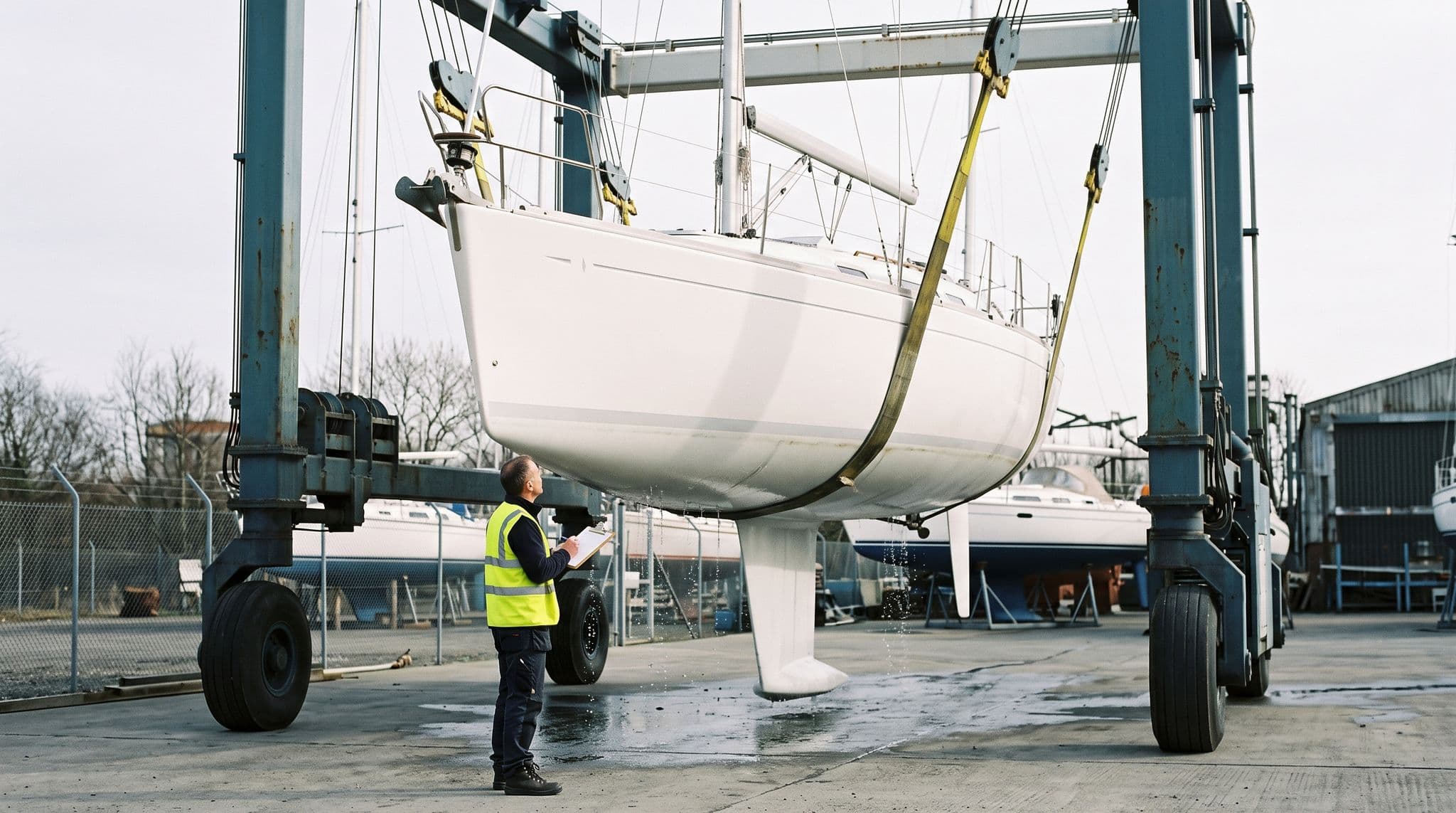
What kind of survey does an insurer actually want?
Insurers want a Condition and Valuation survey, and it is not the survey most owners book. This is the single most common and most expensive mix-up on this subject.
The American Boat and Yacht Council is explicit about the difference. It describes the insurance version as a limited survey whose output is not sufficient to make an informed decision regarding the purchase of the vessel. A standards body drawing that line is worth more than any broker summary, ours included.
| Survey type | What it covers | Sea trial | Typical rate | Who commissions it |
|---|---|---|---|---|
| Condition and Valuation (insurance) | Structure, systems, safety gear, fair market value | No | $20 to $28 per foot | The owner |
| Pre-purchase | Everything above, in more depth, plus operation under way | Usually yes | $25 to $35 per foot | The buyer |
| Damage | The specific casualty, its cause and extent | No | Quoted per job | The insurer or the owner |
| Appraisal | Value alone, for finance, estate or legal use | No | $24 per foot or set fee | The owner or a lender |
| Specialist (engine, rigging) | One system, inspected by that trade | No | $500 per engine, $400 to $600 rig | The owner or buyer |
The insurance survey is the narrower product, and a broader survey generally satisfies a narrower requirement. It does not work the other way round, which is why a condition and valuation report makes a poor basis for a purchase decision. Whether any existing report is accepted is the underwriter's call under the wording, so ask before you assume.
Machinery-heavy boats often need the engine specialist as well, which we cover on the motor yacht insurance page.
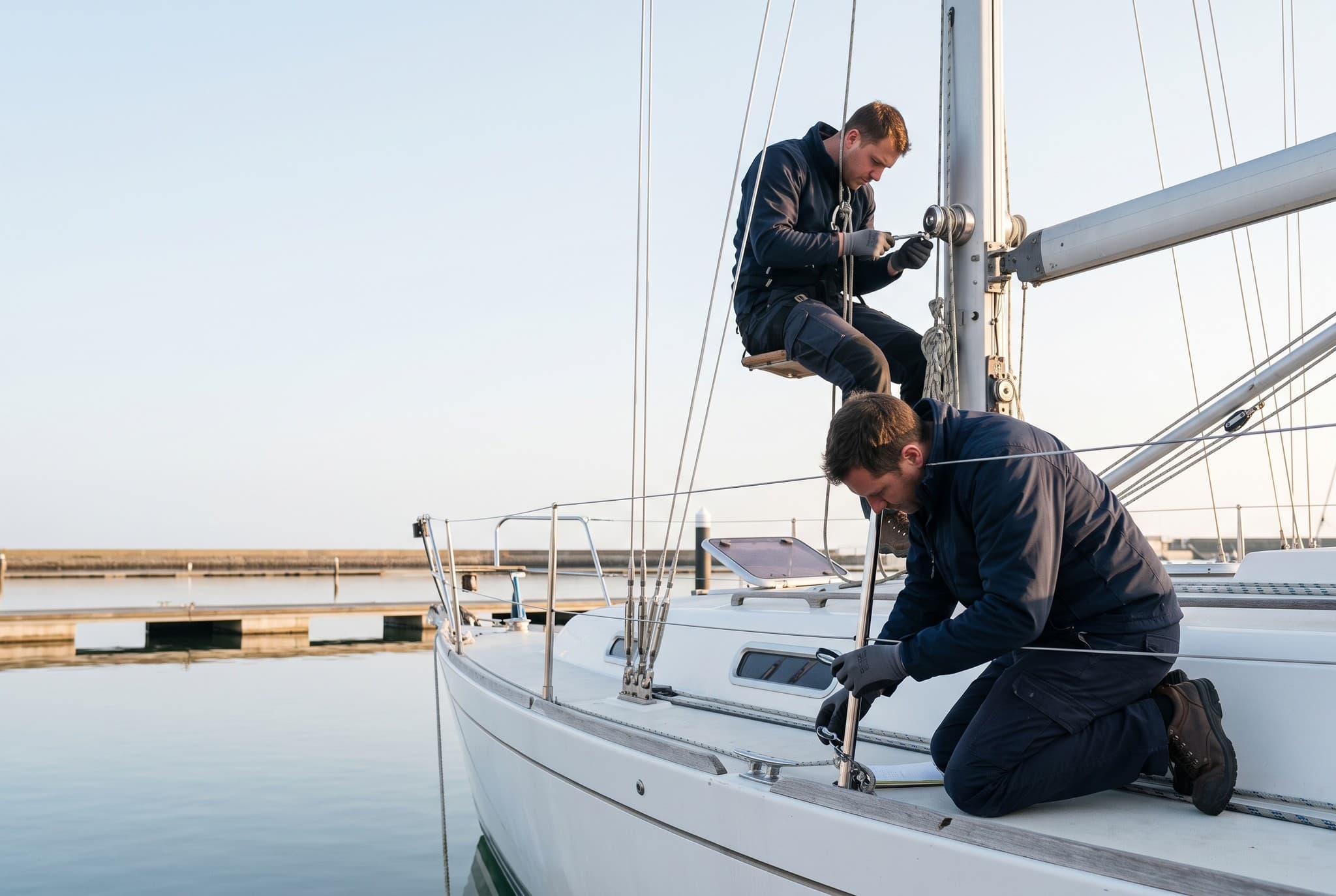
What does a marine surveyor inspect?
A surveyor works from the biggest risks down. Structure comes first, then systems, then everything the haul-out exposes.
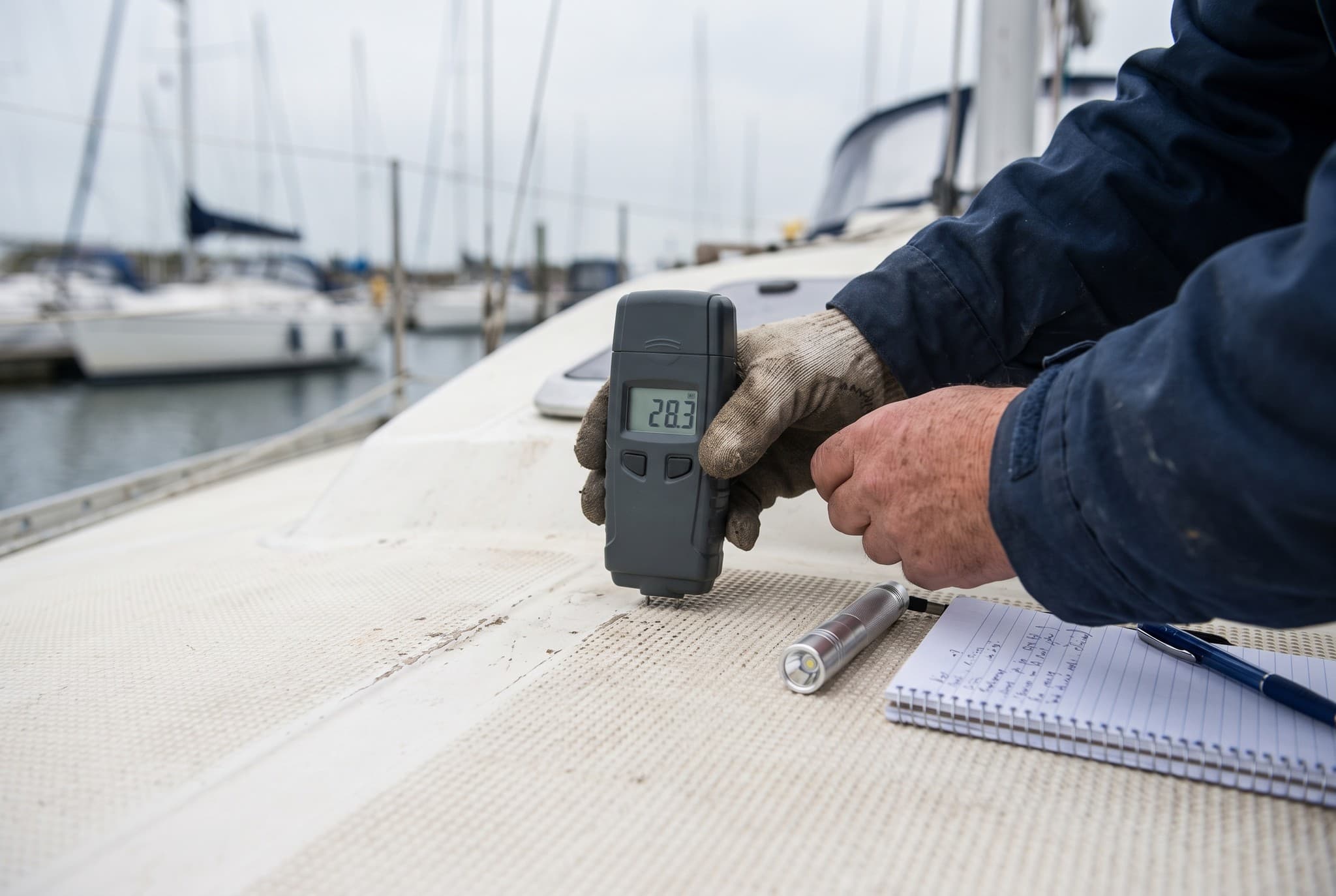
The structural pass looks for water where it should not be. That means moisture readings through the deck and hull laminate, fiberglass delamination, osmotic blistering below the waterline, rot in bulkheads and stringers, and any separation at the hull-to-deck joint. The instrument you will see most is a handheld moisture meter, worked methodically across the deck and topsides.
Then the walkthrough: through-hull fittings and their seacocks, wiring and electrical panels, fuel systems, steering and ground tackle, and the safety equipment aboard. In United States waters that last category is set by federal regulation, 33 CFR Part 175, and a surveyor confirms the boat carries what the law requires.
On smaller monohull powerboats under 20 feet, the surveyor also checks the capacity and certification plate. It is required under 33 CFR Part 183 for that class of boat only, not for sailboats, canoes, kayaks or inflatables, and a missing or replaced plate is one of the first things that flags up.
On the haul-out the surveyor reads the underbody: blisters, the props and shafts, anodes, rudders, struts and thrusters, and the keel joint.
The American Boat and Yacht Council sets out what the report must contain: vessel markings including the Hull Identification Number, construction and installed equipment, condition in general and in detail, repair recommendations, photographs and a fair market valuation. The Hull Identification Number itself is a federal requirement under 33 CFR Part 181, which is why a surveyor records it and why a missing or altered one is a problem worth resolving before you apply for cover. ABYC describes its own standards as the authoritative reference for design, construction and maintenance questions, and surveyors work to them.
There are two jobs a surveyor will not do for you. They will not troubleshoot or repair anything they find, because diagnosis and repair are a different trade carrying different liability. And most work from deck level and do not go aloft, which is why rig inspection is a separate specialist appointment.
Metal and wooden hulls need a surveyor who works in those materials. Corrosion and electrolysis on a steel or aluminium hull, and fastening sickness on a wooden one, are failure modes a fiberglass specialist is not equipped to judge.
Can you get boat insurance without a survey?
Yes below about 20 years, and no above it. Under roughly twenty years the wording we place through has no automatic survey trigger. Over it, an in-force survey is required before cover attaches, and there is no way around that one.
No automatic trigger is not the same as never asked. Underwriters can still request a survey on a pre-owned boat, on an unusual hull, or where the agreed value is high enough to justify checking it. The Survey Requirement clause sets the age band; it does not remove an underwriter's discretion beneath it.

We check a submission against the underwriter's published eligibility before it goes anywhere. When a hull type or a condition puts the risk outside what our market writes, we tell the owner plainly at that point rather than letting them wait on an answer we can already see coming.
Worth clearing up one piece of vocabulary, because it causes real confusion. A survey waiver is a document a yacht broker asks a buyer to sign when the buyer chooses to skip a pre-purchase survey. It is a transaction document between buyer and broker, nothing more. It is not a route to insurance, and no underwriter is party to it.
Liability-only cover is a different conversation from agreed-value hull cover. If the hull is not insured for a stated value, there is less for an underwriter to verify, and requirements can be lighter. That is a narrower product, not a shortcut to the same one.
The chain your cover is placed through, and who decides what, is set out on how it works.
Eligibility and survey conditions are set by underwriters and are subject to the policy wording. This is not financial advice.

How to choose an accredited marine surveyor
Start by asking your insurer which professional affiliation it accepts. Some carriers accept one body and not another, and finding that out after the survey is an expensive way to learn it.
In the United States the two main accreditation bodies are the Society of Accredited Marine Surveyors and the National Association of Marine Surveyors. Internationally, the International Institute of Marine Surveying and the Yacht Designers and Surveyors Association serve UK and worldwide readers. Membership of the American Boat and Yacht Council signals a surveyor works to the published standards.
Call three or four instead of emailing. How someone handles the call tells you a great deal about how they will handle the report. Ask for a sample report and read it for organisation and clarity, because a report an underwriter cannot follow makes work for everyone. And check the accreditation with the body itself. A logo on a website proves nothing.
Here is the part most owners miss. The surveyor works for you, not the seller, the yacht broker or the lender. Whoever made the recommendation, the person paying holds the relationship, and that independence is what makes the valuation usable.
A quick note, since this phrase pulls two audiences. This guide is for owners commissioning a survey. If you are researching how to become a marine surveyor, the accreditation bodies above are the right starting point, and the rest of this page will not help you.
Which insurers ask for what varies, and we compare that in our guide to yacht insurance companies.
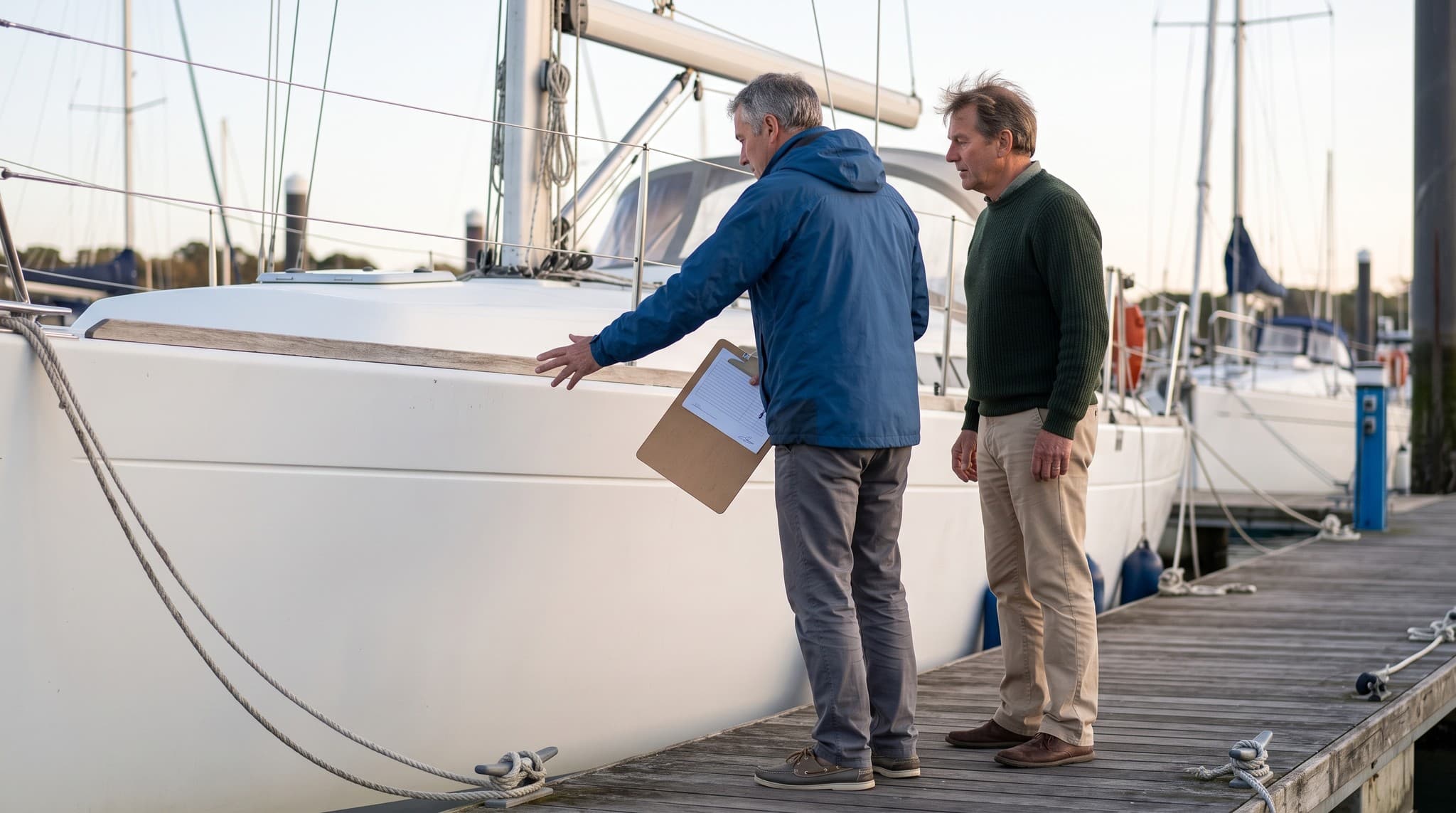
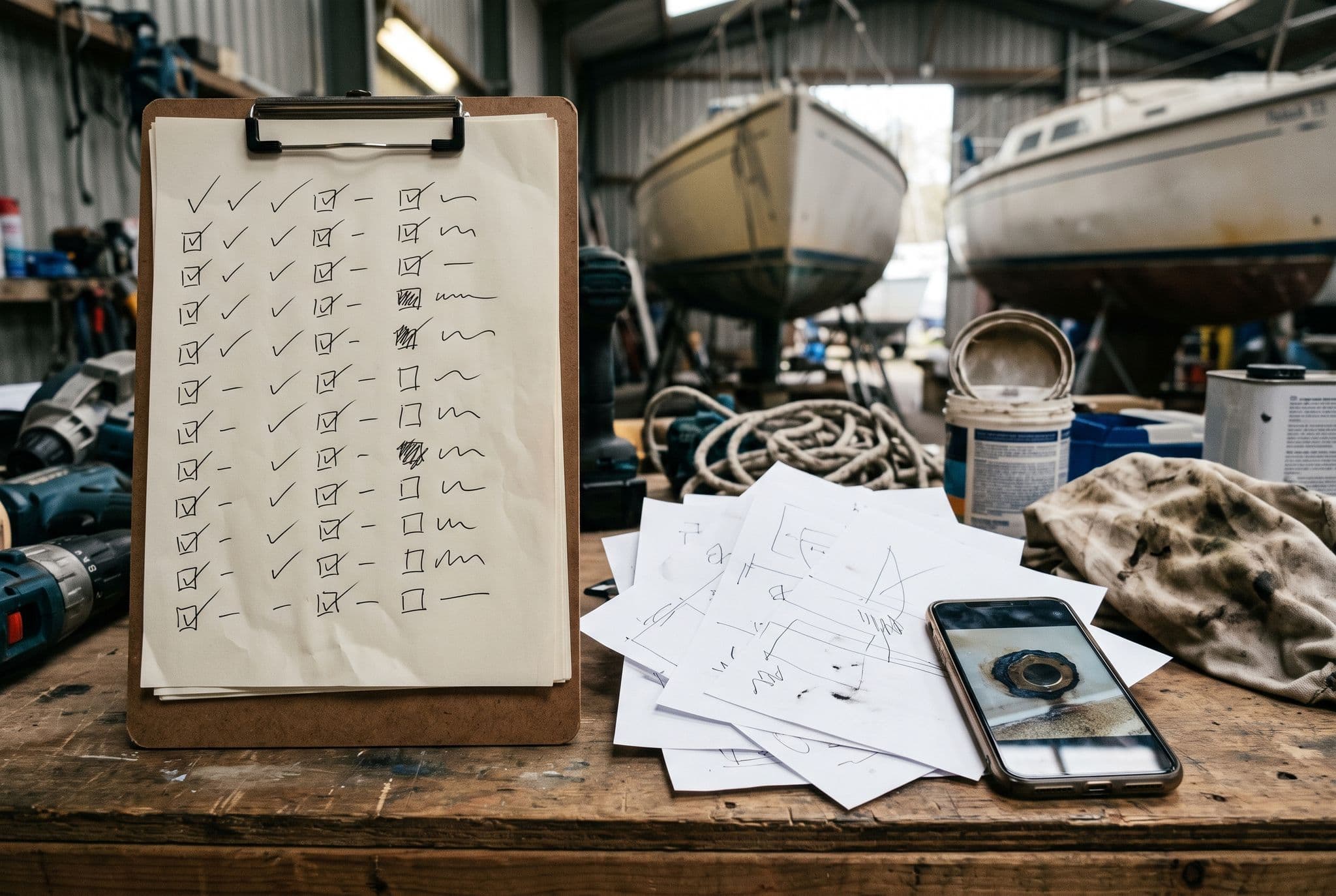
What happens if survey recommendations are not closed out?
An open recommendation is a breach of warranty. The policy warrants that the survey is in force and that all of the surveyor's recommendations have been complied with, so leaving one undone puts the cover itself in question rather than creating a paperwork chore.
There are real deadlines attached, and they are shorter than most owners expect. On the London Marine Insurance Services terms we place through, a marine survey has to be received and approved within 45 days of inception, and the surveyor's recommendations have to be complied with inside 30 days. Both windows come from the conditions attaching to the cover, not from general market practice, and the clock starts before you have the report in your hands.
Complied with means evidenced, and that is the part owners underestimate. An underwriter wants a yard invoice, a photograph of the completed work, a receipt or a surveyor's sign-off letter. The owner's assurance that a job was done is not evidence. The moment it matters is a claim, when the file gets read backwards by someone looking for exactly this.
Build the lead time in. BoatUS puts report turnaround at three to four days after the inspection, so it will not be in your hands the same afternoon, and the close-out work only starts once you have it.
Sequencing matters on the other side of the file too. Policies carrying the Photograph Requirement need a photograph of the insured vessel with underwriters within 14 days of the attachment date. We explain that requirement, and how the survey sets your number, in the guide to agreed value and actual cash value.
What a breached warranty does to a claim is covered in what yacht insurance does not cover.
Warranty and compliance terms are set by the policy wording. This is not financial advice.
How long is a boat survey good for?
What governs is that the survey is in force when cover attaches, not how old the report is. In practice underwriters look for a survey from roughly the last twelve to twenty-four months when setting an agreed value.
The widely repeated claim that insurers want a fresh survey every five to ten years does not come from any policy document we hold, and the AI summaries repeating it name no source. Treat the twelve-to-twenty-four-month window as market practice, not as a rule. The wording is what decides.
Two events reset the clock whatever the date on the report says. A material change to the vessel, meaning a re-engine, a re-rig, major structural work or a change of use, turns the old report into a description of a boat that no longer exists. A claim does the same, because the condition the survey recorded is exactly what is now in dispute.
A renewal can also trigger a fresh requirement when nothing about the boat has changed at all, simply because the boat crossed the age band while you owned it.
The evidence window for setting an agreed value is covered in more detail in agreed value versus actual cash value.
Survey validity is governed by the policy wording and underwriter requirements. This is not financial advice.
Survey requirements by boat age and type
Age sets off the requirement, but the vessel decides what the surveyor is looking for.
Sailboats. The rig is the extra exposure. Standing rigging age can become a condition in its own right for offshore work, separate from the hull's condition. The age bands and the rigging conditions are set out on our sailboat insurance page.
Motor yachts. The machinery carries the value, so an engine survey or oil sample analysis is more likely to be asked for, particularly on higher-hour boats. A documented service history helps. See motor yacht insurance.
Catamarans. Two hulls, two sets of machinery, more systems and harder access, which is why the survey fee is higher for the same overall length. See catamaran insurance.
Wooden and metal hulls. These need a specialist, and expect a survey to be requested whatever the year of build, because on those materials it is the condition that governs and not the age.
The same rule sits under all four. Age triggers the request, condition decides the terms, and a well-kept older boat with a clean survey and closed-out recommendations is an easier risk than a neglected newer one.
Frequently asked questions
1.Can I do my own boat survey?
+
No. Insurers require an independent third party, and a self-inspection satisfies no underwriter. The independence is the point: the surveyor works for you but reports objectively, which is what makes the valuation usable. You can and should walk the boat with the surveyor and ask questions as they go.
2.Is a boat survey worth it?
+
For a boat you intend to insure at agreed value, it is not optional above the age threshold. Below it, a survey is what lets an underwriter price the risk instead of guessing, and a clean report can remove conditions that would otherwise be attached. On very small craft the economics can argue the other way, though financing or insuring without one is difficult.
3.How long does a marine survey take?
+
A small boat takes a few hours. A full pre-purchase survey on a cruising yacht runs most of a day once the haul-out and the trial run are included, and boatyards typically block an hour or less for a short haul. BoatUS puts the report itself at three to four days to write, so build that into your binding date.
4.Who pays for a boat survey?
+
The buyer pays for a pre-purchase survey and owns the report. The current owner pays for an insurance or appraisal survey. The boatyard usually bills the haul-out separately from the surveyor's fee.
5.Can I insure a wooden boat without a survey?
+
Expect a survey to be asked for regardless of age, because on wooden and metal hulls the condition decides and the failure modes differ from fiberglass. Use a surveyor who works in that material. Separately, the facility we place through does not write trimarans, ferro-cement hulls or high-performance cigarette boats at any age.
6.Does a new boat need a survey for insurance?
+
Often not. Builder documentation evidences both condition and value on a new boat. Below roughly twenty years there is no automatic survey trigger in the wording we place through, though underwriters can still ask where the agreed value is high. Above it, an in-force survey is needed before cover attaches.
7.Does the boat have to be hauled out for an insurance survey?
+
Usually yes, because the underbody is where the structural evidence is. Blistering, the keel joint, shafts, props, anodes and rudders cannot be judged in the water. Suncoast Marine Surveying notes that the yard bills the lift separately from the surveyor's fee, and BoatUS reports that boatyards typically block an hour or less for a short haul, which is often enough for a condition and valuation survey.
8.Will my insurer accept a survey I already have?
+
It depends on what the survey is and how old it is. A pre-purchase survey is broader than a condition and valuation survey, so it generally carries the information an underwriter needs, but acceptance is the underwriter's decision under the policy wording, and the London Marine Insurance Services Survey Requirement is what governs. If the report predates the last twelve to twenty-four months, expect it to be questioned.
Sources and how we work
World Yacht Insurance is a yacht-insurance introducer arranging hull and liability cover up to $5M for sail and motor yachts worldwide, including the Caribbean, placed in the London market through London Marine Insurance Services Ltd, a Lloyd's-accredited broker. We are not an insurer and we do not carry risk. The full chain is set out on how it works.
- The age threshold, the Survey Requirement warranty and the Photograph Requirement quoted on this page come from the London Marine Insurance Services yacht clauses and endorsements we place through, read off the document itself and not off a market summary.
- Survey rates are quoted from the published rate cards of Boston Marine Surveyors, Marshall Marine Surveying and San Diego Marine Surveyors, retrieved 17 August 2026. Turnaround, specialist fees and selection guidance are drawn from BoatUS, and cost-driver detail from Suncoast Marine Surveying.
- We name surveyors and surveying firms without linking to them. A link is what we would offer a surveyor as part of a working relationship, and we are not going to spend it before one exists.
- Survey taxonomy and report contents: American Boat and Yacht Council. Federal equipment, hull identification and capacity-plate requirements: 33 CFR Parts 175, 181 and 183.
Reviewed by Costas Matheou, licensed insurance agent.
Last updated 17 August 2026. Facts last verified 17 August 2026.
Coverage terms, premiums and deductibles on this page are indicative and not financial advice. Cover is subject to underwriting, survey and the policy wording.

Booked the survey, or still deciding?
Send us the boat and your cruising plans. We will tell you what the underwriter will want to see, and whether the age band puts a survey in front of you, before you spend anything.
- No obligation
- every underwriting question asked upfront
- a licensed Cyprus agent reviews every enquiry
Also on WhatsApp, Telegram and Viber