
Boat Storage Contract Liability: What a Boatyard's Terms Do to Your Own Cover
Boat storage contract liability is decided by two documents, not one: the boatyard's storage agreement and your own policy's exclusions and conditions. When a boat goes over on stands in a storm, your own hull cover answers first, and what you signed at the yard office decides what happens next.
This guide is about a boat left in a yard's custody for a storm season, anywhere our chain places. The Caribbean hurricane season is the worked example, because that is where the contracts quoted here come from. It is general information, not financial or legal advice.

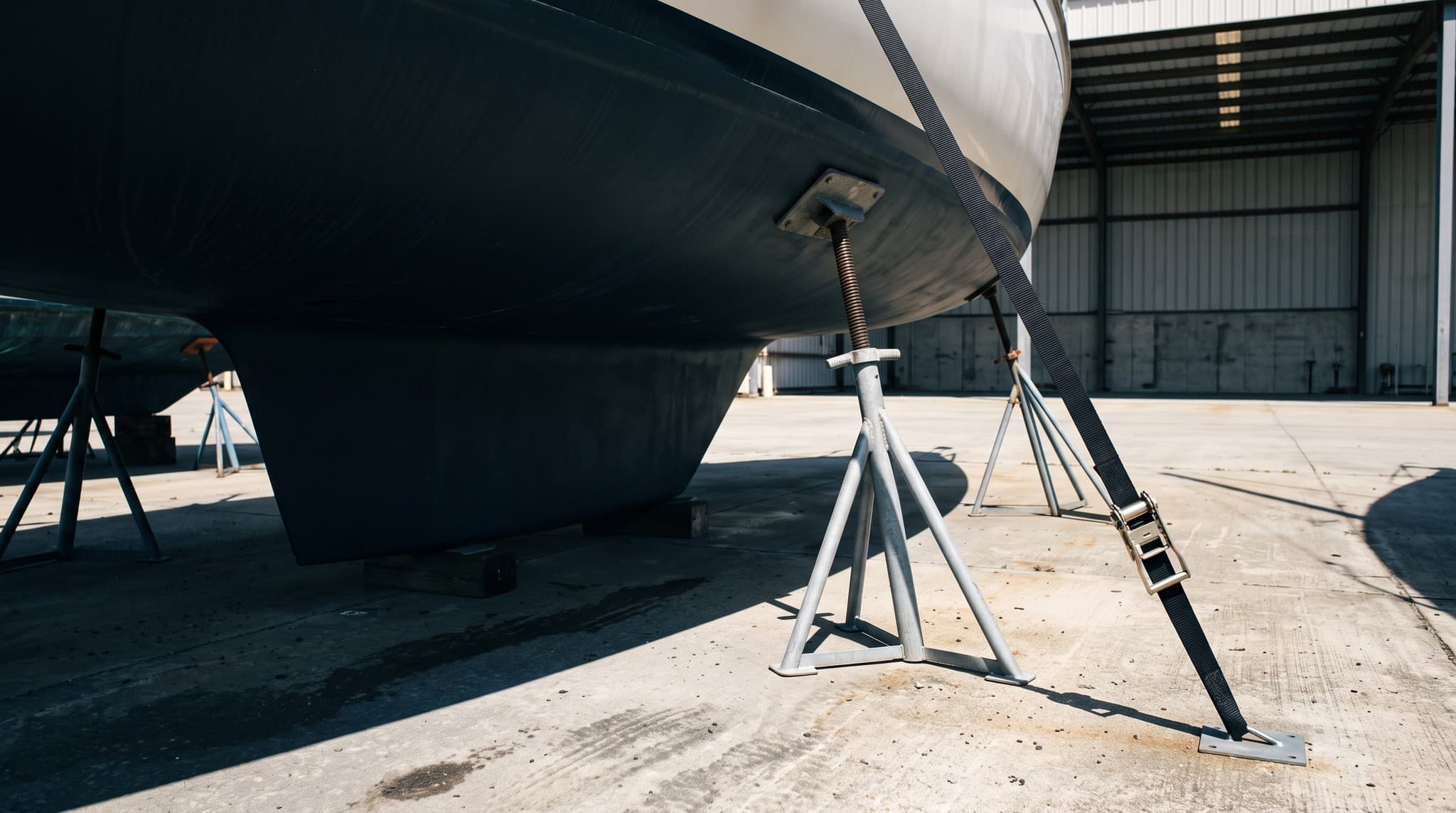
Two documents
Your storage contract and your policy, and they do not agree with each other
5 named yards
Contracts quoted verbatim, each with the date it was read
Not a denial
Giving up recovery rights reduces payment; it does not void the policy
Ask first
The exclusion list opens “unless agreed by us in writing prior to any loss”
What this page is about
Not which yard is safest, and not whether to haul out at all. This is the document the yard hands you at the office, read against the policy you already hold.
What this page establishes
- Your own hull cover answers first. Whether anyone recovers from the yard afterwards is decided by the storage contract you signed and by your own policy's conditions, and those are two separate questions.
- Every storage agreement we read disclaims storm damage. Nanny Cay's Master Agreement, form revision 02/17/2025, also makes the owner hold the yard harmless for the method of supporting the vessel whilst in the yard, choking included.
- The liability section of the wording we work from excludes “Liability assumed by you under any contract or agreement”. The exclusion list it sits in opens “Unless agreed by us in writing prior to any loss”, so it can be lifted by asking first.
- Signing a subrogation waiver does not void the policy on this wording. General Condition 10 reduces payment by the recovery that was forfeited, and only where the waiver was given without underwriters' agreement.
- A promise to name the yard as an additional insured is not self-executing. Conditions 23 and 24 confer no benefit on any third party and exclude the Contracts (Rights of Third Parties) Act 1999.
- Florida statute 327.02(26) defines “marina” for the whole of chapter 327 as including dry storage, which is what carries the marina evacuation law at 327.59 onto a boatyard hardstanding.
The numbers this page turns on
327.02(26)
The subsection defining “marina” to include dry storage, which is what carries a marina evacuation statute onto a boatyard hardstanding.
Florida Senate, statute 327.0248 and 36 hours
The National Hurricane Center's lead times for a hurricane watch and a hurricane warning, the triggers most storm clauses are written around.
National Weather Service24 hours
The contractual removal trigger for a vessel at the dock at one named Grenada yard, written into its published terms.
Clarke's Court terms, read 19 September 20262 of 5
Named yards whose published terms put responsibility for chocking and strap placement on the owner.
Nanny Cay Master Agreement, rev. 02/17/20254 circuits, 4 cases
The federal split on whether a marina exculpatory clause can release a party from its own negligence, as maritime firms summarise it.
Matthiesen, Wickert and Lehrer0 mentions
The words lift, sling, hoist, crane, chock, block and ashore across both London Marine documents we hold. The wording imposes nothing at all on a yard, which is why the contract decides.
Counted 19 September 2026 in the policy wording and clause schedule we work from
What is boat storage contract liability?
Boat storage contract liability is the allocation of loss between a boat owner and a boatyard while the boat is ashore in the yard's care. Two documents decide it: the storage or work-order agreement the owner signs at the office, which usually disclaims storm damage and transfers responsibility back, and the owner's own policy, which decides what it will stand behind.
Whose insurance pays when your boat goes over on stands in a boatyard?
Your own hull cover answers first, subject to your deductible. Whether anyone then recovers from the yard is a separate question, and it is decided by two documents: the storage agreement you signed and the conditions inside your own policy.
That split catches owners out because the yard is the visible party. The boat was in the yard's hands, the yard set it on stands, and the yard is the one still there when you arrive after the storm. But your hull section does not ask whose fault it was before it responds, and your liability section, which is the part that deals with other people, is where the storage contract starts to bite.
Where the damage comes from a named windstorm, the deductible on the wording we work from is 10% of the hull value shown in the Schedule, and it applies where a signed and dated hurricane plan has been agreed by underwriters before cover is granted. The figure and the condition travel together. A plan is not paperwork you file afterwards.
Two related questions belong on other pages. What hauling out does to theft cover and to a lay-up warranty is covered in the guide to where to leave your boat for the season. Which policy clauses change the moment the boat comes out of the water is set out as a clause table on the haul-out and refuge tool.
We hold the policy wording, which is why the answers below quote the clause that applies instead of describing the market in general. This is general information, not financial or legal advice.
Is a boatyard really never liable for an act of God?
That is the rule for a berth, and it is being applied to a fact pattern it was not built for. Courts have consistently held that a marina renting out a slip does not take exclusive possession of the boat, so a lessor and lessee relationship forms rather than a bailment, and the marina is not answerable as a custodian.
Dry storage is different in the one way that matters. The yard hauls the boat, sets it where it chooses, controls who comes and goes, and the owner cannot move it. Where a yard does take that kind of exclusive possession, the relationship can be a bailment, and a bailment carries a burden that a lease does not. As US Legal states the rule, “a prima facie presumption of negligence on the bailee's part arises from the bailor's proof that the bailed article was delivered in good condition and was returned damaged or not returned at all”.
Say can, not does. Whether a particular yard had exclusive possession is a question of fact about that yard on that day, and the Florida marina storage paper by Brais Law records lack of exclusive possession as the most often used defence to a bailment claim. This is general information, not legal advice about your yard.
| Where the boat is | The usual relationship | Who holds possession | Who carries the burden |
|---|---|---|---|
| Afloat in a rented berth | Lessor and lessee | The owner, who can walk aboard and leave | The owner, who must prove the marina's negligence |
| Ashore in dry storage | Capable of being bailor and bailee | The yard, which lifted it and controls access | The yard may have to explain how the damage happened |
| In the yard for repair work | Bailment for the work done | The yard, for the duration of the work | The yard, on the same presumption |
In a storm that distinction decides who has to explain themselves, and the answer circulating on the forums is the berth answer. The rule that a yard is never answerable for weather is not wrong. It is just being quoted about the wrong relationship.
What does a yard's hold-harmless do to your own liability cover?
The liability section of the wording we work from excludes “Liability assumed by you under any contract or agreement”. A liability you incur at law and a liability you took on by signing are treated differently, and only one of them is supported.
“Unless agreed by us in writing prior to any loss, there is no liability coverage under this agreement for: ... 2. Liability assumed by you under any contract or agreement.”
The Nanny Cay Master Agreement and Work Order, the document a boat owner signs in Tortola, says: “The Owner will hold the company harmless for any damage that may occur due to types of lifting used by the Company either in the Boat Hoist, Crane or by Yard Trailer and also by the method of supporting the vessel whilst in the yard (choking, etc.).”
So the owner signs away the securing method, which is the one thing a hurricane plan is written to describe, and the owner's own liability section does not stand behind what was assumed by signing it. The medical payments section carries the same restriction in different words, excluding responsibility assumed under any agreement or contract.
The stem above the exclusion list changes what the list does. The exclusions open “Unless agreed by us in writing prior to any loss”. That is not a wall. It is a door with a condition on it. An owner who sends the yard's indemnity clause to underwriters in May, before anything has happened, is doing exactly what the wording contemplates. An owner who sends it in October, after the boat is on its side, is not.
A Florida law firm quotes the same exclusion verbatim in a paper written for marina counsel, so this is standard market wording. What we have not seen set out anywhere is what it does to a boatyard storage contract, where the assumed obligation reaches the blocking and the straps. The same exclusion, read against a marina berth agreement, is set out in the guide to med mooring damage and your deductible.
What does the yard's contract switch off, and what does your policy switch off?
The two documents bite from opposite directions. The yard's exculpatory clause removes the yard's liability to you. Your policy's assumed-liability exclusion removes your insurer's support for the liability you took on. The owner sits between the two, which is how an owner ends up holding a repair bill for damage that happened on somebody else's watch.
| The same event | The yard's storage contract | The wording we work from |
|---|---|---|
| Storm damage to your boat | An act-of-God clause disclaims it outright | Hull cover answers, subject to the deductible. For a named windstorm it is 10% of the scheduled hull value where a signed hurricane plan has been agreed |
| Damage from the securing method | The hold-harmless reaches the method of supporting the vessel, choking included | Liability exclusion 2 removes support for liability assumed by contract |
| Your liability to the yard | The indemnity clause creates it | Liability exclusion 2 removes it, unless agreed in writing before the loss |
| Recovery from the yard | A waiver of subrogation removes it | General Condition 10 reduces payment by the recovery forfeited, absent agreement |
| Naming the yard on your policy | The additional-insured clause requires it | Conditions 23 and 24 confer no third-party benefit, so an endorsement is needed |
| Who directs the securing | Two of the five contracts read put slings, chocks and straps on the owner, and reserve moving them to yard staff | It is the arrangement a signed hurricane plan describes to underwriters |
An exculpatory clause is not automatically enforceable. Federal maritime law governs how a marina storage agreement is read whichever state the yard sits in, and the circuits disagree with each other. As Matthiesen, Wickert and Lehrer summarise the position, the 11th Circuit in Diesel “Repower” v. Islander Investments, 271 F.3d 1318 (2001) and the 1st Circuit in La Esperanza de Puerto Rico v. Perez y Cia, 124 F.3d 10 (1997) require the clause to leave a deterrent to negligence, while the 9th Circuit in Royal Insurance v. Southwest Marine, 194 F.3d 1009 (1999) and the 5th Circuit in Theriot v. Bay Drilling, 783 F.2d 527 (1986) have enforced clauses releasing a party from its own negligence.
Florida adds a three-part test from Merrill Stevens Dry Dock Co. v. M/V Yeocomico II, 329 F.3d 809 (11th Cir. 2003): the clause must clearly and unequivocally indicate the parties' intention, it must not absolve the marina of all liability and must still provide a deterrent to negligence, and the parties must have equal bargaining power. Brais Law also records that in Florida, exculpatory clauses that hold a marina harmless are looked upon with disfavour and strictly construed against the marina. These are the two firms' stated positions, cited as they report them. What the exclusions on your own side do is set out in full in what yacht insurance does not cover.
Does signing the yard's waiver of subrogation cost you your claim?
On the wording we work from, no. It can reduce what is paid, by the amount of the recovery that was given up, and only where the waiver was given without underwriters' agreement.
The best-published answer to this question says something stronger. Writing in The Log, David Weil explains that a yard waiver impairs the insurer's subrogation rights and so “amounts to a breach of the insurance policy by the boat owner, which will result in a denial of the claim”. That describes the general market pattern, and other wordings do work that way. We are reporting what one wording says, not correcting a lawyer.
“If you give up your rights or our rights to recover damages from anyone who may be liable to you without our agreement, and by doing so deny us the right of recovery, payment of any admissible loss under this insuring agreement shall be reduced by the amount of the recovery that was forfeited.”
Three things follow from that wording. The consequence is a reduction rather than a denial, so the rest of the claim survives. The reduction is measured by what was actually forfeited, so a waiver that was never going to produce a recovery, because the yard had a watertight act-of-God clause anyway, costs nothing. And the whole condition turns on the words “without our agreement”, which means agreement obtained first removes the problem entirely. The matching duty, that you must preserve your rights of recovery from others, is published in the guide to med mooring damage and your deductible.
The principle itself is not unusual. In three of the four European markets we measured, reduction instead of denial is a matter of statute rather than contract. What has not been published anywhere we could find is where it lives on this wording, and that is what an owner holding this policy actually needs to know. Maritime firms add that a waiver clause standing alone is often not enough to waive a carrier's subrogation interests unless the carrier itself consents, which points the same way: ask.
Can your policy name the boatyard as an additional insured?
Not automatically, and the reason sits in the policy rather than in the contract. Condition 23 of the wording we work from provides that neither the insuring agreement nor any document issued with it confers any benefit on any third party, and condition 24 excludes the Contracts (Rights of Third Parties) Act 1999 outright.
So a promise in a storage agreement to name the yard is not self-executing. It needs an endorsement, asked for and agreed, and until that happens the owner has promised something the policy does not deliver. If the yard later relies on that promise and finds nothing behind it, the owner can be personally answerable for the difference.
Brais Law reaches the same result from the other side of the counter, noting that the policy it analyses excludes marinas from the definition of covered person and carries a “No Benefit to Others” clause providing that no organisation which has custody of the insured property and is to be paid for services will benefit from the insurance. Two different wordings, one result.
At least one yard will not start work at all without proof of cover: Clarke's Court in Grenada states that no vessel will be accepted for haul-out without proof of the required insurance, and lists the documents it wants before the lift. And where a yard's terms say you may not cancel or change cover while the boat is ashore, that is a contract term rather than an insurance term, which is a reason to read your cancellation clause before you book the lift.
Who is in charge when the travel lift picks up your boat?
On the contracts we read, you are, and the policy has nothing to say about it. Across both London Marine documents we hold, the words lift, sling, hoist, crane, chock, block and ashore appear nowhere at all. Hauling out and launching appear in three sentences, all three of them exclusions. Two are scoped to a vessel being moved on its own trailer. The third switches medical payments off for anyone injured while a vessel is being hauled out or launched. Not one of the three says who is in charge of the operation, and not one of them asks anything at all of the yard.
The wording is silent on who runs the lift. That is different from excluding it, and more useful, because silence means the document that governs the operation is the one you signed at the office.
Those documents are blunter than most owners expect. Clarke's Court states that “The Owner is responsible for directing the placement of lifting slings, docking lines, chocking positions and placements and hereby agrees to their proper placement”, and declines liability for damage resulting from chocking placement. Nanny Cay asks the owner to “provide us with manufacturer's blocking instructions for the vessel if possible” and to “advise us on the position of the straps when hauling”, and its hold-harmless then covers the lifting method and the method of supporting the vessel in the yard.
The securing arrangement the owner is directing is the same arrangement a signed hurricane plan describes to underwriters, and the same arrangement the hold-harmless makes the owner answerable for. One set of straps and chocks, three documents, and the owner is the only party named in all three.
Directing is not the same as controlling. Clarke's Court reserves the moving of chocks, ties, stands and cradles to yard personnel. Nanny Cay reserves the right to move a vessel's chocked position “without consultation or presence of the owner or his representative”. An owner can specify where the straps go and still have no say in what happens at two in the morning. For the policy clauses that do change when a boat comes out of the water, including the one about medical payments during haul-out, see what hauling out changes in your policy.
What do five named boatyards actually put in writing?
Five yards published terms we could read, quote and date. They are facts about what each yard has published, with the date it was read. No yard here is endorsed, approved or recommended, and five yards are five yards rather than evidence about what Caribbean yards do.
| Yard | What its published terms say | Read |
|---|---|---|
| Nanny Cay, Tortola, BVI | Accepts no responsibility for boat property lost or damaged in the yard, or for acts of God. Owner holds the company harmless for the lifting method and for the method of supporting the vessel, choking included. Asks the owner for blocking instructions and strap positions. May move a chocked vessel without consulting the owner. Form revision 02/17/2025 | 19 Sep 2026 |
| Clarke's Court, Woburn, Grenada | Will not accept a vessel for haul-out without proof of insurance. Storage is at the owner's sole risk. The owner directs sling, docking-line and chocking placement. Only yard personnel move chocks, ties and stands. Requires a vessel at the dock to be moved 24 hours before a named system reaches Grenada | 19 Sep 2026 |
| North Sound Marine, Parham, Antigua | Publishes storage ashore on a concrete base “with welded stands and tie downs to satisfy insurance company requirement” during hurricane season. No insurer is named | 19 Sep 2026 |
| Spice Island Marine, St George's, Grenada | Publishes that it is “insurance approved” for hurricane season storage, offering cradles, ground anchoring and welded boat stands. No insurer is named | 19 Sep 2026 |
| St. Marys Boat Services, Georgia, USA | A dated season notice: boats hauling out for the 2026 hurricane season must pay storage through the end of September at the time of haul-out. A payment term, not a securing procedure | 19 Sep 2026 |
Two of the five put responsibility for chocking and strap placement on the owner in writing. One will not lift a boat at all without proof of insurance, which makes cover a precondition of storage. And one imposes a timed obligation on the owner by contract, to move a vessel off the dock 24 hours before a named system arrives.
Neither yard names an insurer. A yard describing its stands as satisfying insurance requirements is describing its own equipment, not reporting an underwriter's decision. Why no such approval exists to be given is set out in which hurricane holes insurers accept.
One more clause sits against all of this. The wording we work from requires that underwriters be given the opportunity to inspect damaged property before any repair or removal, while a yard's contract may reserve the right to move a vessel whenever it sees fit. Those two are capable of pulling in opposite directions after a storm, which is an argument for a phone call before a forklift.
Does Florida's marina evacuation law reach a boat on stands in a boatyard?
Yes, where the facility meets the statutory definition, and the reason it is not obvious is that you have to read two sections to see it.
Florida statute 327.59 is headed “Marina evacuations”, and its operative language is about slips, waters and removing vessels from waterways, so it reads like a statute about boats afloat. But statute 327.02 defines the terms used across the whole of chapter 327, and at subsection (26) it defines “marina” as “a licensed commercial facility that provides secured public moorings or dry storage for vessels on a leased basis”. Dry storage is inside the definition. A Florida boatyard that meets it is a marina for these purposes.
Two limits come with that. The definition needs a licensed commercial facility providing storage on a leased basis, so a yard that stores under a work order rather than a lease may sit outside it. And the definition section opens with “unless the context clearly requires a different meaning”, which is precisely the argument the slip-and-waterway language of 327.59 would support. The definition points one way and the context argument points the other.
The statute holds a marina harmless for storm damage to a vessel in respect of the securing and removing it permits, expressly excluding intentional acts and negligence. The yard's contract disclaims act-of-God damage outright. And your own liability section excludes what you assumed by signing. Three documents, all pushing the loss in the same direction. The broad version of the statutory point, that Florida marinas are not liable for storm damage, is not what the section says. The hold-harmless is tied to the actions the section permits. This is Florida law applied to a Florida facility, a worked example of how one jurisdiction allocates a loss, and it does not travel with the boat.
The clocks do not line up either. The National Hurricane Center issues a hurricane watch 48 hours before it expects tropical-storm-force winds and a hurricane warning at 36 hours, which is when 327.59 engages, while Clarke's Court asks for a vessel to be off its dock 24 hours before a named system arrives. Your own cover runs on a fourth clock: named-windstorm cover is subject to a condition precedent, a signed and dated hurricane plan agreed by underwriters before cover is granted, and the deductible is 10% of the hull value where that plan has been agreed. How that deductible works is covered in the named-windstorm deductible explained, and the plan itself can be built and signed with the hurricane plan generator.
What should you settle before you sign the storage contract?
Five things, and all five are easier in May than in October.
- 1Read the indemnity clause and the waiver of subrogation before you sign, not after the storm. They are the two clauses that reach your own policy.
- 2Put anything you are being asked to assume to underwriters in writing, before any loss. The exclusion list says “unless agreed by us in writing prior to any loss”, and that sentence is the whole cure.
- 3Settle who directs the lift and the chocking, and get the answer in the file. On two of the five contracts we read, that person is you.
- 4Ask whether an additional-insured endorsement is needed and whether it is available, instead of promising one the policy cannot deliver.
- 5Get the hurricane plan signed and agreed before the season, because it is a condition precedent rather than a formality. You can build and sign one with the hurricane plan generator.
This page has deliberately not argued whether straps beat pins, or welded stands beat jackstands. It is a real question with a real answer, and the answer changes outcomes. BoatUS's Hurricane Center reports that at one named Florida marina in Hurricane Wilma, 33 of 506 boats ashore blew over when anchors pulled out, while at another yard none of 56 boats went over in two earlier storms. What a plan has to be able to demonstrate about a place is set out in which hurricane holes insurers accept, and which yards publish a strap-or-pin answer at all is in the haul-out yard directory. This page is about the document they hand you when you get there.
One question this page does not answer, because it deserves its own: what happens to wreck removal once a boat leaves the stands and has to be lifted off something, or out of something. That is a separate head of cover with its own limit, and it is worth asking about separately.
This is general information, not financial or legal advice. What your own policy does is decided by your wording and your Schedule, and what your yard's contract does is decided by the contract you sign.
Boatyard storage and your policy: common questions
1.Does boat insurance cover a boat stored in a boatyard?
+
Yes in principle. Hull cover follows the boat ashore, subject to your Schedule and your deductible. What changes ashore is theft cover and any lay-up warranty, both covered on the seasonal storage guide. This page is about the liability side, where the yard's storage contract can reach into your own cover.
2.Is a boatyard liable if my boat falls off its stands?
+
The yard's contract will almost always say no for storm damage, and whether that clause holds is a question of federal maritime law on which the circuits disagree. Dry storage, where the yard has exclusive possession, can make the yard a bailee, and a bailment can shift the burden onto the yard to explain how the damage happened. It is fact-specific and this is not legal advice.
3.Does signing a boatyard's waiver of subrogation void my boat insurance?
+
Under the wording we work from, no. It can reduce what is paid, by the amount of the recovery that was forfeited. The condition turns on the words “without our agreement”, so agreement obtained in advance removes the issue. Other wordings differ, and the best-published answer in the market describes outright denial.
4.Can I name a boatyard as an additional insured on my boat policy?
+
Not automatically. The wording we work from confers no benefit on any third party and excludes the Contracts (Rights of Third Parties) Act 1999, so the promise needs an endorsement, requested and agreed. If you promised it in a storage contract and never obtained it, you can be personally answerable for the shortfall.
5.Am I covered while my boat is in the travel-lift slings?
+
The policy wording we work from says nothing about who runs the lift. Lift, sling, hoist, crane and chock appear nowhere in either document we hold. So the storage contract decides, and on two of the five we read it puts the owner in charge of directing sling and chock placement. Settle who is directing, in writing, before the lift. For what hauling out does change in a policy, see the clause table on the haul-out yard directory.
6.Does Florida's marina law apply to a boat stored on land?
+
Florida statute 327.59 reads as though it were about slips, but statute 327.02(26) defines “marina” for the whole chapter as including dry storage on a leased basis. So a qualifying Florida boatyard is a marina for these purposes. It is arguable, because the definition yields where the context clearly requires a different meaning, and it is Florida law applied to a Florida facility, so it does not follow the boat.
7.How much does storage insurance for a boat cost?
+
There is no separate storage premium on the wording we work from. Premium runs on the agreed value of the boat, and nothing in the wording, the clause schedule or the quote questionnaire we hold contains a lay-up credit for a boat ashore. What drives the number is covered in the cost guide, and what storage ashore does change is covered on the seasonal storage guide.
Sources, and how this page was checked
- London Marine Insurance Services policy wording and clause schedule, the documents we work from. Cited by clause name throughout: Third Party Liability exclusion 2, the exclusion stem, Medical Payments exclusion 2, General Condition 10, conditions 23 and 24, duty 4, duty 12 and the Hurricane Plan Clause. Read 19 September 2026.
- Florida Statutes 327.02 and 327.59, Florida Senate, read 19 September 2026. Florida law applied to a Florida facility.
- National Weather Service, hurricane watch and warning lead times, read 19 September 2026.
- Matthiesen, Wickert and Lehrer on marina storage agreements and exculpatory clauses, and Brais Law's Florida marina storage agreements paper. Both read 19 September 2026, and cited as the firms' stated positions rather than as readings of the opinions.
- US Legal on bailee liability for a boat during bailment, read 19 September 2026.
- David Weil in The Log on shipyard waivers, read 19 September 2026.
- Published terms and season notices of Nanny Cay, Clarke's Court, North Sound Marine, Spice Island Marine and St. Marys Boat Services, all read 19 September 2026. No yard is endorsed, approved or recommended.
World Yacht Insurance is a yacht-insurance introducer arranging hull and liability cover up to $5M for sail and motor yachts worldwide, including the Caribbean, placed in the London market through London Marine Insurance Services Ltd, a Lloyd's-accredited broker.
World Yacht Insurance is a trading name of Costas Matheou, a licensed insurance agent in Cyprus, and introduces business through AKD Insurance (A.K. Demetriou Insurance Brokers Ltd, Cyprus). Cover is arranged and placed in the London market by London Marine Insurance Services Ltd, a Lloyd's-accredited broker authorised and regulated by the UK Financial Conduct Authority, firm reference 308599. World Yacht Insurance is not an insurer and does not carry risk. The full chain is set out on how it works.

Send us the clause before you sign it
The useful moment for a yard's indemnity clause, subrogation waiver or additional-insured demand is before the boat comes out, not after the storm. Tell us where the boat is hauling out and what the yard is asking you to sign.
- No obligation
- every underwriting question asked upfront
- a licensed Cyprus agent reviews every enquiry
Also on WhatsApp, Telegram and Viber