
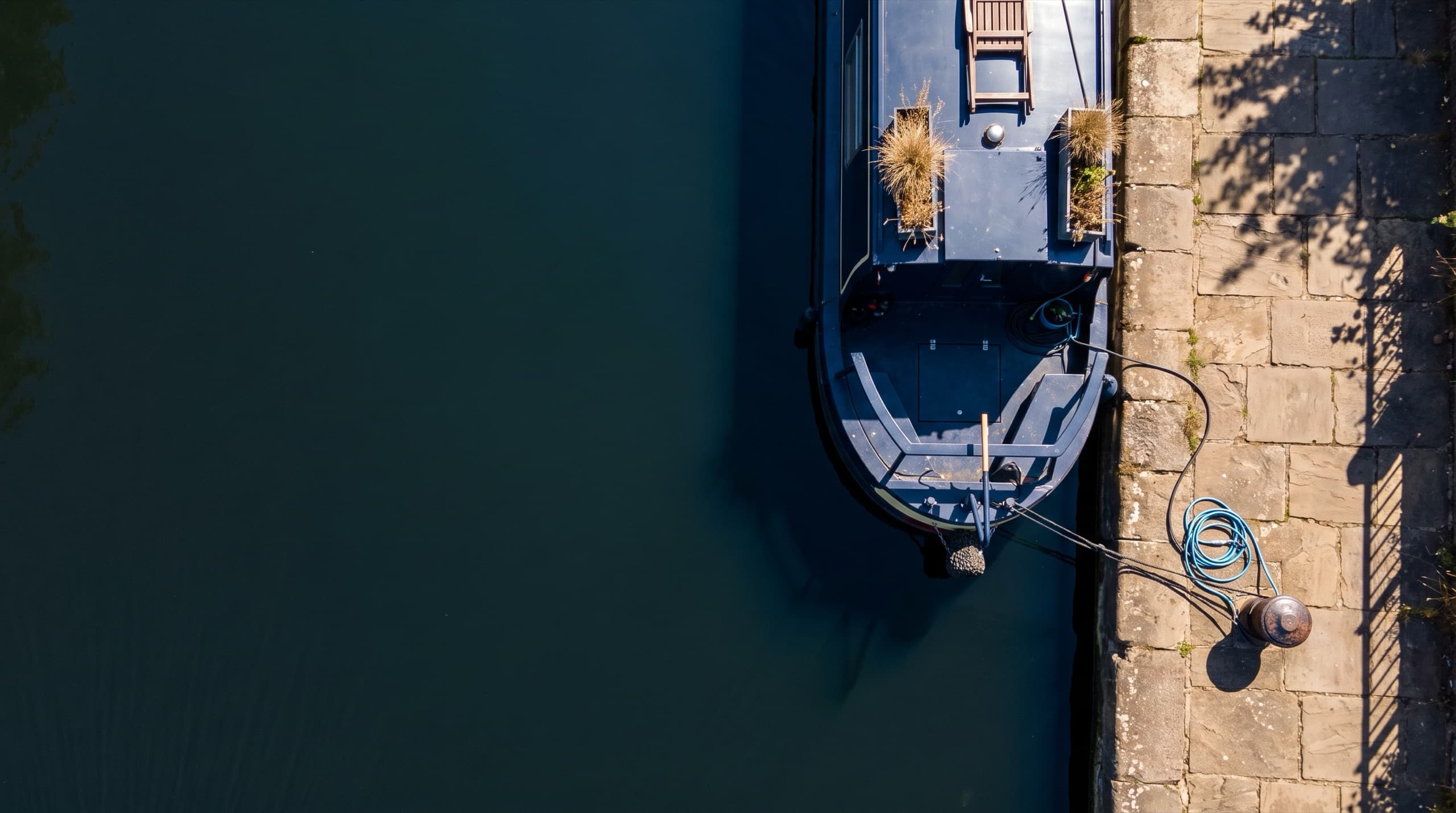
Houseboat insurance in the UK
A houseboat is not defined by living aboard. On the scheme wording it is a craft permanently moored at one location and permanently connected to a shore mains supply for gas, electricity, water or sewage. That use is excluded unless your schedule says otherwise, and an endorsement is what puts it back.
The cover introduced here runs on UK and European inland non-tidal waterways. If your boat cruises tidal or coastal water, this is not the policy for it. The Canal & River Trust wants third-party cover of at least £2,000,000 before it will issue a boat licence.
Two tests
Permanently moored at one location, and permanently connected to a shore mains supply
Endorsement 24
The clause that deletes the houseboat exclusion, and only when your schedule shows it
£500 an item
The contents cap on removable household goods you have not specified
Non-tidal
UK and European inland waterways, and the line the policy is written to
What counts as a houseboat for insurance?
A houseboat is not defined by living aboard. On the scheme wording it is a craft permanently moored at one location and permanently connected to a shore mains supply for gas, electricity, water or sewage. A static or non-navigating floating home is the clearest case. That use is excluded unless your schedule says otherwise, and an endorsement is what puts it back.
Every page you will read on this subject uses the word to mean a boat somebody lives on. The document that decides your claim does not. It is worth reading the definition slowly, because it produces two results that surprise people.
A Craft that is permanently located or moored at a single location, which is permanently connected to either the on shore mains gas supply, mains electricity supply, mains water supply or sewage system.
FreeTime Pleasure Craft policy wording GS_MAR_PC_PW_v08.3, captured 26 August 2026. The document carries a version reference and no issue date.
| The boat | Permanently at one location? | Permanently connected to a mains supply? | A Houseboat under the wording? |
|---|---|---|---|
| A static widebeam on a residential mooring, shore power and water permanently made up | Yes | Yes | Yes, on both tests |
| A liveaboard narrowboat continuously cruising, no home mooring | No | No | No, and living aboard does not change it |
| A leisure boat nobody sleeps on, kept on one berth with a permanent shore power lead | Yes | Yes | Yes, even though nobody lives on it |
| A boat on a long-term leisure berth, shore power plugged in when the owner visits | Yes | Not permanently | The second test is the one to ask about |
So the definition is about the boat's physical arrangement, not about your address. A continuous cruiser who lives aboard full time is not in it. A boat nobody sleeps on can be. Whether an intermittent shore lead counts as permanently connected is a question for the underwriter rather than for a website, and it is worth asking before the policy is written rather than after a claim.
If your boat cruises rather than stays, and you have come here because you live aboard, the inland cruising product is a different page. Narrowboat and canal boat insurance carries the licence conditions authority by authority, the home mooring and continuous cruising declarations, and the survey rules.
Can you move a houseboat, and what must you tell the insurer?
Yes, and moving it is exactly what you have to declare. The wording defines a Houseboat as permanently moored at one location, and separately gives you 14 days to tell your insurance adviser about any change in your craft's mooring or storage location. Those two are not in conflict: one describes the boat, the other is a duty that follows from it.
This is the sharpest unanswered question in the search results and it is worth stating plainly, because the two best-ranking pages in this market answer it in ways that appear to contradict each other. One tells a houseboat owner they can move and to check their cruising range. Our own page's spine says a Houseboat is a craft permanently located or moored at a single location. Both are right, and the reconciliation is the useful part.
How both can be true
The definition is a description of how the boat is normally kept, not a promise you have made never to untie it. What it does is put you in a class with its own exclusion and its own endorsement. Moving the boat does not breach the definition; it changes a fact the policy was priced on, and the wording deals with changed facts through a disclosure duty rather than through the definition. That is why the answer is a clock rather than a prohibition. Where you may go once you move is a separate question again, set by the cruising limits in your schedule, and exclusion 4.7.4 puts travel outside them outside cover unless weather, danger or an order of a government or legal authority forced it.
The 14-day clock, and the nine changes it covers
Clause 5.1.1 requires you to tell your insurance adviser within 14 days of any of the following. Two of the nine are the houseboat question in disguise, and they are marked.
| Change you must report within 14 days | Why it matters on a houseboat |
|---|---|
| Any change in your craft's mooring or storage location | This is the houseboat one. A houseboat is defined by its mooring, so this is the most class-specific duty in the booklet. |
| Any change in the way the craft is used, including a change from private and pleasure use to charter | The second houseboat one. Beginning to live aboard, or letting the boat out, is a change of use. |
| Any additional people to be insured, or any insured person taken off the policy | |
| Any criminal convictions for any of the people insured or to be insured | |
| Any change to your craft's original specification | |
| Any modifications to your craft | A residential fit-out is a modification, and on a houseboat it is the disclosure most often missed. |
| Any change affecting ownership of your craft | |
| A professional valuation of your craft that differs from the sum insured | Applies only where Endorsement 16 (Agreed Value) is shown in your schedule. |
| Your craft offered or advertised for sale at a value different from the sum insured | Also Endorsement 16 only. |
What happens if you do not
The wording sets out its own remedies rather than leaving it to inference, and they are graded. Where reasonable care has not been taken to provide accurate information, at inception or during the period of insurance, insurers may cancel the policy and refuse to pay any claim, or pay only part of a claim, or charge a revised premium, or change the policy excess. The first of those is the reason this is a 14-day task and not a renewal-time one.
Clause 5.1.1 and exclusion 4.7.4, FreeTime Pleasure Craft policy wording GS_MAR_PC_PW_v08.3, captured 26 August 2026. This is a description of a policy wording we hold, not a statement about any particular policy. Your own schedule governs.
Is a houseboat covered by home insurance?
A home insurance policy is written around a building, and a boat is not one. What the marine wording here covers is the vessel and your liability to other people, with household goods reaching only as far as the contents clauses below. The two are not interchangeable, and neither is a substitute for the other.
We hold the marine wording and we do not hold anybody's household wording, so this page says what the marine document does and stops there. What your home insurer will or will not do with a boat is a question for your home insurer, in writing, before you rely on the answer.
What we can tell you is what the marine side is shaped like. It insures the craft as property, it insures your liability to third parties and passengers up to the limit written on your schedule, and it treats your possessions as three separate categories with three separate mechanisms. That third part is where almost every published account of houseboat insurance goes wrong, including the summary Google currently shows above the search results.
Why the published liability figures disagree with each other
Clause 2.2.1 sets the third-party limit as the amount shown in your schedule. The booklet itself prints no liability figure anywhere. So a number quoted on any website, ours included, is a product's marketing figure and not a term of the wording, which is exactly why the published minimum for this class appears to run from £1 million to £5 million across the market. Two numbers matter to you: the one your navigation authority requires, and the one printed on your own schedule.
On the first of those, the Canal & River Trust states it plainly: you need third-party insurance cover for at least £2,000,000 before you buy a boat licence, read 28 August 2026.
A second layer sits under it: GOV.UK states that on inland waterways you will usually need third-party insurance of at least £1 million if you have a powered boat or a houseboat, and then tells you to check with the navigation authority that manages the waterway you want to use, which is the right instruction. A hedged national floor and a specific licence condition are two layers rather than a contradiction, and the licence condition is the one that stops you buying a licence.
The Environment Agency, the Broads Authority and Scottish Canals each set their own figure and their own extra conditions. Rather than repeat them here, the narrowboat page carries all five authorities in one table, each with the date it was read at source.
This page describes policy wordings and published licence conditions. It is not financial advice and it is not a statement of what any particular policy covers.
Boat contents insurance: what covers your possessions if you live aboard?
Three separate categories, three separate mechanisms. Removable household goods are capped at £500 an item unless you specify them. Clothes and personal items are excluded entirely unless Endorsement 5 is on your schedule, then capped at £250 an item. Laptops, phones, jewellery and money sit outside both until they are named.
Boat contents insurance is sold in this market as though it were one thing, and every competing page we measured treats it as a single bullet. The summary Google shows above these results goes further and says contents cover protects your personal belongings, furniture and appliances. The wording does not work like that, and a resident who takes that sentence at face value will find out at the wrong moment. Here is the actual structure.
| Category | What the wording puts in it | The limit | What to do |
|---|---|---|---|
| Removable Household Contents | Removable household goods including but not limited to microwaves, washing machines, dishwashers, TVs and audio equipment, aerials, satellite receiving equipment, linen and bedding | £500 for any one item unless that item is specified in your schedule with a sum insured. Covered only while on board, at a repairer, or in transit between your home and the craft. A contents-only claim takes an excess of £100 or the schedule excess, whichever is lower | List anything worth more than £500 individually. On a residential boat that usually means the washing machine, the television and any built-in appliance |
| Personal Belongings | Clothes and other personal items worn or carried whilst in use. Household linen sits in the category above rather than here | Excluded entirely unless Endorsement 5 is shown in your schedule. With it: capped at the personal belongings sum insured, £250 for any single item unless specified, nothing for money, furs, jewellery or watches, nothing while on board during a laid up period, and an excess of £100 or the policy excess, whichever is lower | Check whether Endorsement 5 appears on your schedule at all. If it does not, your clothes and everyday possessions are not in the policy |
| The named list | Deeds, documents, stores, consumables, moorings, fishing gear, diving equipment, wet and dry suits, tow ropes, water skis, wakeboards, kneeboards, plants, animals, sports equipment, pedal cycles, laptops, mobile phones, business equipment, valuables and money. Valuables means jewellery, watches, clocks, articles of precious metal, medals, antiques and works of art | No cover from any peril unless the item is noted separately by endorsement or shown in your schedule | Name your laptop, your phone and anything of real value individually, or accept that they are outside the policy. Working from home on a boat puts business equipment in this row too |
All three rows are from the FreeTime Pleasure Craft policy wording GS_MAR_PC_PW_v08.3, captured 26 August 2026: the definitions of Removable Household Contents, Personal Belongings, Valuables and Money, exclusions 1.10 and 1.12 to 1.14, limit 1.25, and Endorsements 1 and 5. Your own schedule governs, and it is the document to read alongside this.
The three-line version
The washing machine is contents at £500 an item unless you name it. Your clothes need Endorsement 5 and cap at £250 an item. Your laptop, your phone and your wedding ring are on neither list until you schedule them. A houseboat is the case where all three matter at once, because everything you own is on the boat.
The laid up question nobody can answer from the wording
Two clauses remove portable items and personal belongings from cover while they are on board during the laid up period shown in your schedule. The wording does define the test, and it is worth reading, because it cuts in our favour: Laid Up means the craft is not fitted out and not ready for immediate use, while In Commission means it is fitted out and ready for immediate use. A boat somebody lives on plainly meets the In Commission description. What the wording does not resolve is whether a schedule shows a laid up period anyway, and on a boat that never moves that is a real possibility rather than a theoretical one. Read the pair, then check your own schedule. Do not assume the answer is none.
If the boat is uninhabitable after a claim, who pays for somewhere to live?
Not this policy. The scheme wording excludes personal expenses you pay because of loss or damage, and it names travel and accommodation costs first on that list. On a boat that is also your home that is the largest uninsured exposure in the document, and no competing page we measured mentions it.
This is the question a household policy answers as a matter of course and a marine policy does not. If a house is uninhabitable after a fire, alternative accommodation is a standard feature of buildings cover. The craft wording takes the opposite position, and it says so in a single clause that is easy to read past.
any personal expenses You pay because of loss of or damage to Your Insured Property. This includes but is not limited to: travel and / or accommodation costs; payment for overseeing repairs; lost or unused fees for mooring and / or storage.
FreeTime Pleasure Craft policy wording GS_MAR_PC_PW_v08.3, captured 26 August 2026
What that means on a boat you live on
Three separate costs fall on you rather than on the policy, and on a residential boat all three are likely at once. A hotel or rental while the boat is repaired. The time and travel involved in overseeing the work. And the mooring fees that keep running on a berth you cannot occupy, which on a residential mooring do not pause because the boat is in a yard. The clause is a list of examples rather than a closed set, so read it as the shape of the exclusion rather than its limit.
What to do about it, because there is something
Ask specifically whether alternative accommodation can be added, and get the answer in writing before you rely on it. Some inland and floating-home products in this market do offer it, and where it exists it is a scheduled benefit with its own limit rather than something the base wording grants. If the answer is no, that is a number to hold in reserve rather than a surprise at the worst possible moment. We cannot promise you the cover; we can tell you it is the right question.
Is houseboat use covered as standard?
No. The scheme wording lists use as a Houseboat among its non-standard uses, and says you are not insured for it unless it is noted in your schedule or amended by endorsement. Endorsement 24 is the clause that deletes that exclusion. Endorsements apply only when they are shown on your policy schedule.
This is the single most important sentence on the page and it appears on none of the competing pages we measured. General Policy Exclusion 4.7 is headed Non-standard use of Your Craft, and it opens by saying that unless the use is noted in your schedule or amended by endorsement, you are not insured if you use your craft in any of the ways it then lists. The third of those is as a Houseboat.
Unless it is noted in Your Schedule or amended by Endorsement You are not insured if You use Your Craft ... as a Houseboat. Endorsement 24, Houseboat: It is agreed that Your Craft is used as a Houseboat and that General Policy Exclusion 4.7.3 is deleted.
FreeTime Pleasure Craft policy wording GS_MAR_PC_PW_v08.3, captured 26 August 2026
The condition that governs every endorsement
Section 9 of the wording opens with one line that governs all twenty-five of its endorsements: these endorsements only apply when they are shown in your policy schedule. An endorsement existing in the booklet is not the same as an endorsement applying to you. That is why this section tells you what to look for rather than telling you what your policy does.
Three things to look for on your own schedule
Endorsement 24, by name
It is the clause that deletes exclusion 4.7.3. If the boat meets the two tests above and the endorsement is not listed, the wording says the houseboat use itself is outside cover.
The Third Party and Passenger cover limit
Clause 2.2.1 says the most your insurers will pay under the liability section is the amount shown in your schedule. The booklet prints no figure at all, so your limit is a field on your own paperwork rather than a constant of the product.
Any Laid Up period
Two clauses remove portable items and personal belongings from cover while they are on board during a laid up period. On a boat that never moves it is not obvious whether one is scheduled, and it changes what is covered for part of the year.
The two uses next to it in the same clause
Exclusion 4.7 also names hire or charter, and any use except your own private pleasure. A houseboat let out on a holiday-let platform, even for a few weeks a year, is a different question from the one this page answers, and it needs raising at quotation rather than assumed. Ask us before the boat is listed anywhere, not after.
The duty that follows from the definition
The definition decides what your boat is. Clause 5.1.1 decides what you have to say about it, and it carries a clock. You must tell your insurance adviser within 14 days of any change in the craft's mooring or storage location, and of any change in the way the craft is used. Both are the houseboat question in disguise: moving to a residential mooring, or connecting permanently to a shore main and beginning to live aboard, is exactly the kind of change that clause is written for. The remedies where information is not accurate are set out in the same clause and they run as far as cancelling the policy and refusing a claim, so this is a 14-day task rather than a renewal-time one.
What decides the price of houseboat insurance?
We publish no premium for this class, because we do not have one to publish. What we can publish is better: the wording names the facts the rating actually turns on, the valuation rule that decides what a total loss pays, and the no-claims scale. Those are the levers, and they are on your own schedule.
Every competing page in this market answers the cost question with an average, and an average across boats this different is close to meaningless. The scheme wording answers it more usefully, because clause 5.1.1 lists what you must tell the insurer, and a list of what must be disclosed is a description of what is being rated.
| What must be disclosed | Why it changes the number |
|---|---|
| Any change in your craft's mooring or storage location | A houseboat is defined by its mooring, so this is the most houseboat-specific rating fact in the document. Marina, residential mooring, online berth and boatyard are different risks for theft, flood and third-party exposure. |
| Any change in the way the craft is used, including a change from private and pleasure use to charter | Use is the same axis exclusion 4.7 turns on. Private pleasure, houseboat use and any form of letting are three different answers. |
| Any additional people to be insured, or anyone removed | Who is aboard and who is responsible for the boat is a rated field, not an administrative one. |
| Any criminal convictions for any of the people insured | Standard disclosure, and the consequence set in 5.1.1 applies if it is not given. |
| Any change to the craft's original specification, and any modifications | A fit-out that turns a shell into a home is a modification. On a residential boat this is the disclosure most often missed. |
| Any change affecting ownership | The policy is personal to the insured named on the schedule. |
| A professional valuation, or an advertised sale price, that differs from the sum insured | These two apply only where Endorsement 16 (Agreed Value) is on the schedule, and they feed directly into what a total loss pays. See below. |
Clause 5.1.1, FreeTime Pleasure Craft policy wording GS_MAR_PC_PW_v08.3, captured 26 August 2026. The clause gives insurers a stated set of remedies where information is not accurate, running from a revised premium or a changed excess through to cancelling the policy and refusing a claim. Fourteen days is the window it sets for telling your insurance adviser.
What a total loss actually pays, and why the answer is on your schedule
This is the part most published accounts get wrong. The default in this wording is market value up to the sum insured, not agreed value: clause 1.18 says the most insurers will pay for a total loss is the market value of the craft up to the sum insured, unless Endorsement 16 is shown in your schedule. So agreed value is an endorsement you have to have, not a property of the product.
Where Endorsement 16 is on the schedule it does not simply pay the sum insured either. It settles at the lower of three figures: the sum insured, the most recent professional valuation from an independent qualified marine surveyor or yacht broker, and the advertised or agreed sale price if the boat has been offered for sale publicly or privately within the twelve months before the loss. Insuring a boat for more than it is worth therefore buys premium rather than settlement. Note that the endorsement is drafted as replacing clause 1.18 and then numbers its replacement 1.16, which is an inconsistency in the document rather than in this description.
The no-claims scale
The scheme advertises up to 25% no claims bonus, and clause 7.1 sets the conditions it runs on: the policy has to have been in force for twelve consecutive months, it has to be renewed, it must not be on a laid up basis, and the discounted premium cannot fall below the minimum the insurer sets. Protected no claims bonus and an excess waiver are among the options the scheme publishes.
We do not publish a premium, an average or a band for this class. There is no independent UK market average for a houseboat, and a figure borrowed from another product is worse than no figure at all. What a quotation costs depends on the facts in the table above, and the only way to get it is to give them.
Is frost damage covered on a houseboat?
Freezing is already an insured peril rather than an optional extra. The wording's definition of an Accident expressly includes freezing conditions and the formation of ice. What removes it is a maintenance condition: freezing damage to machinery is excluded where the machinery has not been maintained to the manufacturer's recommendations, or protected with the appropriate antifreeze.
Product pages in this market sell frost damage as an add-on. The wording tells a more useful story, because it turns the question from what you can buy into what you have to do. Not one of the eight competing pages we measured mentions antifreeze.
freezing to Machinery that has not been maintained in accordance with the manufacturers' recommendations and / or has not been protected by the appropriate anti-freeze mixed and inserted in accordance with manufacturers' specification
FreeTime Pleasure Craft policy wording GS_MAR_PC_PW_v08.3, captured 26 August 2026
How to read that
The peril is granted and then narrowed. Freezing conditions and the formation of ice on rivers and lakes are inside the definition of an Accident, so a frozen and split system is the kind of event the policy contemplates. The exclusion takes it away again only where the machinery was not maintained as the manufacturer says, or where the antifreeze was wrong, or mixed wrong, or not put in. Two of those three are entirely within your control and cost an afternoon in October.
What that means before the first hard frost
Service to the manufacturer's schedule, and keep the paperwork
The clause is written around the manufacturer's recommendations, so the manufacturer's schedule is the standard your claim is measured against. Dated invoices are the evidence.
The right antifreeze, at the right mix, actually in the system
The wording asks for the appropriate antifreeze mixed and inserted in accordance with the manufacturer's specification. A weak mix and a correct one look identical until January.
The burst domestic pipe is a different clause, and it is worth asking about
Exclusion 1.1.8 is written about Machinery. A domestic water system on a residential boat is not obviously machinery, and the wording does not resolve it, so this is a question to put at quotation rather than an answer to assume. On a boat where the plumbing is a home's plumbing rather than an engine's, it is the frost question that matters most.
The winter condition that is not about frost at all
Endorsement 17, where it is shown on the schedule, is the one most likely to catch out a boat that sits on one mooring all winter. It requires an automatic bilge pump with a float switch installed and maintained in working order within the engine compartment, and it requires a means of maintaining power to the battery whenever the craft is left unattended for any period of time, giving shore power or a solar panel as the examples. On a houseboat the shore power that satisfies that condition is often the same connection that makes the boat a Houseboat under the definition, which is a neat illustration of how tightly this wording is wired together. Check whether Endorsement 17 is on your schedule, and if it is, that the pump and the power actually work.
What the scheme lists as options
Topsail's own houseboat page offers contents cover, frost damage protection and legal expenses as optional extras alongside the standard cover, read 26 August 2026. What any of them costs, and whether all three are available on a given boat, is a quotation question rather than a published one. We do not publish a premium for this class, because we do not have one to publish.
Where the cover runs, and where it stops
UK and European inland non-tidal waterways. Coastal or European cruising is described by the scheme as arrangeable rather than included, so treat it as a question at quotation. A sea-going boat you live aboard is a different market entirely and a different page on this site.
- UK and European inland non-tidal waterways, as published by the scheme and read 26 August 2026.
- A tidal reach is outside it. If your route crosses one, say so on the enquiry rather than after.
- Third-party liability is published at up to £3,000,000 on the scheme's own houseboat page, read 26 August 2026. The wording sets no figure and defers to your schedule.
- Up to 25% no claims bonus, with protected no claims bonus and excess waiver among the benefits the scheme advertises.
- A United States resident enquiry is outside this market for every class on this route.
Houseboat, or liveaboard yacht?
The word liveaboard is used for two different boats and they are not the same insurance question. A houseboat here is a residential inland boat that stays where it is. A liveaboard yacht is a sea-going sail or motor yacht that cruises and that someone lives aboard while it does. If that is your boat, liveaboard yacht insurance is the page for it, and it is arranged on a different route from this one. The short test: if the boat is permanently connected to a shore main and does not move, you are on the right page now.
The other inland pages
A boat that cruises the network rather than staying put is the inland cruising product. Narrowboat and canal boat insurance covers narrowboats, widebeams and Dutch barges on the same waters.
For the inland category as a whole, including which authority governs which water, inland waterways insurance is the parent page.
If the licence limit is all you need and you do not want cover on the boat itself, third party only boat insurance is the cover type to ask about.
To see every class on the register and which route reaches it, start at the boat insurance hub.
Wreck removal is inside the liability section, not an optional extra
Worth stating because the summary Google currently shows above these results files it under specialist add-ons. On this wording it is not an add-on. Section 2, clause 2.1 iii puts the raising or attempted raising, removing or destroying of the wreck of your craft inside liability to third parties, alongside injury to other people and damage to other property. On an inland boat that sinks on a mooring it is frequently the largest single cost in the claim.
The boats this market does not reach
Said plainly, because nobody publishes it and a reader deserves to know before they spend an afternoon on forms. A floating structure with no means of propulsion and no navigable hull is a building question rather than a marine one, and the further a boat sits from being a boat, the harder it is to place anywhere. Age and condition matter more here than on a cruising boat, because a residential fit-out hides the hull. And a boat that cannot move cannot be taken to a yard, so a survey requirement can be the practical obstacle rather than the cover itself. If your boat is at that end, tell us at the outset and we will tell you honestly whether there is a route.
Who arranges the cover
World Yacht Insurance is an insurance introducer. We do not underwrite anything and we carry no risk. We take your details, match the boat to a route that can write it, and pass the enquiry to the partner who handles that class. How it works sets out the full chain and who does what at each step.
Our principal on this route is Topsail Insurance Ltd, and any firm arranging insurance for you in the UK appears on the Financial Services Register, which is worth checking against the firm named in your paperwork.
Reviewed by Costas Matheou, licensed insurance agent (Cyprus). Policy wording references are to the FreeTime Pleasure Craft policy wording GS_MAR_PC_PW_v08.3, captured 26 August 2026, which carries a version reference and no issue date. Licence figures were read at source on 28 August 2026. Your own schedule and wording govern your policy.
Houseboat insurance questions
Does home insurance cover a houseboat?+
A home insurance policy is written around a building, and a boat is not one, so the two products are not interchangeable. A marine policy of the kind introduced here insures the craft itself and your liability to other people, with household goods handled by separate contents clauses that carry their own per-item caps. What your own home insurer will do with a boat is a question to put to them in writing. Do not assume either policy picks up what the other leaves.
Is it possible to live on a houseboat in the UK?+
Yes, and the practical constraints are the mooring and the licence rather than the boat. A residential mooring is a specific kind of mooring with its own agreement and its own conditions, and the navigation authority that manages your water requires a licence, a Boat Safety Scheme certificate and third-party insurance before the boat may be there at all. The Canal & River Trust sets that insurance minimum at £2,000,000. On the insurance side, the wording treats permanent mooring plus a permanent mains connection as the definition of a houseboat, and that use needs to be shown on your schedule.
Do you need to pay council tax if you live on a houseboat?+
It turns on the mooring rather than the boat, and a houseboat is the case most likely to attract it: a permanently moored boat with permanent mains connections on a residential mooring looks to a billing authority much like a permanent address. Whether it is charged depends on whether the mooring is entered in the valuation list, which is a matter for the local billing authority, so check with the council for your mooring. The same facts are rated fields on the insurance side. This is not tax advice.
Are contents covered on a houseboat insurance policy?+
Partly, and in three separate categories rather than one. Removable household goods such as a washing machine, a television or bedding are covered to £500 for any one item unless the item is specified in your schedule with a sum insured. Clothes and everyday personal items are excluded altogether unless Endorsement 5 is shown on your schedule, and are then capped at £250 for any single item with money, jewellery and watches excluded. Laptops, phones, business equipment and valuables are outside both categories until they are named. Read your own schedule against those three rows.
Is frost damage covered on a houseboat?+
Freezing conditions and the formation of ice are inside the wording's definition of an Accident, so frost is an insured peril rather than an optional extra. What removes it is a maintenance condition: freezing damage to machinery is excluded where the machinery has not been maintained in accordance with the manufacturer's recommendations, or has not been protected by the appropriate antifreeze mixed and inserted to the manufacturer's specification. Service to schedule, keep the invoices, and get the antifreeze right before the first hard frost.
Can I rent out my houseboat?+
Raise it before you list it anywhere. Exclusion 4.7 of the scheme wording puts hire or charter, and any use except your own private pleasure, in the same clause as houseboat use, one and two lines above it. The endorsement that deletes the houseboat limb does not touch the other two, so a boat let out even for a few weeks a year is a different question from the one this page answers. Shelter's guidance for someone living on a boat also lists what an owner generally needs before letting one residentially: a static letting licence, proof of insurance, a Boat Safety Scheme certificate, a gas safety certificate, a permanent residential mooring, and permission from the mooring provider. That is a licensing and tenancy question we do not advise on. The insurance half is simple: ask at quotation rather than after.
Does houseboat insurance pay for somewhere to live if the boat is damaged?+
Not on this wording. Clause 1.9 excludes personal expenses you pay because of loss or damage to your insured property, and it names travel and accommodation costs first, along with the cost of overseeing repairs and mooring fees you cannot use. For someone whose only home is the boat that is the largest uninsured exposure in the document, and it is the feature a household buildings policy would normally provide. Ask specifically whether alternative accommodation can be added and get the answer in writing. Source: FreeTime Pleasure Craft policy wording GS_MAR_PC_PW_v08.3, captured 26 August 2026.

Tell us about the boat and the mooring
Two facts decide most of this: where the boat sits, and whether it is permanently connected to a shore supply. Send those with the enquiry and we can route it to the partner who writes the class, rather than guessing at it.
- No obligation
- every underwriting question asked upfront
- a licensed Cyprus agent reviews every enquiry
Also on WhatsApp, Telegram and Viber