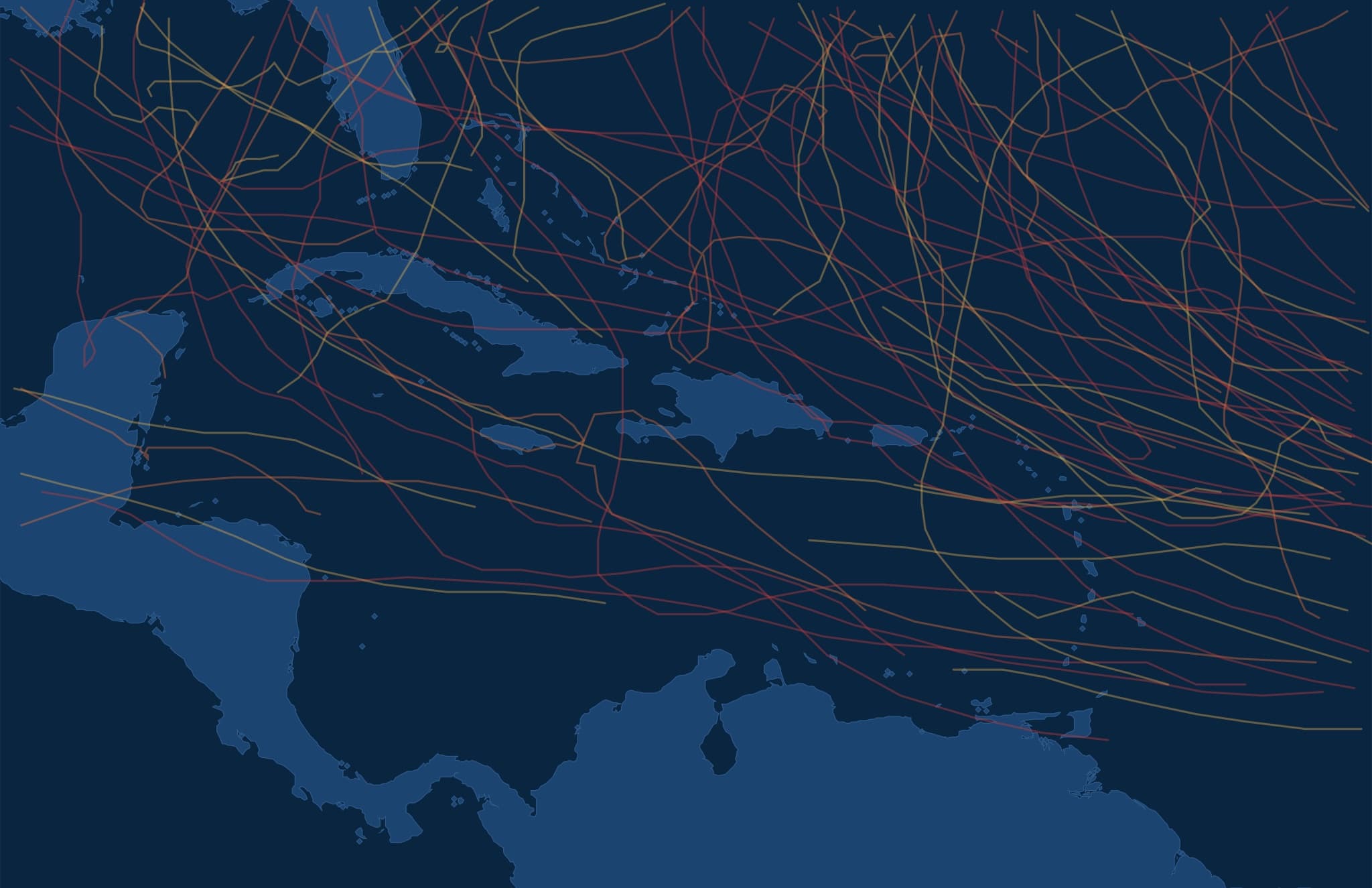
Map of historical September hurricane tracks across the Caribbean, drawn from NOAA IBTrACS data
Free interactive guide

When Is Hurricane Season in the Caribbean?

Hurricane season in the Caribbean runs from June 1 to November 30, and the most dangerous stretch is mid-August to mid-October. September is the peak month, with 30% of all named-storm activity recorded in the region since 1980. Storms can form outside those dates, but December through May is reliably quiet.

Pick a month in the planner below to see every named-storm track since 2000, hurricane counts for your island group, and the policy rules that apply while your yacht stays in the region.

Jun 1 to Nov 30
Atlantic hurricane season, per NOAA
336
named storms crossed Caribbean waters since 1980
September
peak month, 30% of all storm activity
10%
named-windstorm deductible, with a signed hurricane plan
Pick a month

Bar height shows the average number of named storms in Caribbean waters that month, from 46 seasons of NOAA IBTrACS records. Tap a month to update the map and the numbers.

Policy hurricane season: June 1 to November 30

Tap or hover a storm track to identify it. Pinch, double-tap or use the buttons to zoom.
Named stormHurricaneMajor, Cat 3+Tracks 2000 to 2025, IBTrACS v04r01 (NOAA)

July

Elevated

The season is running. An average year brings storm activity to some part of the region this month, so passage plans need a weather routine and your hurricane plan should already be signed.

0.6
named storms in an average year
10
hurricanes since 1980
4
major hurricanes, Cat 3+, since 1980
8%
of the year's storm activity

Counts cover named storms recorded inside the Caribbean and Bahamas waters between 8 and 28 degrees north, 55 and 90 degrees west, seasons 1980 to 2025.

What this means for cover

This month sits inside the policy hurricane season. On Lloyd's-market terms placed through London Marine Insurance Services Ltd, named-windstorm damage carries a 10% deductible, and the cover responds only if a signed hurricane plan was in place before the storm.

Staying for the season? See the boat hurricane plan generator and the boat insurance calculator.

Ask the producer desk
The full year

Caribbean hurricane season month by month

The table below is the planner's raw data: every named storm recorded in Caribbean and Bahamas waters across the 46 seasons from 1980 to 2025, from the NOAA IBTrACS archive. June and November belong to the season but carry a fraction of September's risk, which is why experienced crews treat the season's edges and its core very differently.

Caribbean hurricane season month by month
MonthNamed storms, avg per yearHurricanes since 1980Major hurricanesSeason status
January0.000Off season
February0.000Off season
March0.000Off season
April0.000Off season
May0.100Off season
June0.531Policy season
July0.6104Policy season
August1.94519Policy season
September2.46846Policy season
October1.74222Policy season
November0.6188Policy season
December0.110Off season

Source: IBTrACS v04r01, NOAA NCEI, seasons 1980 to 2025. Named storm means winds of 34 knots or more inside the region.

Island by island

Hurricane season is not the same on every island

Storm exposure varies enormously across the region. The counts below are named storms passing within about 60 nautical miles of each island group, or directly over it, in the 46 seasons from 1980 to 2025.

When is hurricane season in the Bahamas?

The Bahamas share the same June 1 to November 30 season, but sit in one of the region's most exposed corridors: 103 named storms have passed through or near the islands since 1980, 54 of them at hurricane strength. Recurving Atlantic systems and storms exiting Cuba both funnel this way in August and September. Most cruising boats leave the banks or haul out for the core of the season.

103
named storms since 1980
54
hurricanes
2.2
per year on average
Aug, Sep
peak months

Hurricane season in the Dominican Republic, Cuba and the Greater Antilles

The Greater Antilles, meaning Cuba, Jamaica, Hispaniola with the Dominican Republic and Haiti, and Puerto Rico, log the region's highest raw counts simply because the landmass is huge: 169 named storms since 1980, 88 at hurricane strength, about 4 a year. The Dominican Republic's south coast is somewhat sheltered from systems tracking along the classic east-to-west lane north of the islands. The peak months are Aug, Sep.

169
named storms since 1980
88
hurricanes
3.7
per year on average
Aug, Sep
peak months

The Leeward Islands: first landfall for Atlantic systems

The Leewards, from the Virgin Islands down through Antigua to Guadeloupe, are the first land that Cape Verde hurricanes meet after crossing the Atlantic. 67 named storms have passed within about 60 miles since 1980, 29 at hurricane strength, and September systems arriving here are often already at their strongest, as Irma showed in 2017.

67
named storms since 1980
29
hurricanes
1.5
per year on average
Aug, Sep
peak months

The Windward Islands: the southern edge of the belt

From Martinique down to Grenada, storm frequency drops noticeably: 52 named storms since 1980 and only 12 hurricanes. Many systems pass north of the chain, which is why so many yachts spend the season around Grenada. The record still has sharp exceptions, such as Beryl in 2024, a major hurricane through the southern Grenadines, and Ivan over Grenada in 2004.

52
named storms since 1980
12
hurricanes
1.1
per year on average
Aug, Sep
peak months

The ABC Islands: Aruba, Bonaire and Curaçao

The ABCs sit at the region's southern rim, and the numbers back their reputation: just 12 named storms have passed within about 60 miles since 1980, 4 of them at hurricane strength, roughly one storm every four years. That is the lowest count of any group here, which is why many owners and some insurers treat the ABCs as a season haven. Low is not zero, though, and policy season terms are set by your schedule, not by folklore.

12
named storms since 1980
4
hurricanes
0.3
per year on average
Jul, Sep
peak months
The insurance layer

What hurricane season means in a yacht policy

Lloyd's-market yacht policies placed through London Marine Insurance Services Ltd apply seasonal conditions from June 1 to November 30, matching the NOAA season. Named-windstorm damage in that window carries a 10% deductible, and the cover responds only if a signed hurricane plan is in place.

The policy season matches the weather, not the calendar year

Underwriters use the same June 1 to November 30 window that NOAA defines for the Atlantic. Outside those dates, storm damage in the Caribbean falls under the standard deductible, typically 1% to 5% of the agreed value. Inside them, a named windstorm triggers its own terms.

The 10% named-windstorm deductible, worked through

On a $400,000 yacht, a named-windstorm claim carries a $40,000 deductible, against $4,000 to $20,000 on the standard 1% to 5% band. That difference is the market's price for keeping cover in force through the season, and it is why the hurricane plan matters: a signed plan is a condition of the cover, not a courtesy.

There is no single industry hurricane box

Each insurer draws its own box, meaning the latitudes and dates where seasonal terms apply, in the policy schedule. Common versions cover roughly the waters between the US Gulf coast and the north coast of South America during the season. If your schedule says out of the box by a given date, that means the yacht must be south of the stated latitude, hauled out, or relocated before it. Read the schedule, not a forum post. The link between insurance and these dates is old: in 1844 the meteorologist William Redfield pegged the season at July 15 to October 15 because underwriters were already raising premiums over that window.

Restricted waters stay restricted year round

Cuba, Haiti and Venezuela are restricted or excluded on standard terms regardless of the season. If an itinerary touches them, that is a conversation with the producer desk before departure, not a claim discussion after.

Planning cover for the region? Start with worldwide yacht insurance, the boat insurance cost calculator, liveaboard insurance, bluewater and offshore insurance, how much yacht insurance costs.

Insuring a yacht for hurricane season?

Named-windstorm cover needs a signed hurricane plan before the season starts. Send your boat details and cruising plans, and the producer desk returns Lloyd's-market terms in about 48 hours.

Get a quote by email
Common questions

Caribbean hurricane season FAQ

When is hurricane season in the Bahamas?+

The Bahamas follow the same Atlantic season as the rest of the region: June 1 to November 30, with the peak from mid-August to mid-October. The islands are among the most exposed in the record, with 103 named storms passing through or near them since 1980, so most cruising yachts clear the banks or haul out for the core months.

Is it safe to sail the Caribbean in August?+

August averages about 1.9 named storms in Caribbean waters and sits at the front edge of the peak. Crews do sail then, but with a daily weather routine, a reachable hurricane hole or haul-out plan, and insurance terms in order: named-windstorm cover carries a 10% deductible and requires a signed hurricane plan. September is statistically the riskier month.

What is the hurricane box in yacht insurance?+

The hurricane box is the area and date range where a policy applies seasonal windstorm conditions. There is no industry-standard box; each insurer defines its own in the policy schedule. On Lloyd's-market terms placed through London Marine Insurance Services Ltd, named-windstorm damage between June 1 and November 30 carries a 10% deductible and requires a signed hurricane plan.

When is hurricane season in the Dominican Republic?+

June 1 to November 30, the same as the wider Atlantic basin, with peak risk from mid-August to mid-October. The Greater Antilles group that includes Hispaniola has seen 169 named storms since 1980, though the Dominican Republic's south coast sees fewer direct hits than the Atlantic-facing north.

Which Caribbean islands are outside the hurricane belt?+

Statistically, the southern rim: Aruba, Bonaire and Curaçao have seen only 12 named storms within about 60 miles since 1980, roughly one every four years, and Trinidad sits similarly low. Outside the belt is relative, not absolute, and policy hurricane-season terms depend on your schedule's own box definition, so confirm whether your insurer applies seasonal conditions there.

Do I need a hurricane plan for my boat insurance?+

If the yacht stays in named-windstorm territory during the season, yes. On the Lloyd's-market wording this cover only responds when a signed hurricane plan is in place before the storm, covering where the boat will be, who acts if you are away, and what gets stripped or secured. The producer desk supplies an insurer-ready plan format on request.

Sources and method

  • Storm counts and tracks: International Best Track Archive for Climate Stewardship (IBTrACS) v04r01, NOAA National Centers for Environmental Information. Knapp, K. R., M. C. Kruk, D. H. Levinson, H. J. Diamond, and C. J. Neumann, 2010, Bulletin of the American Meteorological Society. DOI 10.25921/82ty-9e16.
  • Season dates: NOAA National Hurricane Center, Atlantic hurricane season June 1 to November 30.
  • Method: named storm means sustained winds of 34 knots or more recorded inside the Caribbean and Bahamas waters between 8 and 28 degrees north and 55 and 90 degrees west. Island-group counts use a corridor of about 60 nautical miles. Seasons 1980 to 2025; map tracks show 2000 to 2025. Figures verified July 2026.
  • Policy terms: London Marine Insurance Services Ltd policy wording held by World Yacht Insurance. Deductibles and conditions are indicative; final terms are set by Lloyd's underwriters.

IBTrACS dataset, DOI 10.25921/82ty-9e16 · NOAA National Hurricane Center

Reviewed by Costas Matheou, licensed insurance agent (Cyprus).

Coverage terms, premiums and deductibles on this page are indicative and not financial advice. Cover is subject to underwriting, survey and the policy wording.

Cruising the Caribbean through the season?

Agreed-value hull and liability cover up to $5M, placed at Lloyd's of London, with honest seasonal terms explained before you bind. Quotes in about 48 hours.