
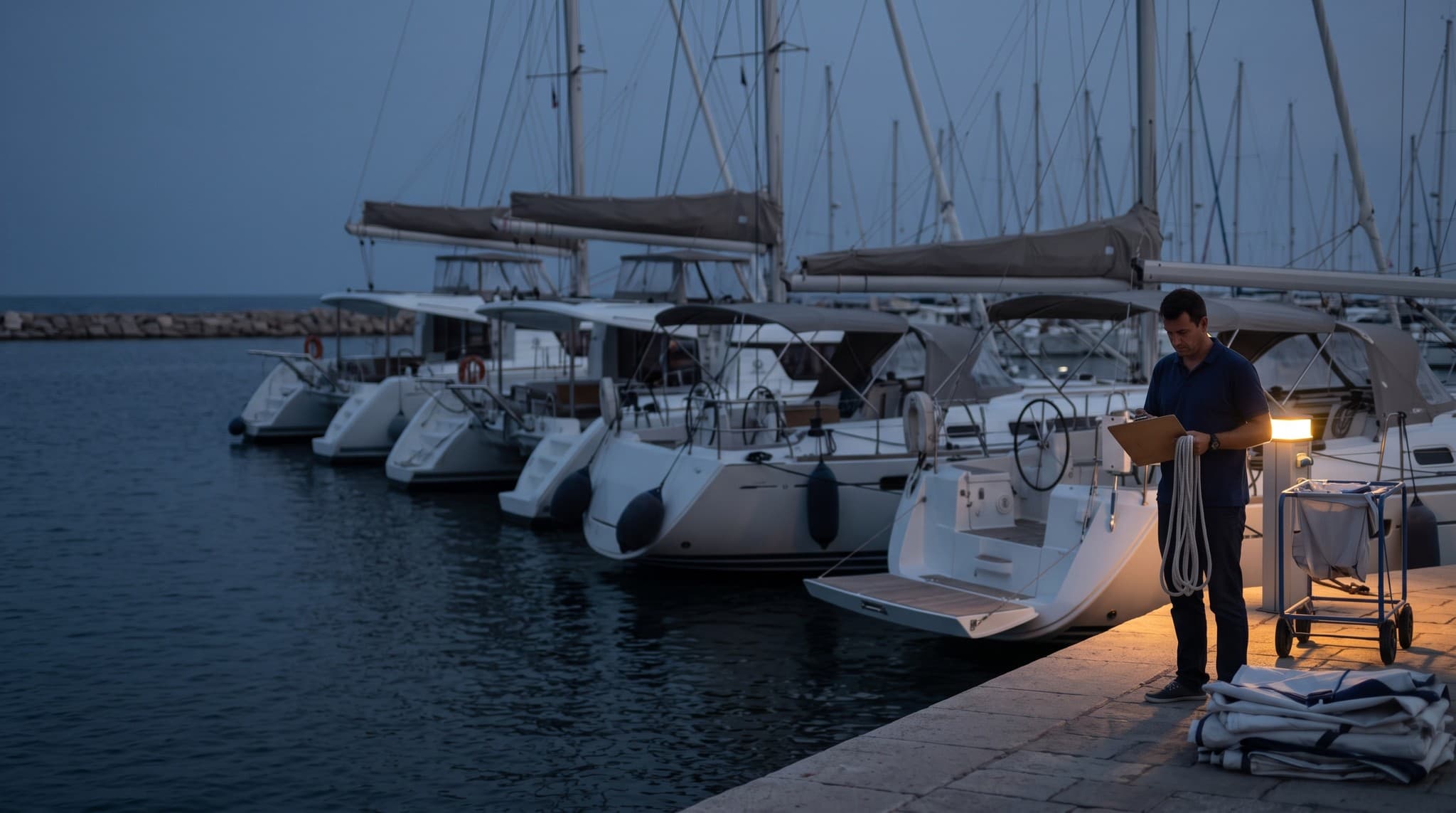
Commercial Charter Boat Insurance
Commercial charter boat insurance is arranged in two groups: cover on the boats, meaning fleet and commercial-use hull, third-party liability, and separate passenger and crew sections; and cover on the company, meaning marine general liability, premises, employers liability, and legal liability for managed hulls. Whether the fleet goes out bareboat or skippered changes who is liable.
Cover arranged for companies running a charter fleet, including boats the company manages rather than owns.
Lloyd's
Where cover is placed
FCA 308599
London Marine Insurance Services Ltd
24 hours
Quote terms back from the desk
Four lines
Fleet hull, liability, premises, charter deposit
What insurance does a charter company need?
Two groups of cover, not one policy. One sits on the boats. The other sits on the company, and an owner never needs it.
One boat you own, out on paying bookings? See chartering out your own yacht, not this page.
Hiring a boat for a week? Read the charterer's side of a bareboat instead.
Running six-pack or OUPV fishing trips yourself? A page on fishing charter insurance is planned, and the desk can quote that work today.
On the boats:
- Fleet and commercial-use hull on the boats named on the schedule.
- Third-party liability, which answers the other vessel, the swimmer and the dock.
- Commercial passenger liability and crew liability, which are two schedule sections rather than one.
On the company:
- Marine general liability, for injury and damage outside the business.
- Premises liability for the shore base, the office and the yard.
- Employers liability where staff are employed, under whichever regime applies locally.
- Professional indemnity where the company advises rather than only hires boats out.
- Marina operators or ship repairers legal liability where the base holds other people's boats.
Charter deposit and skipper liability gets forgotten most, and it belongs next to the vetting question rather than the hull. The wider picture is at marine business insurance.
Bareboat or crewed changes who is liable
Whether the company supplies the skipper moves a charter between two legal regimes. It changes the inspection threshold, whether a credential is required, and who the law treats as in control. An underwriter asks it first.
| What the company supplies | What the arrangement is | Federal threshold that triggers inspection | Who the law treats as in control |
|---|---|---|---|
| No crew provided or specified | The charterer takes possession, command and navigation, so under 46 U.S.C. §2101(31)(A)(i) an individual charterer is not a passenger | More than twelve passengers, 46 U.S.C. §2101(49)(C) | The charterer |
| A skipper provided or specified by the company | Carriage of passengers for hire, so the guests are passengers rather than charterers | More than six passengers, §2101(49)(B). Below that it is an uninspected passenger vessel under §2101(55)(B)(ii) | The company, through the skipper it puts aboard |
| A skipper, on an uninspected passenger vessel | A credential requirement attaches: the boat must be operated by an individual licensed by the Secretary | 46 CFR 15.605 sets an OUPV endorsement below 100 gross tons and a Master endorsement at or above | The credentialed individual in command |
| Neither provided nor required, in Florida | The operator is a livery under Fla. Stat. §327.54(1)(c). Providing or requiring a USCG-licensed master keeps an operator outside that definition | No federal threshold. In Florida the whole §327.54 regime applies instead | The customer at the helm |
In Guzman v. Pichirilo, 369 U.S. 698 the Supreme Court held that to create a demise the owner must completely and exclusively relinquish possession, command and navigation to the demisee. Congress uses the same test in 46 U.S.C. §30501(2): an owner includes a charterer that mans, supplies and navigates a vessel at its own expense. That definition governs the limitation of liability provisions, so it holds for those purposes rather than as a general rule of American law.
The consequence for a company sits in that test rather than in the paperwork. Where a charter is documented as bareboat but the company keeps day to day control of the boat, the question is whether possession, command and navigation really passed at all. If they did not, what is left is carriage of passengers for hire, with a six-passenger threshold and the credential requirement in 46 U.S.C. §8903 attached to it. Whether any particular arrangement is a genuine demise is a question of fact the Coast Guard tests, so this page states the definitions and does not apply them to your boats.
In Florida the same act decides something else. The livery test turns on whether a Coast Guard licensed master is provided or required, and the Florida Fish and Wildlife Conservation Commission states the negative in its own words. Bareboat puts a Florida operator inside that regime; supplying or requiring a master puts them outside it.
The same hull run bareboat one week and skippered the next gives two answers on one schedule, and both have to be declared.
This is general information, not legal or financial advice. Statutes change, so check the current text before relying on it.
Skipper vetting is a condition of cover, not a formality
An owner vets one skipper once. A charter company is underwritten on a procedure it repeats at every handover, and the wording makes that procedure a condition of cover.
What the wording we work from says, in order:
- The Owner and/or the Manager named on the Declaration Page verifies the charterer's qualifications, experience and suitability. The duty is the operator's.
- The operator instructs the charterer on handling the boat before handover, including the Emergency Manual.
- Charterers approved that way are deemed Covered Persons. Approval is the act that brings the person at the helm inside the cover.
- The boat must be under the command of a competent person holding the qualifications applicable regulations require, detailed in the Bareboat Charter Supplementary Sheet, which is incorporated in its entirety into the policy.
- There is no cover when the vessel is operated by anyone other than those listed as operators, including anyone listed in a bareboat charter agreement.
Read this one twice. Where a vessel is let on a bareboat basis there must be a written charter agreement with a hold harmless provision in favour of insurers, and failure to use one is grounds for a claim to be avoided.
Three conditions catch operators out. Charter payment goes by card, bank transfer or cheque with bank details recorded; cash calls for a card deposit and a retained identity document. Embezzlement cover is conditional on a third-party reference on the signatory's identity and address, taken by means other than a copy of the passport or licence. And a breach of warranty by a charterer, captain or crew, without the operator's knowledge, extends cover rather than withdrawing it.
Georgia has written a version of the same duty into statute: its boat livery liability shield falls away where the operator rented to someone it knew or should have known was not a reasonably safe operator. These duties are the operator's; we arrange the placement.
Paying guests and paid crew are two different liabilities
Most of this market sells passenger and crew cover as one bullet. In the wording we work from they are two schedule sections with separate sums insured and deductibles.
The base third-party liability section excludes liability to fare-paying passengers and to any passenger carried under charter, and bodily injury to any person employed by you, crew or not. So it answers the other vessel, the swimmer and the dock, and neither the guest nor the deckhand.
Two extensions restore them, each only if the schedule shows a sum insured for it:
Commercial passenger liability, for a fare-paying passenger or a passenger carried under charter.
Crew liability, for sums payable to hired crew under any applicable statute, which the wording names as including maintenance and cure and the US Merchant Marine Act of 1920, the Jones Act.
Each extension carries its own deductible, and both form part of the same Third Party Liability Combined Single Limit. A bad guest claim and a bad crew claim erode one number, not two. The racing endorsement names the same five sections when it doubles deductibles: Hull and Machinery, Protection and Indemnity, Crew Liability, Passenger Liability and Personal Property.
The crew side is published on the owner-side pages, so see chartering out your own yacht for the Jones Act, 46 U.S.C. §30104, detail. The base section also excludes benefits any state or federal statute requires, where state workers' compensation and Longshore sit.
How a charter fleet is rated, including boats you do not own
A fleet is one submission with a schedule behind it, so the underwriter is pricing a business, not a boat.
The wording we work from names the Owner and/or the Manager detailed on the Declaration Page, so a company managing hulls it does not own is inside that contract rather than an exception to it, and the duties attach to the Manager. Owner and operating company then hold different interests in the same boat, and both have to appear correctly on the paperwork.
What a fleet submission is rated on:
- Number of hulls, their classes and agreed values, and total insured value.
- The mix of bareboat and skippered weeks, a regulatory fact as much as a commercial one.
- The cruising area and season each hull works.
- The vetting and handover procedure, which the wording makes a condition.
- Loss runs across the whole fleet, not one hull's history.
- Per-vessel deductibles, an operating expense on a fleet rather than a catastrophe threshold.
- Payroll, where staff are employed, which is also what an employers liability placement is rated on.
- Whether the base holds customers' or owners' boats ashore or afloat.
- Any additional-insured requirement a marina, resort or booking agency imposes.
Two boundaries before you submit. Unless insurers specifically agree in writing, the wording says such agreements may only be made for recreational charter to individuals, and not to other charter companies or commercial organisations. We draw no conclusion about block bookings.
The second is mixed use. Non-disclosure of a material fact makes the agreement null and void, and undeclared use is the commonest reason a commercial claim gets argued instead of paid.
You can build a fleet schedule before you submit. A base that stores other people's boats should read marina insurance, and catamaran fleets can check catamaran hull cover.
What we can arrange for a charter company, and what we cannot
Four lines for a charter company, and five boundaries. We arrange and we introduce, and the right column is what makes the left column worth believing.
| What the chain can arrange | What sits outside it |
|---|---|
| Fleet and commercial-use hull on the boats on the schedule | Cover placed in the London market for a US business is generally non-admitted surplus lines, and it is not backed by a state guaranty fund |
| Marine general liability and premises for the shore base and third parties | Employers liability and professional indemnity are jurisdictional. Some of it is placed locally rather than in the London market, so a company with staff in more than one country gets more than one answer |
| Marina operators or ship repairers legal liability, where the base holds other people's boats | Marine cargo is not arranged |
| Charter deposit and skipper liability, where a skipper is part of the arrangement | The placeable classes are yachts, sailboats, catamarans, motor boats and superyachts. Personal watercraft and jet skis fall outside the London-market facility |
| Sub-chartering to another charter company or commercial organisation sits outside the standard bareboat endorsement unless insurers agree it in writing |
One clause a US operator asks about and nobody answers: the wording is subject to English law and the exclusive jurisdiction of the courts of England and Wales, except that where a claim falls properly within US jurisdiction and a provision conflicts with US Federal Admiralty Law, that law governs.
The chain, once and in full. World Yacht Insurance introduces the business, which goes through AKD Insurance, our contracted broker in Cyprus. Cover is arranged and placed at Lloyd's of London by London Marine Insurance Services Ltd, a Lloyd's-accredited broker authorised and regulated by the Financial Conduct Authority under firm reference 308599. World Yacht Insurance is not an insurer and does not carry risk. The insurers behind the facility carry the risk and pay valid claims.
World Yacht Insurance is a yacht-insurance introducer arranging hull and liability cover up to $5M for sail and motor yachts worldwide, including the Caribbean, placed in the London market through London Marine Insurance Services Ltd, a Lloyd's-accredited broker.
The figure in it is agreed-value hull capacity on the private-yacht side, not a limit offered to a charter fleet. How the chain works carries the full regulatory disclosure, and who we are names the licensed agent behind it.
What does commercial charter boat insurance cost?
There is no published rate for a charter fleet. The business is individually rated rather than priced from a table, and the longer pages here say the same. What it is rated on sits above.
One correction this page owes its own site. The 1% to 1.5% of agreed value figure quoted elsewhere here is a private-yacht agreed-value indication. It does not apply to a charter fleet, and it does not apply to liability business at all.
A limit is not a price. The same limit costs different money on four catamarans worked bareboat in the Cyclades than on two crewed motor yachts in Florida, and here a passenger claim and a crew claim draw on one combined single limit.
The only published figures in this market belong to somebody else. Read on 2026-08-21, one specialist market publishes sub-limits of up to $25,000 medical payments for clients and passengers, $5,000 personal property and fishing tackle, and $2,500 towing and emergency services. Another advertises fleet discounts with no figure. Those are their terms, not ours, and limits rather than prices.
Loss-of-charter-hire is an owner-side cover rather than a company one, published under chartering out your own yacht. Send the fleet through the form.
Charter company, charter owner, or charterer: which page is yours
These pages answer questions that sound the same. The test is what you own and who you hand it to.
A fleet on a schedule, staff, a base and a different customer every week? This page.
One boat you own, on paying bookings? A commercial-use endorsement on that boat's own policy, and chartering out your own yacht is the page written for it.
Hiring a boat for a week and worried about the deposit? Read the charterer's side of a bareboat.
Renting boats by the hour or the day off a counter? boat rental insurance is yours.
Six-pack or OUPV fishing trips? A page on fishing charter insurance is planned; the desk quotes that work today.
The difference is exposure rather than nouns. The owner's question is whether one skipper is competent. The company's question is whether a vetting procedure repeated at every handover, across hulls it may not own, is. Start at marine business insurance.
Commercial charter boat insurance FAQ
What insurance does a charter boat business need?+
Two groups of cover rather than one policy. On the boats: fleet and commercial-use hull, third-party liability, and separate passenger and crew liability sections where the schedule shows a sum insured for each. On the company: marine general liability, premises for the shore base, employers liability where staff are employed, professional indemnity where the company advises, legal liability for other people's boats where the base holds managed hulls, and the charter deposit and skipper liability line. Which of them apply depends on whether the fleet goes out bareboat or skippered.
Does a charter company need a US Coast Guard licensed captain?+
It depends on which arrangement the company is running, and the answer changes the whole regulatory picture. Where no crew is provided or specified by the owner, the vessel becomes a small passenger vessel requiring inspection only above twelve passengers, under 46 U.S.C. §2101(49)(C), and the person at the helm is the charterer rather than a passenger under §2101(31)(A)(i). Where the company provides or specifies the crew, the threshold drops to more than six passengers under §2101(49)(B), and a self-propelled uninspected passenger vessel must be operated by an individual licensed by the Secretary under 46 U.S.C. §8903, which 46 CFR 15.605 sets at an OUPV endorsement below 100 gross tons. In Florida the same act decides something else again: an operator who provides or requires a Coast Guard licensed master is not a livery under Fla. Stat. §327.54(1)(c) and does not pick up that section's permit and insurance duties, while one that bareboats does. This is general information and not legal or financial advice.
Does a bareboat charter need a written agreement for insurance to respond?+
Yes, and the wording is specific about it. The wording we work from requires a bareboat charter to be let on a written charter agreement carrying a hold harmless provision in favour of insurers, and says that failure to use one is grounds for a claim to be avoided. Separately, there is no cover when the vessel is operated by anyone other than the people listed as operators, including anyone listed in a bareboat charter agreement, and the charterer only becomes a covered person once the owner or the manager named on the declaration page has verified their qualifications, experience and suitability and instructed them on handling the boat before handover. The paperwork is the cover, not the file copy of it.
Can insurance be arranged for a charter fleet the company manages but does not own?+
Yes, and the wording contemplates it directly: it names the owner and/or the manager detailed on the declaration page, and it attaches the vetting and handover duties to whichever of them is running the boat. That matters for an owner-in-programme structure, where the hull's owner and the operating company are different parties with different interests in the same boat and both have to appear correctly on the paperwork. What we cannot publish is a fleet minimum, a maximum, a territory or a limit, because none of those has been confirmed for commercial lines. They are confirmed at quotation.
How much does commercial charter boat insurance cost?+
There is no published rate, because a charter fleet is individually rated rather than priced from a table, and every longer page in this market says the same thing in its own words. Premium is built from the number of hulls and their agreed values, the split between bareboat and skippered weeks, the cruising areas and season worked, the vetting and handover procedure, loss runs across the whole fleet, per-vessel deductibles, payroll where staff are employed, and any additional insured a marina or booking agency requires. A limit is not a price either, and on this wording a passenger claim and a crew claim draw on one combined single limit. The 1% to 1.5% of agreed value figure used elsewhere on this site is a private-yacht indication and does not apply to a fleet or to liability business. The quote form asks the rating questions directly.
Reviewed by Costas Matheou, licensed insurance agent.
Coverage terms, premiums and deductibles on this page are indicative and not financial advice. Cover is subject to underwriting, survey and the policy wording.
Get terms for your charter fleet
Tell us the hulls, the split between bareboat and skippered weeks, the waters each part of the fleet works, and whether a written charter agreement with a hold harmless provision is already in use. Those are the rating questions, so the answers go straight to the broker desk instead of into a queue.
- No obligation
- every underwriting question asked upfront
- a licensed Cyprus agent reviews every enquiry
Also on WhatsApp, Telegram and Viber