

RIB Insurance for UK and European Waters
RIB insurance covers a rigid inflatable boat's hull, outboard, trailer and third-party liability in UK and European inland and coastal waters, with standard cover to 12 nautical miles offshore and third-party liability up to £5 million. Past 12 miles the cruising area has to be extended by agreement before you go. UK and European risks only.
World Yacht Insurance introduces RIB and rigid inflatable boat enquiries to the market that writes them. We read the scheme wordings, so this page gives you the thresholds before you ask for a quote: what a tender is actually insured for, how far you can tow, and where the boat may be left unattended.
Reviewed by Costas Matheou, licensed insurance agent (Cyprus). Reviewed 27 August 2026.
up to £5m
Third-party liability on the scheme, as the partner publishes it
12 nm
Standard offshore limit, from the wording's own definition of Coastal Waters
£2,000 / £4,000
What a tender and its outboard are insured for on a mothership policy unless the certificate says more
up to 25%
No claims bonus on the scheme
What does RIB insurance cover, and where does it stop?
Start with the boundary rather than the benefits. RIB boat insurance runs in the inland and coastal waters of the UK and Europe, up to 12 nautical miles from the shore. Past that line the cruising area has to be extended by agreement before you go, and the Mediterranean and worldwide extensions are on request rather than standard. Third-party liability runs up to £5 million.
The 12 mile figure is not a marketing number. The FreeTime Pleasure Craft policy wording (GS_MAR_PC_PW_v08.3, no date printed on the document) defines Coastal Waters as “Waters up to a distance of 12 nautical miles from the shore”. So the limit is written into the cover rather than into an advert. Act on it directly: if your cruising plan crosses that line, the extension is a conversation to have before the trip, not after.
One carve-out surprises almost everyone, and no competitor page states it. The same wording's Cruising Limits let you run between two points in the United Kingdom by the most direct route, even where that route leaves the 12 mile limit. Then it adds that this “does not include travel between Great Britain and either the Isle of Man, Northern Ireland or the Channel Islands” (FreeTime Pleasure Craft, Cruising Limits). So a Solent to Cherbourg plan and a Liverpool to Douglas plan are not the same request under this wording.
| On the wordings we hold | Where it stops |
|---|---|
| Third-party liability, up to £5 million, covering damage to another vessel or property, death or injury, pollution and other financial losses (BW1 Section 2, cl. 1) | Cover for the cost of removing or disposing of the vessel is restricted where there is no accidental damage to it, or the damage is not wholly or substantially covered (BW1 Section 2, cl. 4.1) |
| Hull, machinery, gear, equipment, trolleys and road trailers, as the insured Vessel (BW1 Vessel definition) | Diving equipment, wet suits and dry suits, excluded unless noted by endorsement or shown in Your Schedule (Craft 1.13) |
| The tender and outboard, capped at £2,000 each item and £4,000 in all unless the Certificate of Insurance shows more (BW1 Section 1, cl. 2.1) | Theft of a tender that does not carry an identifiable mark (BW1 4.5) |
| Transit by road, granted in Section 1 and limited by clause 4.12 | Transit where the vessel exceeds 9.15m (30 feet) overall, or the transit exceeds 500km (300 miles) in total (BW1 4.12) |
| Loss or damage from the failure of a machinery component, on four conditions (BW1 2.4) | One of those four is a Maximum Designed Speed under 35 knots (BW1 2.4(c)) |
| Salvage charges, including towage or assistance (BW1 3.1) | A RIB of any length, while moored or anchored unattended off an exposed beach or shore (BW1 5.4) |
| Cruising in the inland and coastal waters of the UK and Europe, to 12 nautical miles | Hire, charter and any use except your own private pleasure, unless noted on the Certificate (BW1 10:1.7.1 and 10:1.7.2) |
Governing wording: Topsail Yacht and Motor Boat Policy, “All Risk” wording, Version BW1, dated June 2026. Second wording: FreeTime Pleasure Craft, GS_MAR_PC_PW_v08.3, no date printed.
Around that core the market sells a short benefit list. The scheme carries up to 25% no claims bonus. One UK insurer publishes legal expenses up to £100,000; another publishes personal accident cover of £25,000, medical expenses of £1,000 and personal effects of £250, both read 27 August 2026. Those are their figures, not ours.
Every threshold on this page resolves in the same place. Your limits, your excess and your cruising area are set on the Certificate of Insurance, or on Your Schedule under the second wording. Not one of the five strongest pages competing for this search mentions either document.
For a boat that is not a RIB, which cover follows which boat routes the other classes.
Is my RIB already covered as my yacht's tender?
Not automatically, and not never. On the wording we hold a tender is part of the insured vessel only where it is used in connection with the operation of the vessel and does not exceed 16 feet, its outboard does not exceed 10hp, it carries an identifiable mark, and the claim stays inside £2,000 each item and £4,000 in all. On the second wording it is covered only when it is noted on Your Schedule. Above any of those lines, it has to be specified.
The question does get answered elsewhere, in general terms. What is not published anywhere is the answer with the thresholds attached, so here they are.
The five conditions that decide it
Size. The insured Vessel includes “tender(s) used in connection with the operation of the Vessel not exceeding 16 feet in length unless specified in the Certificate of Insurance” (BW1 Vessel definition).
Purpose. The same clause carries the words “used in connection with the operation of the Vessel”. A RIB used as a runabout in its own right is doing something else.
Sum insured. Ashore, afloat, being lifted, hauled out, launched or in transit, the grant for the tender and the outboard runs “up to a maximum value of £2,000 each item and £4,000 in all, or as shown in the Certificate of Insurance” (BW1 Section 1, cl. 2.1).
Marking. Theft of a tender without an identifiable mark is excluded (BW1 4.5). The second wording is more specific: no cover for theft of tenders or dinghies without “the name of Your Craft or Your name or Your current postcode or Your sail number permanently shown on them” (Craft 1.11).
Outboard power. Machinery includes “outboard motors not exceeding 10hp unless specified in the Certificate of Insurance” (BW1 Machinery definition). Above 10hp the outboard is not automatically machinery.
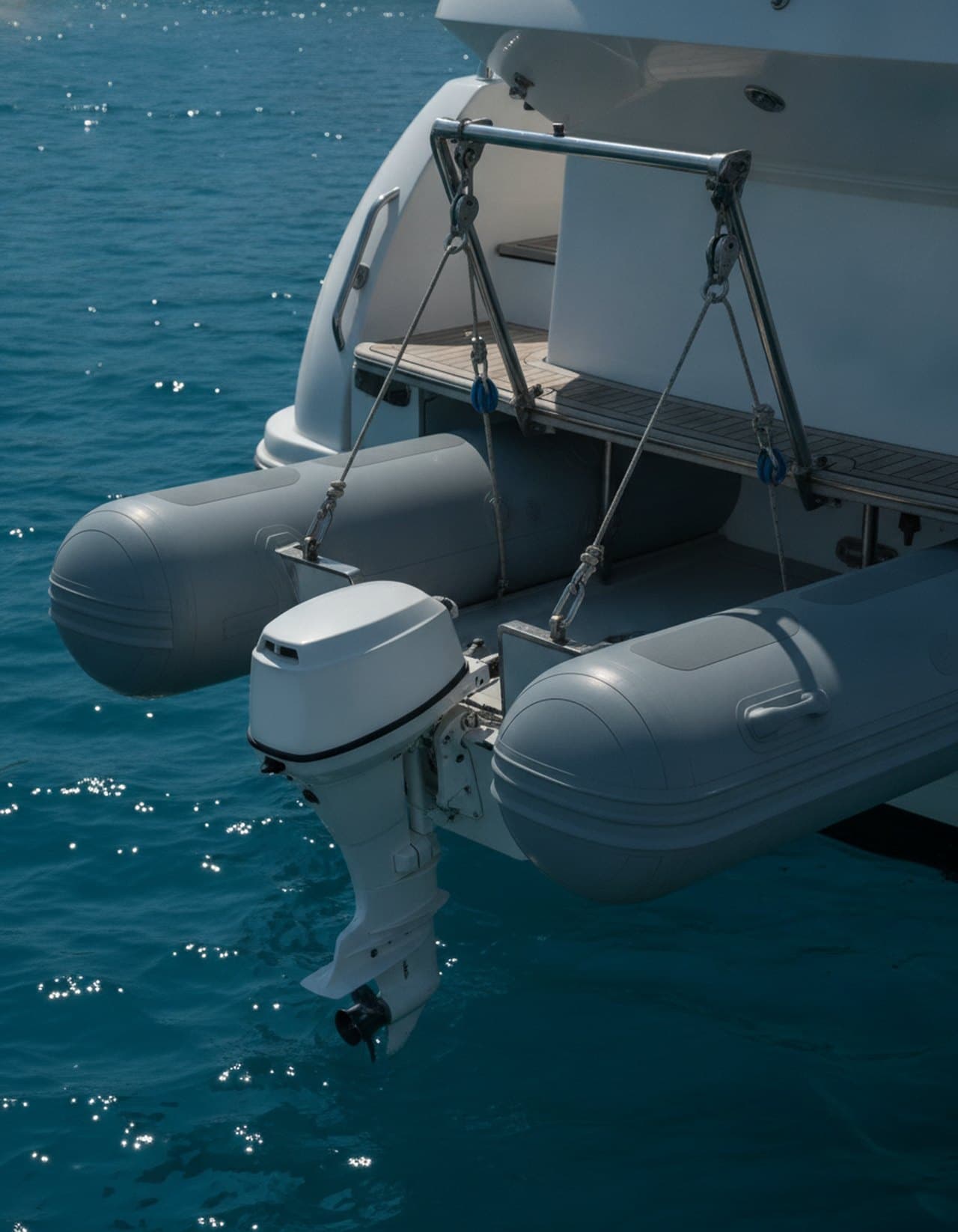
There is a sixth line, and it is the one to check first. The FreeTime Pleasure Craft wording covers “trailers, tenders, dinghies or other vessels noted in Your Schedule”, with no automatic size allowance at all. The two wordings differ here, so take the stricter reading: assume the tender is covered only if it is named on your schedule, and treat the 16 foot allowance as specific to BW1.
Claims on the tender and the outboard also carry their own excess: £100, or the excess shown on the Certificate of Insurance, whichever is higher (BW1 Section 11, cl. 3).
Now the arithmetic, because this is where a flat yes fails
Take a real case from a UK owners' forum in February 2026. A 3.1m aluminium RIB with a 15hp outboard, hanging on davits. The owner had listed it on the main boat policy and was still not sure it was covered. Run that boat through the conditions. At 3.1m the RIB is 10 feet 2 inches, comfortably inside the 16 foot allowance. The 15hp outboard is outside the 10hp machinery definition, so it needs specifying. And the payout for both items together is capped at £4,000 unless the certificate says more. His question was answerable from the document; nobody answered it.
The bigger boat fails earlier. A 5.5m RIB is 18 feet, over the size threshold before you reach the cap. And a £14,000 RIB inside a £4,000 all-in grant is not insured for £14,000. That is the point at which the tender needs a policy of its own, and it is a sums-insured question rather than a preference. Owners also report that a standalone policy can price better than a tender add-on that excludes trailered risk.
Two boundaries, stated plainly. This section speaks only for the two wordings named above, and a superyacht's tender is not on either of them: how tenders are treated on a superyacht schedule is the page for that. If your question is what figure to insure the tender and trailer for, work out the sums insured, tender and trailer separately is the tool.
Is my RIB insured on the trailer, and how far can I tow it?
Road transit has two hard boundaries on the wording we hold. Cover stops where the vessel's overall length exceeds 9.15m (30 feet), and where a single transit exceeds 500km (300 miles) in total (BW1 clause 4.12, Version BW1, June 2026). Trailer theft needs a wheel clamp, or the trailer stolen from a locked building. Your motor policy does not fill either gap.
| Limit | What the clause says |
|---|---|
| Length | Transit by road is excluded where the vessel has an overall length exceeding 9.15m (30 feet) |
| Distance | Transit by road is excluded where the transit exceeds 500km (300 miles) in total |
Both from BW1 clause 4.12. Be clear about which half is news. Two UK insurers publish a length threshold of around nine metres, one in metres and one as 30ft, both read 27 August 2026, so the length limit is market standard. No page in the top five publishes a distance cap of any kind. That one matters on a real weekend: a 20 mile tow to the slipway and a 400 mile tow to Scotland are different questions, and only one is inside the grant.
The security conditions, and they reach the boat as well as the trailer
There is no cover for “theft of the trolley(s) and trailer(s) and any insured items attached to it, including the Vessel, unless the trolley(s) or trailer(s) has been locked with a wheel clamp, or is stolen from a locked building” (BW1 4.9). The second wording forks the requirement by craft type: a wheel clamp where the craft is a speedboat or personal watercraft, a wheel clamp or a hitchlock for everything else (Craft 1.4.4). A RIB doing over 17 knots is a speedboat on that wording, so for most sports RIBs the clamp is not the optional half of the choice.
Then the detail owners ask each other about and never resolve. The same clause counts the trailer as unattended “when the trailer is parked attached to a towing vehicle and left unattended or out of Your direct line of sight” (Craft 1.4.4(ii)). Hitched to the car is not the test. Out of sight is the test, which is the motorway services and the supermarket car park on the way to the coast.
One sentence on motor insurance, because it is the assumption behind most of these questions. A motor policy answers for third-party harm you cause on the road, not for the load on your trailer. The boat policy's transit grant is where the boat lives, so the limits above decide the answer.
Record the outboard's serial number now
There is no cover for “theft of any outboard motor whose serial number You do not provide Us within the event of a claim” (BW1 4.7). Nor for theft of the outboard unless it was in a locked cabin, locker, storage or vehicle, or secured to the boat or its tender “by an anti-theft device specifically designed and marketed for the purpose in addition to its normal method of attachment” (BW1 4.8). On the second wording a padlock and chain does not qualify as that device (Craft 1.4.3).
Whether road transit is standard on a given scheme or an extension to it is a quote-time answer, so we publish the grant and its limits rather than a claim about which it is.
Where can I leave a RIB unattended, and for how long?
There is no single answer, and that is the answer. Four separate published rules can apply to a RIB left unattended: an exposed beach or shore exclusion that names RIBs of any length, a sinking exclusion for boats under 17 feet doing over 17 knots, a condition to be ashore overnight with a three hour daylight maximum on a mooring, and a mooring permission that runs from 1 May to 30 September only. Which one binds you is on your own certificate.
Owners ask this constantly and get told to shop around. The reason nobody explains it is that the answer lives in wordings and endorsements rather than on a product page. Here are the four, side by side.
| Rule | What it turns on | What it says | Source |
|---|---|---|---|
| Exposed beach or shore | Place, with no time limit | Vessels under 8.5m (28 feet), and RIBs of any length, are not covered for being stolen, swamped, stranded, sunk or breaking adrift while moored or anchored unattended off an exposed beach or shore | BW1 cl. 5.4, Version BW1, June 2026 |
| Unattended afloat | Size and speed together | No cover for sinking or swamping while unattended afloat where the vessel is under 17 feet overall and its Maximum Designed Speed exceeds 17 knots, unless agreed | BW1 Section 10, cl. 1.12 |
| Taken Ashore Condition | Time of day | The craft must be ashore whenever nobody is on board and between sunset and sunrise, with a maximum of three hours unattended on a mooring in daylight | FreeTime Pleasure Craft, Endorsement 2 |
| Small craft mooring permission | Season | The craft may be afloat at the mooring named on the schedule between 1 May and 30 September only, ashore at all other times | FreeTime Pleasure Craft, Endorsement 3 |
Read the first two together, because they catch different boats. The exposed shore rule singles out RIBs by name, at any length, and it is about where the boat is rather than how long it has been there. The sinking rule is about the boat itself: a 4.8m RIB is under 17 feet, and a 40hp outboard on it will exceed 17 knots, so a boat outside the first rule can sit inside the second. Market practice varies again. Craftinsure publishes an exclusion for a boat left unattended afloat for more than 24 hours unless it is in a marina or on non-tidal waters, read 27 August 2026, and that is the only published clock in the set.
One line carries the whole comparison. The answer is a property of the wording and the endorsements on your certificate, not a property of RIBs in general. That is why “am I covered on a marina berth?” has no flat answer, and why where the boat is kept is a rated field on the enquiry form rather than an afterthought.
One misconception needs clearing up carefully. Berth hire and theft cover are different things, and a berthing agreement usually is not an insurance policy on your boat. We are not going to tell you what your marina's contract says. Read it, and read it next to your own certificate.
Which RIB you have changes the answer: six thresholds from the wordings
A 4m club safety boat, a 7m dive RIB and a 9m offshore RIB are three different risks, and the wordings say so in numbers. Six thresholds decide which conditions apply to you: 16 feet, 10hp, 8.5m, 9.15m, 17 knots and 35 knots. Two of them change the scheme rather than the detail.
| Threshold | What changes above it | Source |
|---|---|---|
| 16 feet, as a tender | The tender must be specified in the Certificate of Insurance rather than carried automatically | BW1 Vessel definition |
| 10hp outboard | The outboard must be specified to be machinery | BW1 Machinery definition |
| 8.5m (28 feet) | Below this length, and for RIBs at any length, the exposed beach or shore exclusion applies | BW1 cl. 5.4 |
| 9.15m (30 feet) overall | Outside the road transit grant entirely | BW1 cl. 4.12 |
| 17 knots maximum speed | The craft is a speedboat on the second wording, which changes the scheme, makes a wheel clamp the trailer condition, and adds a fire-extinguishing requirement where inboard machinery is fitted | Craft Speedboat definition; BW1 10:1.11 |
| 35 knots Maximum Designed Speed | Outside the condition for machinery component-failure cover | BW1 cl. 2.4(c) |
Maximum Designed Speed is not a judgement call. The wording defines it as “the maximum speed that the Vessel is designed to achieve under power as stated by the Vessel manufacturer with the particular engine fitted”, so it is a number you can look up.
Two speed figures circulate in this market and they are not the same kind of thing
Craftinsure advertises cover for high-performance RIBs up to 50 knots, read 27 August 2026. That is an eligibility ceiling: the speed above which that insurer will not write the boat. The 35 knot and 17 knot figures above are cover conditions inside a wording, which gate specific grants on a policy that has already been written. Conflating an eligibility ceiling with a cover condition is the most common error published about fast RIBs. The two answers point different ways.
Machinery component-failure cover shows how a grant can carry more than one condition. It needs machinery under 10 years old, professionally installed, a Maximum Designed Speed under 35 knots, and written evidence that the manufacturer's maintenance recommendations have been carried out (BW1 2.4). Three of those are about the boat. One is about your paperwork.
Two of those six numbers also decide whether you can race or run a timed run at all. What the 17-knot line does to competitive use, and what a UK racing licence involves, is set out in the guide to powerboat licences and racing cover.
What you use the RIB for matters as much as its size
Cover excludes non-standard use unless it is noted on the Certificate of Insurance or amended by endorsement, and the wording names it: no cover if you use the vessel “for hire or charter”, and none “for anything except Your own private pleasure” (BW1 10:1.7.1 and 10:1.7.2). A club safety boat, a training boat and a commercial dive RIB are all non-standard use. They are a declaration rather than a decline, and they must be declared rather than assumed. For a dive RIB there is a second condition on the equipment: diving equipment, wet suits and dry suits are excluded unless noted by endorsement or shown in Your Schedule (Craft 1.13), which is often the most valuable thing on board.
Commercial use also crosses a statutory line, not just a policy one. GOV.UK states you must apply for a boatmaster's licence to use your boat commercially, and a passenger-carrying certificate from the Maritime and Coastguard Agency to carry more than 12 passengers.
Which of the two schemes a given RIB is placed on depends on the boat, so it is a quote-time answer and we are not going to pick it for you. If the boat is a hard-hulled sports boat rather than a RIB, speedboat insurance and motorboat insurance are the neighbouring classes, and the 17 knot line is usually where the question starts.
Who actually sets the third-party figure for a coastal RIB?
Not the law, in most cases. The UK government's own boat insurance page gives a third-party figure for inland waterways and gives no figure at all for a boat at sea. For a coastal RIB the binding number comes from the harbour, marina, club or slipway whose water you use, and it can carry conditions the limit alone does not describe.
The GOV.UK guidance on owning a boat, read 27 August 2026, has exactly two headings. Under “If you're using inland waterways” it says you “will usually need to have 'third party' insurance for at least £1 million if you have a powered boat or a houseboat”. Under “If you're using a boat at sea” it names no insurance requirement and no figure whatsoever. Quote the £1 million with its heading attached, because it is an inland figure and it is routinely repeated as though it were a national minimum for boats at sea. It is not.
| Who sets it | The figure | The condition attached |
|---|---|---|
| GOV.UK, inland waterways | Usually at least £1 million for a powered boat or a houseboat | Applies to inland waterways, not to a boat at sea |
| GOV.UK, boat at sea | No figure at all | Statutory certificates apply to small commercial boats, not to private pleasure use |
| Bembridge Harbour, berthing terms cl. 3.1.3 | Not less than £5,000,000 | It must include salvage and wreck removal, and evidence has to be produced within 7 days of request |
| A slipway or club operator | Varies, and set locally | Some set a training condition as well as a limit, so check before you launch |
All read 27 August 2026. Bembridge is one worked example of a contractual requirement rather than a national rule, and figures vary by authority.
The reason that harbour asks for salvage and wreck removal is in the clause above it. Its published berthing terms state that the company “shall not be under any duty to salvage or preserve an Owners Vessel”, and where it does so it charges the owner on a normal commercial basis (cl. 3.1.2). Someone has to pay to move a sunk boat out of a berth, and the berthing terms decide who.
A limit and a condition are not the same test
A £5 million third-party limit and a requirement for £5 million including salvage and wreck removal do not automatically meet. The liability section of the wording we hold gives no cover for the cost you may be legally liable to pay for the removal or disposal of the vessel where there is no accidental damage to it, or where the damage is not wholly or substantially covered by the policy (BW1 Section 2, cl. 4.1). Wreck removal appears nowhere across the five strongest pages competing for this search, while a harbour authority requires it inside the limit.
So the instruction is concrete and you can check it yourself before you sign anything: read the limit and what the limit has to include, against your own certificate and your own berthing agreement. Where the two do not line up, that is a question for the desk before the berth starts, not after. If you only need liability, third party only cover is a separate product with its own boundaries.
What RIB insurance costs, and what moves the figure
We publish no premium of our own, because no figure we hold describes a RIB. What is published in this market is two insurers' own customer averages, £281 and £429 a year, and one itemised price: £40 plus Insurance Premium Tax to raise a £3 million third-party limit to £5 million. All three read 27 August 2026. None of them is a quotation.
| Figure | What it actually is | Whose figure | Read on |
|---|---|---|---|
| £281 a year | That insurer's own averaged customer figure for RIB insurance, asterisked on its page | Craftinsure | 27 August 2026 |
| £429 a year | That insurer's own averaged customer figure for RIB insurance, asterisked on its page | GJW Direct | 27 August 2026 |
| £40 plus IPT | The published price to raise a £3 million standard third-party limit to £5 million | Insure4Boats | 27 August 2026 |
| 12.5%, capped at £150 | Multi-boat discount on a RIB policy | Noble Marine | 27 August 2026 |
| Up to 15% | Discount for a RIB moored in a recognised marina | Insure4Boats | 27 August 2026 |
| Up to 25% | No claims bonus on the scheme we introduce to | The partner's published scheme terms | Evidenced 27 August 2026 |
Say what those two averages do not mean. They disagree by more than half again for the same product, because each is an average across very different boats, and neither is a price for yours. A published average tells a buyer almost nothing.
The £40 figure is more useful than either of them. It prices the one variable that gets averaged away in most write-ups: the difference between a £3 million and a £5 million third-party limit. It also shows that a £5 million limit is not free everywhere. If your berth demands £5 million, ask what it costs rather than assuming it is included.
Insurance Premium Tax sits on top of every quoted premium. Not one of the five strongest pages in this market mentions it. A premium quoted before tax and a premium quoted after tax are not comparable, and you will see both.
What actually moves the figure is a shorter list than the market implies:
- The boat's length, insured value and age
- The outboard's power, and its Maximum Designed Speed
- Where it is kept, and whether it is left afloat unattended
- The cruising area you need, and whether it goes past 12 nautical miles
- The excess you choose, and any excess waiver
- Your no claims bonus, up to 25%
- What you use it for: private pleasure, water sports, a club boat, diving or charter
Two cost mechanics from the wording that nobody publishes
First, where a claimable item is aged five years or over, the payment can be reduced by 25% if repairing or replacing it would restore it to a better condition than before the loss. The named items include machinery, batteries and tenders. That reduction does not apply to a total loss or a constructive total loss (BW1 Section 11, cl. 2). Second, a claim resulting from the vessel striking a submerged object or grounding is subject to double the excess shown on the Certificate of Insurance. RIBs run shallow and get launched off ramps, so that one is not theoretical.
We are not going to tell you who is cheapest. We introduce the enquiry and we do not rank insurers.
This page is general information, not financial advice, and nothing on it is a quotation.
How the arrangement works
We introduce your enquiry. We do not quote it, we do not underwrite it, and we carry no risk. On this class the enquiry goes to Topsail Insurance Ltd, our principal, which is also the firm named in the documents you receive. How the arrangement works sets out the route in full.
Any firm arranging insurance for you in the UK appears on the Financial Services Register, and it is worth checking the one named in your paperwork.
Reviewed by Costas Matheou, licensed insurance agent (Cyprus), ICCS certificate 6882. Content reviewed 27 August 2026.
RIB insurance FAQ
Do you need a licence for a RIB?+
Not for private recreational use at sea. GOV.UK's boat licensing guidance is about inland waterways: you usually need to register or licence a boat to keep or use it on rivers and canals, and a fine of up to £1,000 or removal can follow if you do not. Two thresholds do bite. Commercial use requires a boatmaster's licence, and carrying more than 12 passengers requires a passenger-carrying certificate from the Maritime and Coastguard Agency. Insurance is a separate question from licensing. Training is not a licence, but it is rated, and a club or slipway can set its own training condition. Crossing into commercial use is a declaration, because cover excludes hire or charter and any use except your own private pleasure unless it is noted on the Certificate of Insurance (BW1 10:1.7.1 and 10:1.7.2, Version BW1, June 2026).
What happens if I don't have boat insurance?+
It depends on where the boat is. Inland, insurance is a licensing condition, and GOV.UK says you could be prosecuted or fined, with the penalty depending on your navigation authority. At sea there is no general statutory minimum for a private pleasure craft, and GOV.UK's “If you're using a boat at sea” section names no insurance figure at all. The consequence is contractual instead: a harbour, marina, club or slipway can refuse you access and can require evidence of cover, and Bembridge Harbour's berthing terms require proof within 7 days of being asked (cl. 3.1.3, read 27 August 2026). The exposure is also wider than the boat. Third-party liability covers damage to another vessel or property, death or injury, pollution and other financial losses (BW1 Section 2, cl. 1), and where a vessel has to be moved the harbour has no duty to salvage it and charges commercially (cl. 3.1.2). General information, not financial advice.
Is my RIB covered whilst stored on its trailer?+
Yes, subject to conditions, and the conditions are specific. Theft of the trailer and anything attached to it, including the boat, is not covered unless the trailer has been locked with a wheel clamp, or is stolen from a locked building (BW1 4.9). On the second wording the requirement forks: a wheel clamp where the craft is a speedboat or personal watercraft, a wheel clamp or a hitchlock otherwise (Craft 1.4.4). It counts as unattended when the trailer is unhitched, and also when it is parked attached to the towing vehicle and left out of your direct line of sight (Craft 1.4.4(ii)), which is the service station scenario. Towing itself has two boundaries: transit by road is excluded where the vessel exceeds 9.15m (30 feet) overall or the transit exceeds 500km (300 miles) in total (BW1 4.12). Your motor policy does not fill the gap, because it answers for third-party harm on the road rather than for the load.
Can I get boat insurance without a survey?+
Usually yes for a RIB, and the reason is the boat rather than the policy. Survey conditions are driven by hull age and insured value, and most RIBs are neither old enough nor valuable enough to trigger one. It is a per-risk answer at quote time rather than a rule. What replaces a survey is declaration and condition. The wording relies on the boat being seaworthy, properly crewed, equipped and fuelled, and it attaches maintenance conditions to specific grants: cover for the failure of a machinery component requires machinery less than 10 years old, professionally installed, and written evidence that the manufacturer's maintenance recommendations have been carried out (BW1 2.4). So a survey may not be asked for, and your maintenance record still matters at claim time. Not financial advice.
What is the difference between a RIB and a SIB?+
A RIB, a rigid inflatable boat, has a rigid hull with inflatable tubes. A SIB, a soft or small inflatable boat, has no rigid hull and packs away, so it is usually carried rather than trailered. For insurance that is a routing difference rather than a wording difference: the two often go to different products and are rated differently, and at least one UK insurer sends SIBs to a small-craft policy rather than its RIB policy. The threshold that actually splits the market is speed rather than construction. A craft with a manufacturer's stated maximum speed of more than 17 knots is a speedboat under the FreeTime Pleasure Craft wording, which changes the scheme, the trailer security condition, and the fire condition where inboard machinery is fitted. A fast SIB and a slow RIB can land on different sides of that line.
Tell us about the RIB
The boat, the outboard, where it is kept and what you use it for are the four answers that decide the quote. Send those and we introduce the enquiry to the market that writes this class.
- No obligation
- every underwriting question asked upfront
- a licensed Cyprus agent reviews every enquiry
Also on WhatsApp, Telegram and Viber