
Taking Your Boat to the Bahamas: Cruising Permit, Clearance and Cover
A Bahamas cruising permit costs $150 to $600 for 30 days under the schedule effective 1 April 2026, and it is the shorter half of the job: the permit governs your boat, while your insurance schedule governs whether the boat is covered once it gets there.
The clearance sequence a US-based owner actually follows, with every fee dated and sourced to the government page it came from.
Insuring a yacht of your own?
Tell us the boat, its value and where it cruises. We come back with Lloyd's-market terms, usually inside 24 hours.
Key takeaways
- A 30-day permit runs $150 up to 30 feet and $600 above 100 feet, under fees effective 1 April 2026 that the Bahamas Ministry of Tourism, Investments and Aviation published under Regulation 91.
- The permit fee does not cover anchoring, fishing, a tender over 25 feet, extra passengers or outbound clearance.
- A 12-month permit does not buy a 12-month stay. Immigration commonly stamps 30 days, and extending costs $200 per person.
- Clearance runs through Click2Clear, but filing online never replaces presenting at one of the 32 designated Ports of Entry.
- The underwriter's questionnaire asks whether the vessel sits between 12 degrees 40 minutes and 23 degrees 30 minutes North between 1 July and 1 November. That northern line runs through the middle of the Bahamas.
- Named-windstorm cover carries a 10% deductible with a signed hurricane plan, which on a $400,000 agreed value is $40,000.
- Coming home, the master must report to US Customs and Border Protection immediately. The Small Vessel Reporting System is retired and float plans are no longer accepted.
The numbers that decide the trip
$150 to $600
A 30-day cruising permit, by vessel length band
10%
Named-windstorm deductible with a signed hurricane plan. On a $400,000 agreed value that is $40,000
The policy wording we hold
$27.50
Per arrival without a CBP annual User Fee Decal, for a vessel 30 feet or over
23 degrees 30 minutes N
The northern edge of the underwriter's box question, which crosses the archipelago
The underwriter's questionnaire we hold
What is a Bahamas cruising permit, and does your boat need one?
A Bahamas cruising permit is the document a foreign, private, non-commercial pleasure vessel must obtain to move between the islands in Bahamian waters. The Bahamas Customs Department issues it at a designated Port of Entry.
This is about arriving under your own keel, not about arriving as a passenger on a ship, which is what most of the search results for this question are really answering.
The eligibility conditions are narrow and worth reading before you plan around them. The Customs Department states that the importer must not be a resident of The Bahamas, must not be employed there beyond six months, and the vessel must not be used commercially or for hire. A boat that fails any of those is on a different route entirely.
The official visitor guidance puts it plainly: a permit is required for all foreign private non-commercial pleasure boats. There is no length exemption and no short-visit exemption.
Bimini sits about 49 nautical miles from the Florida coast. The crossing is short enough that a first-time visitor can treat it as a day out, and that is exactly why the rest of this page matters. Nothing about the distance makes it a domestic trip.
What does a Bahamas cruising permit cost in 2026?
A 30-day cruising permit starts at $150 for a boat not exceeding 30 feet and rises to $600 above 100 feet. Price is set by two variables only, vessel length and permit duration, under a schedule that took effect on 1 April 2026.
| Vessel length | 30 days | 6 months | 12 months | FDCC (2 years, unlimited entries) |
|---|---|---|---|---|
| Not exceeding 30 ft | $150 | $300 | $500 | $1,500 |
| 30 to 50 ft | $250 | $300 | $500 | $1,500 |
| 50 to 100 ft | $350 | $750 | $1,000 | $2,500 |
| Over 100 ft | $600 | $2,000 | $3,000 | $8,000 |
| Free re-entries | none | one | two | unlimited |
Only the 30-day tier splits at 30 feet. The 6-month, 12-month and Frequent Digital Cruising Card schedules use a single band for vessels not exceeding 50 feet, so the first two rows carry the same figure in those three columns.
All figures in US dollars, as published by the Bahamas Ministry of Tourism, Investments and Aviation for fees effective 1 April 2026 and corroborated by the Bahamas Customs Department. Read 25 August 2026.
The fee covers the cruising permit itself under regulation 90(a), attendance by Customs and Immigration officers, and their transport. The free re-entry ladder is the part most people miss: a 30-day permit carries no free re-entries at all, a 6-month permit carries one, and a 12-month permit carries two. The Frequent Digital Cruising Card is a different product, a two-year card with unlimited entries, and it is not a cruising permit.
Our cruising permits and entry fees by country table sets these figures beside 19 other cruising countries. This page goes deeper on the Bahamas alone, because the Bahamas is the only country in that table with a fee schedule detailed enough to need one.
What does the permit fee not cover?
The permit fee covers Customs and Immigration attendance and transport. It does not cover anchoring, fishing, a large tender, extra passengers, outbound clearance, or permission for your crew to stay.
| Charge | Amount | The rule that catches people |
|---|---|---|
| Anchorage fee (Regulation 91B) | $50 to $200 for 30 days by length | Applies only when the vessel actually anchors, not on entry and not at a marina |
| Fishing permit | $100 under 50 ft, $300 at 50 ft and over | Valid 30 days regardless of permit length, so it needs renewing monthly |
| Tender over 25 ft | $500 for up to 12 months | Charged its own permit fee, separate from the mother vessel. See the note below on this figure |
| Passenger arrival tax | $20 per person | Applies beyond three passengers, aged six or over, non-resident |
| Outbound clearance (Form C28A) | $75 | Required only if you need clearance documents at the next foreign port |
| Immigration stay extension | $200 per person | Non-refundable, applied for in advance, covered in the next section |
One figure in that table is not the government's own. The Customs Department states that a tender exceeding 25 feet is not covered by the mother vessel's permit, but it does not publish the fee. The $500 comes from restatements of the amending regulations rather than from a government schedule, and we mark it because everything else in the table does come from one.
The anchorage rule changed in April 2026 and is widely mis-stated. It applies only to pleasure vessels that are not docking at a marina, so a boat that spends its stay in slips does not pay it. The fishing permit is no longer included in the cruising permit fee at all, which is a change from the previous schedule, and its 30-day validity is independent of how long your cruising permit runs.
One figure on this page is genuinely unsettled and we are not going to paper over it. The Bahamas Customs Department publishes the passenger arrival tax as $20 per person. Restatements of the amending regulations, the Customs Management (Amendment) Regulations, 2025 (No. 2), publish $30, and the dated Ministry statement does not mention the tax at all. We publish the government department's own figure and record the conflict rather than present a disputed number as settled.
How do you clear in through Click2Clear, step by step?
Pre-registering through Click2Clear is the preferred and easiest route, and it is not the only one. A boater may still complete the paperwork in person on arrival.
What filing online does not do is exempt anyone from presenting to Customs and Immigration at a designated Port of Entry: the permit is not legalised until an officer stamps and signs it, and only after payment.
- Submit the Inward Declaration and Application for Cruising Permit together with the Maritime Declaration of Health through the Click2Clear Cruising Permit Module. No username or password is required.
- Pay in the Payments tab using the Rotation Number, or pay cash on arrival through the marina.
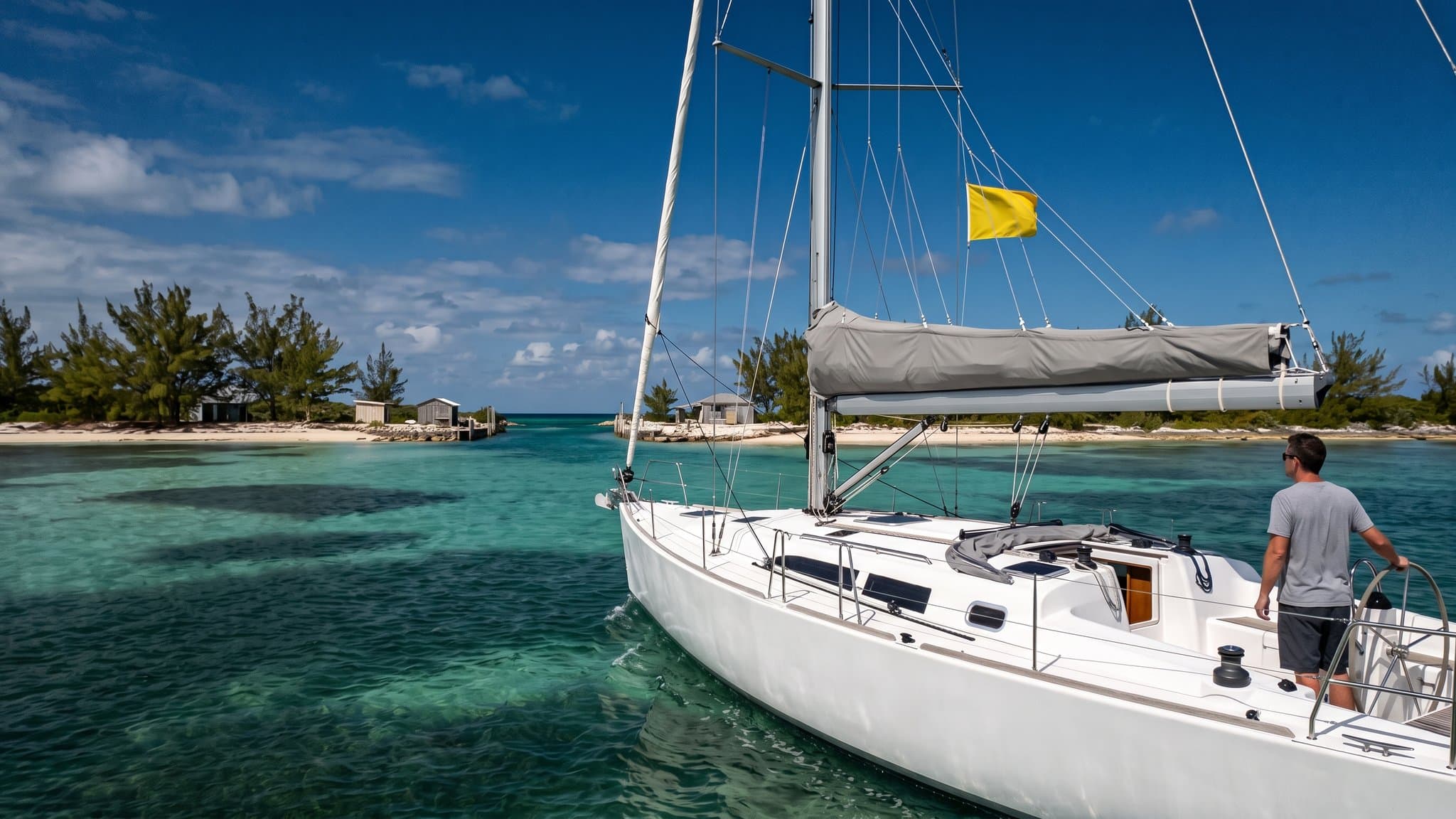
- Enter at one of the 32 designated Ports of Entry, flying the yellow quarantine flag.
- Only the captain may leave the boat until Customs and Immigration have cleared the vessel.
- Customs stamps and signs the permit and issues it. Every person on board also receives a Bahamas Immigration Card, which is a separate document from the permit.
Carry passports for everyone aboard and the vessel registration or title. A vessel over 50 feet must have AIS fitted and fully operational, transmitting at all times. Once payment has cleared you can reprint the permit from Search Inbound, which is the answer to a question a lot of people ask after the fact.
The 32 ports span thirteen island groups, from Abaco and Bimini in the north to Inagua in the far southeast. Clearing in at the first one you reach is the rule, not the nearest one to where you are going.
Why does a 12-month cruising permit not let you stay 12 months?
A cruising permit is a Customs document about the vessel. Permission for the people aboard to remain is a separate decision made by the Bahamas Department of Immigration, and on a first entry Immigration commonly stamps only 30 days regardless of how long the permit runs.
Extending means going back to a Port of Entry Immigration office in advance rather than after the stamp expires. The extension fee is $200 and non-refundable, and it is charged per person, not per vessel. Renewals run in increments up to an eight-month maximum stay for a non-resident.
The structural fact underneath this is what makes it predictable rather than unlucky. Immigration's permits are not coordinated with the Department of Customs. Two agencies issue two documents on two clocks, and a 12-month permit in the ship's papers tells you nothing about how long the people holding it may stay. Plan the crew's dates and the boat's dates as separate problems.
What should you settle with your insurer before you leave, and in what order?
Settling cover for a Bahamas crossing is four things done in a fixed order, and three of them have to close before the boat leaves the dock. The order matters more than the individual steps, because each one is a precondition for the next.
- Declare the waters in the words the questionnaire usesThe underwriter's quote questionnaire carries a field headed WATERS TO BE NAVIGATED alongside the home port. The cruising ground is a rated field on the form, not a conversation you have later. This is where a Bahamas season is either on the schedule or is not.
- Answer the box question honestly, because it is asked by dateThe same questionnaire asks whether the vessel will be located between 12 degrees 40 minutes and 23 degrees 30 minutes North, and 55 to 85 degrees West, during the period 1 July to 1 November. It is a dated screening question rather than a chart of where you may go. How you answer it decides the rating and whether the hurricane-plan condition attaches.
- Get any extension endorsed, not agreed verballyLimits can normally be extended by agreement before you leave. Our Caribbean page carries that mechanism in full, including the clause reference and what a declined claim looks like when the order is reversed.
- Match the dates, not just the geographyA limit extended for a February crossing does not cover a boat still sitting there in September. The season and the schedule are two separate dates and both of them are on the form.
Step three is the one with a mechanism behind it, and we have written that mechanism out on our Caribbean yacht insurance page rather than repeat it here.
There is a fifth thing, and it is the one almost nobody connects to a cruising permit. The policy wording we hold carries a general condition warranting that covered persons operating the insured vessel must comply at all times with any and all local laws and regulations governing vessel operation. Read against the section above, that turns every formality on this page from administration into contract. Cruising Bahamian waters without a valid permit, or running a vessel over 50 feet without a functioning AIS, is not simply a matter of a fine from the authorities. It touches a warranty in the policy.
On what a US domestic policy typically reaches, we would rather point at a published figure than imply one of our own. Motor Boat and Yachting reports one published coverage territory of 75 miles offshore of the Lower 48, with a Bahamas option raising it to 150 miles offshore of a contiguous United States or Bahamian shore. That describes one carrier's published product. It is not a description of ours, and no mileage or latitude on this page should be read as a limit we offer.
For how the named carriers compare on cruising territory, our best yacht insurance companies guide carries the survey.
We are an introducer and not an insurer, so none of this is a statement about what any particular policy does. It is not financial advice. Your Confirmation of Cover is the only document that decides what you actually hold, and it is worth reading before you file the Inward Declaration rather than after.
Where will your boat sit in September, and what does that do to your deductible?
Where the boat physically sits between July and November is a rated fact on the underwriter's questionnaire. In the Bahamas that question does not have one answer, because the line the underwriter asks about runs through the middle of the islands.
Longitude is not the constraint. The whole archipelago sits between roughly 72 and 79 degrees West, comfortably inside the 55 to 85 degree West span the form asks about. Latitude is the constraint, and the northern edge of that box, 23 degrees 30 minutes North, crosses the Bahamas.
George Town, Great Exuma, the classic winter cruiser rendezvous, sits at about 23 degrees 31 minutes North. It clears the line by roughly one arcminute, which is one nautical mile. Freeport is at 26 degrees 32 minutes North and Governor's Harbour at 25 degrees 12 minutes, so the northern and central Bahamas, where the overwhelming majority of visiting US cruisers actually go, fall well outside the box. Matthew Town on Great Inagua, at 20 degrees 57 minutes North, falls inside it.
Two things keep that honest, and both of them matter more than the coordinates. Those figures are a dated screening question used to rate the risk. They are not a geographical exclusion and not a promise about where cover reaches. And the named-windstorm deductible clause itself is geography-free: it fires wherever a named storm does, so being north of a line on a form is not the same as being outside the weather. The Atlantic hurricane season runs 1 June to 30 November and peaks around 10 September, and it does not consult the form.
The practical upshot is a planning fact rather than a coverage promise. Two boats in the same country, six hundred miles apart, will answer the same form question differently, and will be rated differently for it.
Named-windstorm cover carries a 10% deductible and requires a signed hurricane plan. On a $400,000 agreed value, that deductible is $40,000. Our guide to the named-windstorm deductible explains how the 10% is calculated and the part of the clause that applies on a total loss, and our Caribbean hurricane season guide carries the season data itself.

The hurricane plan is a condition, not a formality, and for a Bahamas season it is the piece owners most often leave until last. We publish a generator that drafts one, because the alternative is an owner guessing at what the document has to contain.
If you are heading to the islands for a season rather than a fortnight, our boat hurricane plan generator produces the document that condition asks for.
What does clearing back into the United States require?
Arriving back in the United States from a foreign port, the master of a small pleasure vessel must report to US Customs and Border Protection immediately. The CBP ROAM app is the free way to do it from the boat.
- The obligation is statutory, under 19 CFR 4.2 and 19 U.S.C. 1433, and applies on arrival from any foreign port or place.
- The Small Vessel Reporting System is retired and float plans are no longer accepted. A good deal of published advice still tells boaters to file one.
- CBP ROAM is free, requires a login.gov account, and qualifies as an Alternative Inspection System satisfying the face-to-face requirement under 8 CFR 235.1. There are exceptions, including anyone who must be issued an arrival and departure record and anyone who owes duty.
- A private vessel 30 feet or over entering the United States needs an annual User Fee Decal, obtained on form 339V through DTOPS. Without one there is a non-refundable $27.50 user fee per arrival.
- Leaving a US port into international waters without calling at a foreign port does not count as departing. That is the cruise-to-nowhere rule, and it catches people who assume a day offshore resets something.
- On the Bahamian side, outbound clearance on Form C28A costs $75 and is required only if you need clearance documents at your next port outside The Bahamas.
Cruisers commonly report being hailed by the US Coast Guard on Channel 16 within sight of land on the way back in. That is what people describe rather than a published rule, but it is worth expecting.
What goes wrong most often, and how do you avoid it?
- Confusing the Frequent Digital Cruising Card with a cruising permitThe $1,500, $2,500 and $8,000 figures that circulate as the new fees are the two-year unlimited-entry card, not a permit. Google's own AI Overview blurs the two.
- Reading the wrong government pageThe government services portal still publishes only the 12-month tier and an outdated anchorage schedule, and still heads its table as including a fishing permit. The Customs Department page is the operative one.
- Searching for the wrong form nameThe Customs Department calls the inward declaration Form C2A. The services portal files the same PDF as C7a. They are the same document. The permit issued on approval is Form C39, and outbound clearance is Form C28A.
- Assuming the fishing permit lasts as long as the cruising permitIt runs 30 days regardless, even on a 12-month permit.
- Assuming re-entry is freeA 30-day permit carries no free re-entries.
The stale page is the government services portal listing, which is worth seeing so you recognise it when a search result sends you there.
One more worth naming, because it is live right now. At least three trade restatements print the Frequent Digital Cruising Card bands under a heading about fishing permit fees. The Bahamas Customs Department publishes fishing permits at $100 under 50 feet and $300 at 50 feet and over. If a page shows you $1,500 for a fishing permit, it has crossed two tables.
Sources
- Bahamas Customs Department, pleasure vessel clearance and cruising permits
- Bahamas Ministry of Tourism, Investments and Aviation, cruising permit and anchorage fees effective 1 April 2026
- The Bahamas, official boating regulations for visiting vessels
- Bahamas Customs Department, Ports of Entry
- US Customs and Border Protection, pleasure boat overview
- US Customs and Border Protection, ROAM
- US Customs and Border Protection, user fee decal
- National Hurricane Center, Atlantic hurricane climatology
Fees read on 25 August 2026. The Bahamas fee schedule changed on 1 April 2026 and is expected to change again, so check the Customs Department page against the date above before you budget a trip.
Who we are, and what this page is not
World Yacht Insurance is a yacht-insurance introducer arranging hull and liability cover up to $5M for sail and motor yachts worldwide, including the Caribbean, placed in the London market through London Marine Insurance Services Ltd, a Lloyd's-accredited broker.
We are not an insurer and we do not carry risk. Our how it works page sets out the full chain and the regulatory disclosure behind that sentence.
This page states entry formalities and general policy terms as they were published on 25 August 2026. It is not financial or legal advice, and it does not replace your own Confirmation of Cover, which is the only document that decides what you hold.
- $150 to $600
- A 30-day cruising permit, by vessel length band
- $200
- Per person, non-refundable, to extend an Immigration stay
- 32
- Designated Ports of Entry, across thirteen island groups
Frequently asked questions
1.How much is a cruising permit in The Bahamas?
+
A 30-day permit runs $150 up to 30 feet, $250 from 30 to 50 feet, $350 from 50 to 100 feet and $600 above 100 feet. Longer tiers and the two-year Frequent Digital Cruising Card cost more and carry free re-entries. These fees took effect on 1 April 2026 under Regulation 91.
2.Is Click2Clear mandatory for a Bahamas cruising permit?
+
No. Official guidance calls online pre-registration the preferred and easiest route, and a boater may still complete the paperwork in person on arrival. Either way everyone must present to Customs and Immigration at a designated Port of Entry. Filing online does not replace the visit, and the permit is not legalised until an officer stamps and signs it after payment.
3.How long can I stay in The Bahamas on a 12-month cruising permit?
+
The permit governs the vessel, not the people aboard. Immigration commonly stamps 30 days on a first entry regardless of how long the permit runs. Extending costs $200 per person, is non-refundable, and must be applied for in person and in advance, up to an eight-month maximum for a non-resident.
4.Is the Bahamas cruising permit form C2A or C7a?
+
Both names refer to the same document, the Inward Declaration and Application for Cruising Permit. The Bahamas Customs Department calls it Form C2A, while the government services portal files the same PDF under C7a. The permit issued on approval is Form C39, and outbound clearance is Form C28A.
5.Does a US boat need AIS to enter Bahamian waters?
+
Every foreign vessel over 50 feet in Bahamian waters must carry AIS, fitted and functioning, transmitting at all times whether docked, under way or transiting. The regulation carries a fine of up to $1,000 on summary conviction, for the owner and the master. Under 50 feet it is not required.
6.Do I have to check in with US Customs when I come back from the Bahamas?
+
Yes. The master of a small pleasure vessel arriving from a foreign port must report to US Customs and Border Protection immediately, under 19 CFR 4.2 and 19 U.S.C. 1433. The CBP ROAM app is the free way to do it from the boat. The Small Vessel Reporting System is retired and float plans are no longer accepted.
7.My crew is flying in and sailing home with me. What does that change?
+
A traveller arriving by air and leaving by boat should hold a return ticket. If they arrive on a one-way ticket, the boat's owner or operator must present themselves and the vessel's cruising permit at Immigration. A copy of the permit is accepted for crew whose names appear on the manifest. A letter is not accepted.
Ready for a worldwide yacht insurance quote?
Send us the yacht and cruising area. London Marine Insurance Services returns Lloyd's-market terms within about 24 hours.
- No obligation
- every underwriting question asked upfront
- a licensed Cyprus agent reviews every enquiry
Also on WhatsApp, Telegram and Viber