
Boat Insurance for Older Boats: Who Writes Them, and What a Claim Pays
Boat insurance for older boats is decided by length, hull material and use, not by the year on the hull plate. Age triggers a survey at about 20 years. What closes the door on a still-cruising 40-year-old boat is usually length, not age.
Three routes exist for a hull this old, and the one that fits is set by how long the boat is and how you use it.
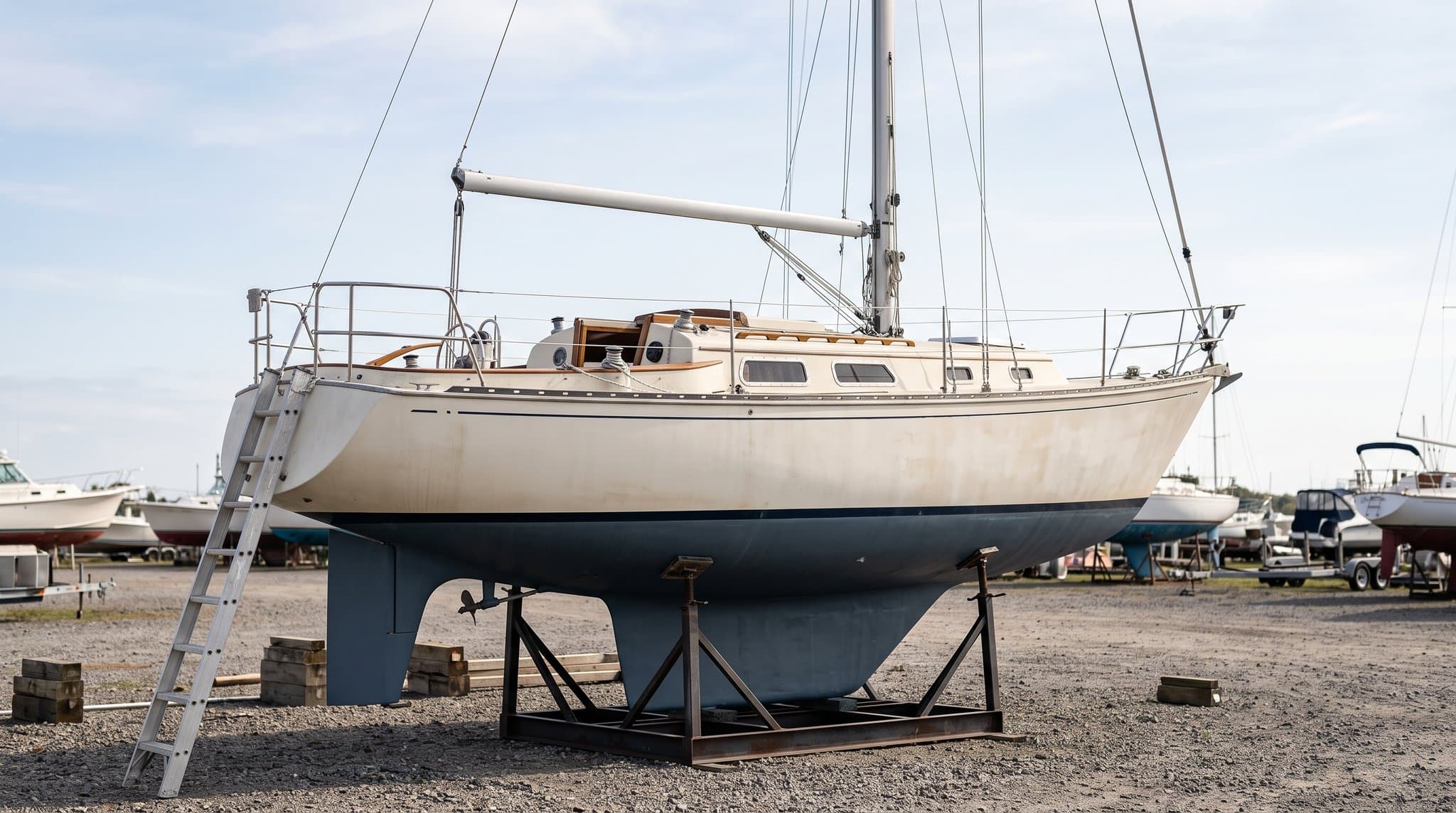
Insuring a yacht of your own?
Tell us the boat, its value and where it cruises. We come back with Lloyd's-market terms, usually inside 24 hours.
What this covers
An older cruising boat and a collector boat are two different insurance products. A collector or classic program is built for a limited-use, often wooden or early-fiberglass boat kept for shows and short outings. A still-cruising boat is an ordinary hull risk, and the question is which market writes a hull that old at your length.
Key takeaways
- Age triggers the survey request at about 20 years as this desk places the risk, and the Survey Requirement clause in the London Marine Insurance Services wording then decides the terms.
- Owners search on 40 and 50 years. The bands carriers actually publish are over 20 years, 25 to 40 years, and 40-plus.
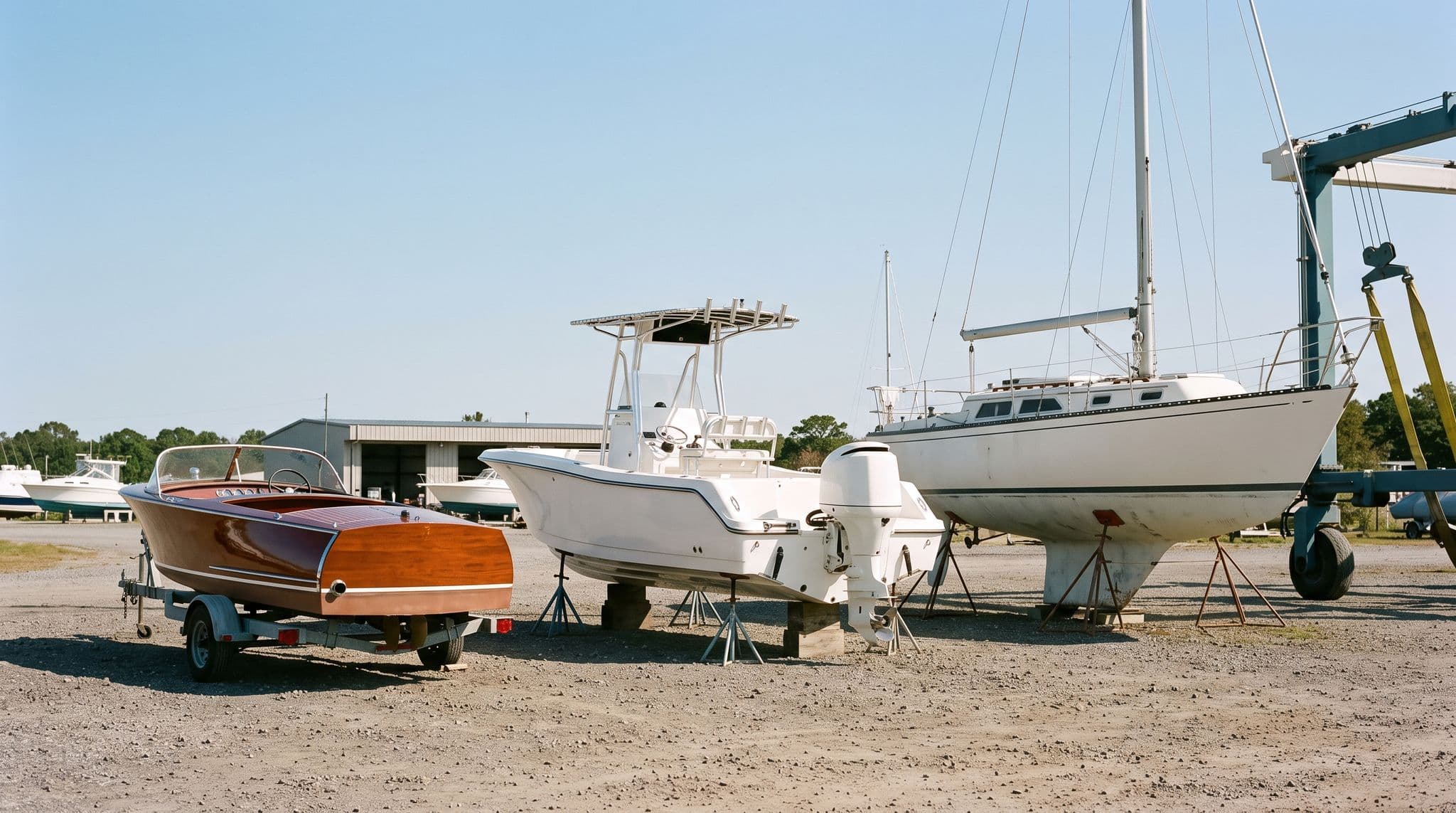
- Collector programs publish length ranges, not just vintages: runabouts at 14 to 33 feet, utilities at 12 to 30 feet, launches at 16 to 30 feet, with an out-of-water survey for sailboats over 26 feet.
- One mass-market boat program publishes a 26-foot ceiling and states that all ages of boats fall inside it, which is why a 42-foot 1985 cruiser fails on length while a 22-foot 1975 runabout does not.
- Repairs to a plywood, fiberglass or metal hull are made by applying suitable patches to the damaged area, and where planking has to be replaced the insurer may elect any suitable alternative hardwood or softwood.
- World Yacht Insurance arranges cover placed in the London market through London Marine Insurance Services Ltd, a Lloyd's-accredited broker, on an agreed-value basis up to $5M.
Reviewed by Costas Matheou, licensed insurance agent (Cyprus). Verify his licence and credentials Last updated 19 August 2026. Sources last verified 18 August 2026.
Sourced numbers on this page
About 20 years
The hull age at which an in-force marine survey is required before cover attaches.
Underwriting practice as this desk places the risk; the Survey Requirement clause is the in-force warranty in the LMIS wording
40-plus years
Where a reader survey put the insurability tipping point for most companies, and as low as 15 years for some.
Practical Sailor reader survey, page updated February 202512 of 24
Yacht and boat insurers reported to have left the market in the couple of years before early 2023.
Power & Motoryacht, published January 2023Over 7,000
Vessels displaced in Florida after Hurricane Ian, with over 2,100 assessed on state waters.
Florida Fish and Wildlife Conservation Commission, October 2022s.55(2)(c)
The statutory exclusion for ordinary wear and tear, inherent vice and machinery damage not caused by maritime perils.
Marine Insurance Act 1906, legislation.gov.uk1% to 1.5%
Of the agreed value a year, the typical band for hull and liability cover on a cruised boat.
London Marine Insurance Services indications, 2026
How old is too old for boat insurance?
There is no age at which a boat becomes uninsurable. Age moves a boat from no conditions, to a survey condition, to a shorter list of markets. In practice, a vessel over about 20 years old needs an in-force marine survey before cover attaches, as this desk places the risk. The Survey Requirement warranty in the wording we place through is what then holds the survey in force.
Beyond roughly 40 years the constraint stops being the survey and becomes which programs still quote at all.
A reader survey by Practical Sailor put the insurability tipping point at 40-plus years for most companies, and as low as 15 years for some. That spread is the real answer to the age question: there is no industry threshold, only each market's own appetite.
| Boat age | What changes | Who calls it what |
|---|---|---|
| Under about 20 years | No automatic survey trigger in the wording we place through | Ordinary pre-owned boat |
| About 20 to 40 years | In-force survey required before cover attaches, recommendations closed out | Classic opens at 25 years in one carrier's own bands |
| Over 40 years | Survey plus a shorter list of markets, and length starts to govern | Antique in carrier language, Classic from 1943 to 1975 in the collector taxonomy |
The collector world runs a separate system, and its numbers land close to the underwriting ones by coincidence. The Antique and Classic Boat Society classes boats as Historic up to 1918, Antique from 1919 to 1942, Classic from 1943 to 1975, Late Classic from 1976 to twenty-five years ago, and Contemporary for any wooden boat built in the last twenty-five years. That is a judging taxonomy for shows. No underwriter is bound by it.
What a survey has to show, what it costs and how fast recommendations must be closed out are all in our guide to yacht survey requirements for insurance. Age triggers the request; that guide covers what happens next.
Why do mass-market carriers decline older boats?
Because their programs are bounded by length and value before age is considered, and a still-cruising older boat is usually long enough to fall outside them.
One mass-market boat program publishes cover for watercraft up to 26 feet and states that all ages of boats fall into that program. Read those two facts together and the age story collapses: the boat is not too old for the program, it is too long for it, and the yacht market it gets routed to has its own appetite.
Two other things get blamed on age.
One is tenure, and Practical Sailor's reader survey found that an owner applying as a new client with a 40-plus-year boat has more difficulty than an established client with the same boat, no matter what the survey report indicates. The boat did not change. The relationship did.
The other is the step-up rule. Power & Motoryacht reported that underwriters balk when a buyer moves up more than 10 to 12 feet from their last boat, and that the old workaround of carrying a qualified captain for a season has largely closed. Experience on the specific size of hull matters more than the certificate.
Behind both sits a smaller market than there used to be. The same report counted about 12 of 24 yacht and boat insurers leaving the market in the couple of years before early 2023, after storm losses. Florida's own Fish and Wildlife Conservation Commission recorded over 7,000 displaced vessels after Hurricane Ian, with over 2,100 assessed on state waters. A market absorbing losses on that scale tightens its rules on the boats it understands least. A 40-year-old hull with no survey on file sits at the front of that queue.
None of that is a criticism of those carriers. Their programs are built for a different boat, and an owner is better off hearing it than being told the door is open.
Who insures boats over 40 years old?
Three routes, not three brands. A collector or classic program, if the boat is used lightly and fits published length and vintage limits. The ordinary recreational market, if the boat is inside a program's length ceiling. A specialist or Lloyd's-market route reached through a broker, which is where a boat that is still cruised and longer than those ceilings gets placed.
| Route | Built for | Published limits | Settlement basis offered | A still-cruising 1985 42-footer |
|---|---|---|---|---|
| Collector program (Hagerty) | Collectible boats used lightly, shown and stored | Collectible fiberglass older than 1990; runabouts 14 to 33 ft, utilities 12 to 30 ft, launches 16 to 30 ft; out-of-water survey for sailboats over 26 ft | Agreed value, and the program distinguishes it from stated value, which pays only up to the insured figure | Outside the published length ranges, and cruising use is not what the program is for |
| Collector program (Grundy) | Antique and classic boats, restored or preserved | Collector eligibility with agreed value and no depreciation applied | Agreed value | Same length and use problem |
| Older-fiberglass specialist (Keane Specialty) | Fiberglass boats 25-plus years old | Addresses older fiberglass specifically, by age rather than by show class | Program-dependent | Possible on age, still bounded by the program's own limits |
| Mass-market boat program (Markel, GEICO) | Small recreational boats, trailered and coastal | Up to 26 ft for the boat program, with all ages of boats inside it (Markel); carrier age bands over 20, 25 to 40, and 40-plus (GEICO) | Replacement cost only up to three years of age, actual cash value thereafter (Markel) | Fails on length before age is reached, and is routed to a yacht program |
| Lloyd's market via a broker (this desk) | Cruising sail and motor yachts, including older hulls, worldwide | Hull and liability up to $5M in-house, larger risks placed in the Lloyd's of London market; survey required over about 20 years | Agreed value, fixed at inception | This is the route it fits, placed on a non-admitted basis for a US-domiciled owner |
Every limit in that table comes from the publisher's own page. We name them because an owner needs to recognise which door is theirs. Most 40-year-old boats that fail on both of the first two routes fail on length, not on the year.
For a US owner the placement is non-admitted, which is the surplus-lines basis, and it is never an admitted US policy. The regulated party is the broker, not us: cover is arranged and placed at Lloyd's of London by London Marine Insurance Services Ltd, authorised and regulated by the Financial Conduct Authority under firm reference 308599.
If hull cover cannot be found at a value that makes sense, liability-only is the honest fallback. It pays for damage the boat does to other people and their property, and nothing toward the boat itself. Many marinas and yards accept it as proof of insurance, so the berth stays available while the hull question is worked out.
For how the named markets compare across the whole field, see our guide to the best yacht insurance companies.
What does an older-boat claim actually pay for?
It pays to put the damaged part back into use, by the method the wording allows, and not to bring an aged boat up to new condition. Three clauses in the London Marine Insurance Services yacht wording we place through decide that, and they matter far more on a 40-year-old boat than the headline sum insured does.
Repair method
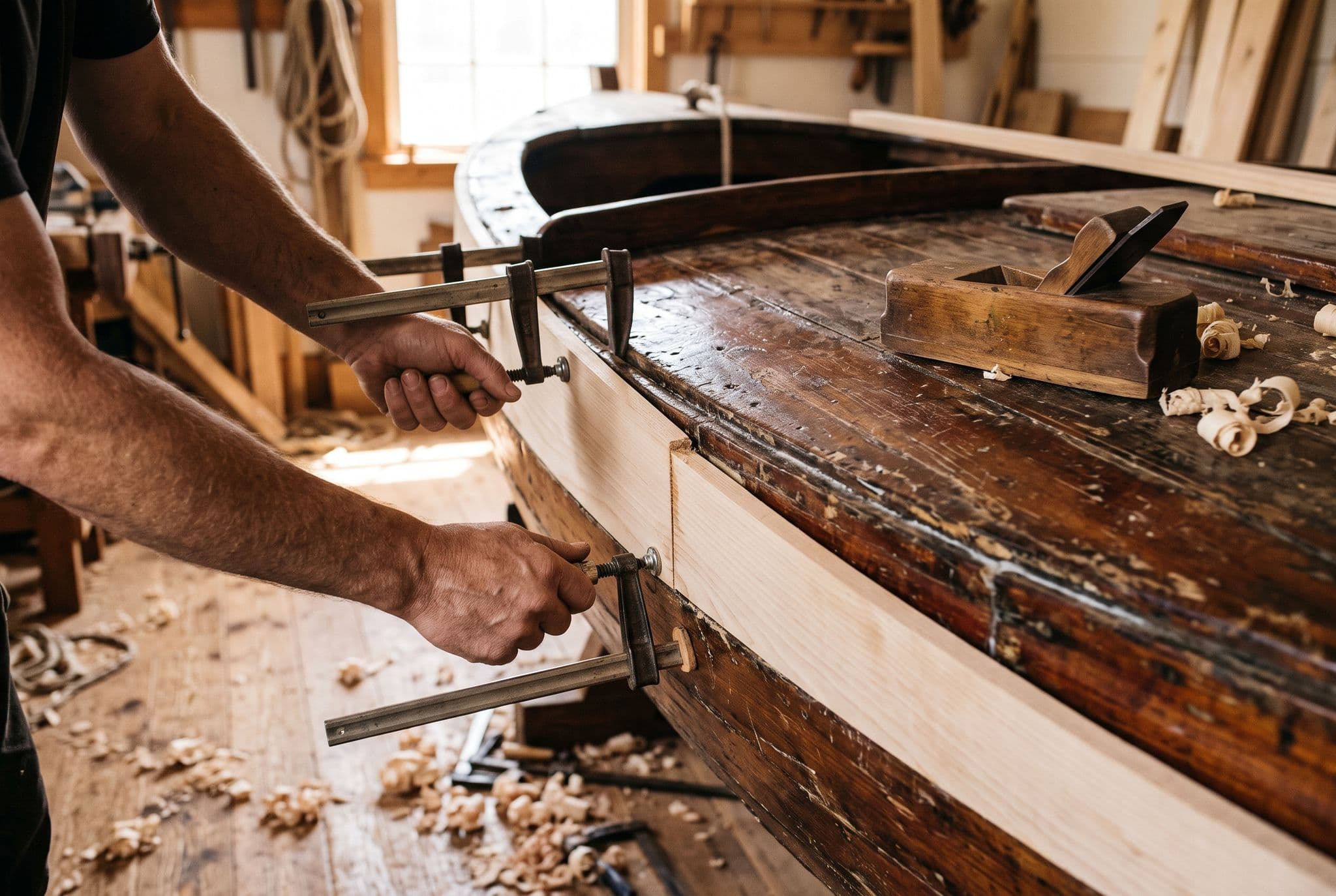
Where a hull is plywood, fiberglass, metal or similar, repairs following a recoverable loss are made by applying suitable patches to the damaged hull area, in accordance with generally accepted appropriate repair practices. A patch, correctly done, not a new section of hull.
Substitute timber
If damage to the vessel or its equipment requires the replacement of planking or wood, the insurer has the option to elect that the repair uses any suitable alternative hardwood or softwood. Anyone expecting original-species timber on a 1953 mahogany hull should read that clause while the boat is still in one piece.
Finish
The policy does not cover the cost of painting or impregnating colour beyond the immediate damaged area. On a faded or hand-finished surface, you will see exactly where the repair stops.
Source: repair-method, substitute-timber and finish provisions quoted from the London Marine Insurance Services yacht policy wording, clauses and endorsements held at this desk.
Statute rules some losses out entirely, whatever the policy says. The Marine Insurance Act 1906, section 55(2)(c) provides that the insurer is not liable for ordinary wear and tear, ordinary leakage and breakage, inherent vice, loss caused by rats or vermin, or injury to machinery not proximately caused by maritime perils. The wording we place through excludes the same family, plus one more: a claim for unrepaired damage is excluded where the vessel later becomes a total loss from an insured peril in the same period.
For the full exclusion family, including gradual deterioration and osmosis, see what yacht insurance does not cover. For what the boat is valued at when it settles, see agreed value versus actual cash value.

The repair-method clauses sit in the wording held at this desk, and on an older hull they decide what a claim actually pays. We read them straight off the document when an owner asks, because a broker summary tends to stop at the sum insured, and the option to substitute timber almost never appears in one at all.
What makes an older boat insurable?
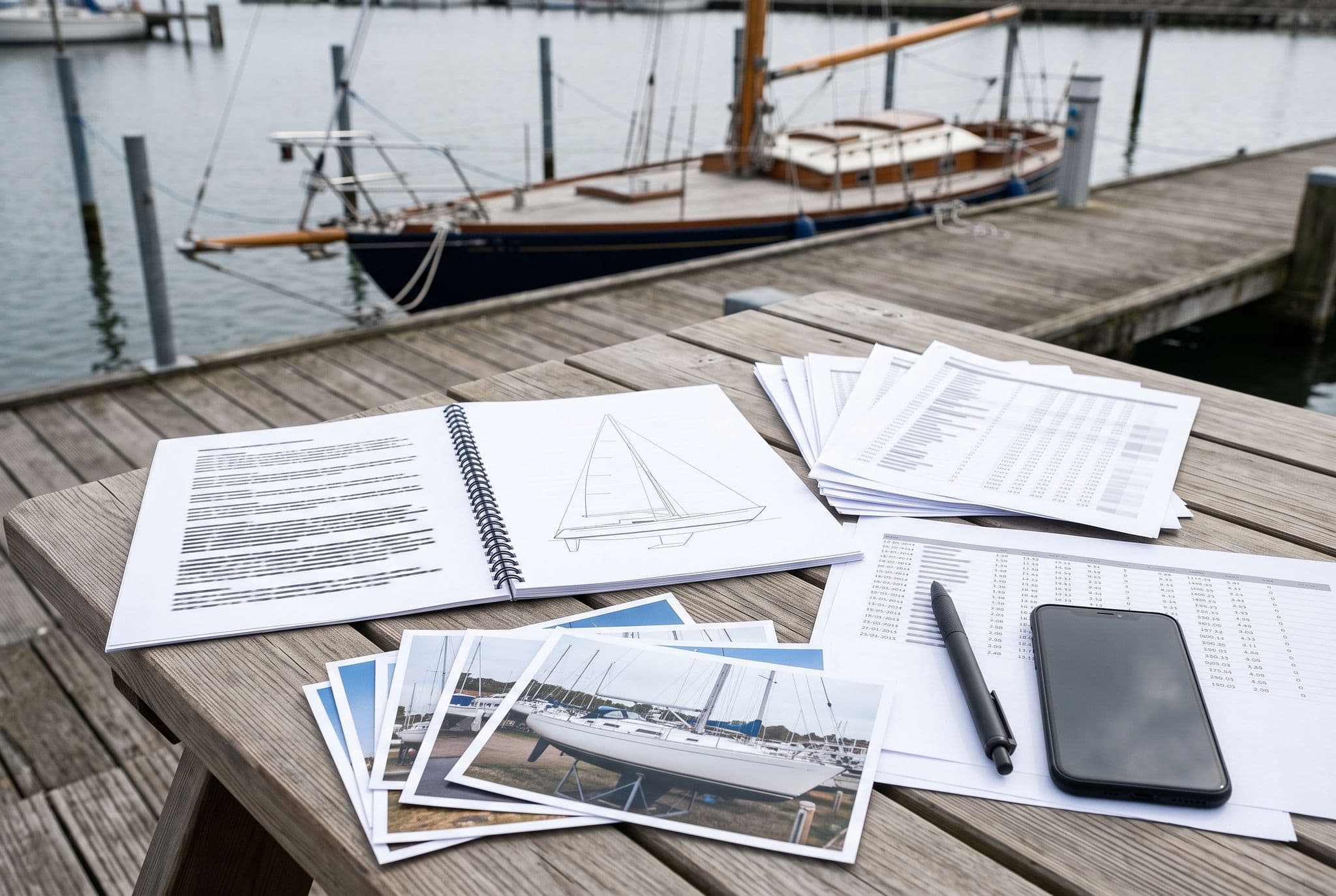
Condition on paper. Underwriters cannot see the boat, so they read the documents, and every item below is something an owner can assemble before applying rather than after being declined.
- 1Get an in-force insurance survey from an accredited surveyor before you apply. The National Association of Marine Surveyors and the Society of Accredited Marine Surveyors both list qualified members, and our survey requirements guide covers what the report must show.
- 2Close out every recommendation in writing and keep the evidence. The wording warrants that the survey is in force and that the surveyor's recommendations have been complied with, which means an open recommendation surfaces at claim time, when it is too late to fix.
- 3Expect a survey at any age on a wooden or metal hull. Condition governs on those materials and the year barely matters, which is set out on our agreed value check.
- 4On a sail boat, declare the standing rigging age and the date of any re-rig. Offshore work often carries a condition on rig age, covered on our sailboat insurance and bluewater and offshore pages.
- 5For a motor boat, expect an engine survey or oil analysis on an older or high-hour installation, and have the service history ready. Details sit on our motor yacht insurance page.
- 6Keep invoices for the refit, the repower and the rewire. Estimates do not carry the same weight, and that paperwork is what supports an agreed value on an old boat, as our agreed value check sets out.
- 7Do not let cover lapse, and go to a broker instead of a single carrier's agent. An agent sells one appetite. A broker searches several, which is what the tenure and parameter effects above reward.
Practical Sailor's survey of owners found that underwriters rely completely on the survey report, and that the more restrictive policies ask for a specific rig inspection. Boats of this vintage were not built to current standards, so a surveyor reads the wiring, the plumbing and the through-hulls against guidance such as the American Boat and Yacht Council standards.
Does the boat's age change the settlement basis?
Yes, and this is where age costs real money rather than paperwork. Agreed value fixes the payout at inception and pays that figure on a total loss. Actual cash value pays market value on the day of loss after depreciation, and on an old boat those two numbers diverge sharply.
An agreed-value policy is a valued policy under the Marine Insurance Act 1906, section 27, and the fixed value is conclusive between the parties. Age also changes the point at which a boat is written off instead of repaired, because a constructive total loss is tested against the value of the boat when repaired. Depreciate that value and the write-off point arrives sooner.
We work the arithmetic on both bases, including a partial loss, in agreed value versus actual cash value, and you can sanity-check your own figure with the agreed value check.
One caution: some policies hold the hull at agreed value while depreciating equipment past a set age. Read the equipment clause, not just the hull sum.
How much does boat insurance for older boats cost?
Published figures for older boats span two orders of magnitude, and the reason is that they describe three different products rather than one negotiable price.
| Regime | Typical published figure | What the figure describes |
|---|---|---|
| Collector or seasonal use | About $100 to $150 a year liability-only, and $300 to $1,000-plus comprehensive under 30 feet | Limited use, low agreed value, stored much of the year |
| Mass-market small older boat | About $200 to $500 a year | Small, often trailered boat through an auto-style carrier |
| Agreed-value cruising yacht | 1% to 1.5% of the agreed value a year | Hull and liability on a cruised boat, agreed value fixed at inception, worldwide navigation by arrangement |
The middle row is the figure most owners have seen quoted, and where it comes from is set out on our liveaboard insurance page.
On the third row, a $150,000 agreed value runs about $1,500 to $2,250 a year before area and use loadings. Cruising inside the Atlantic hurricane box adds the named-windstorm deductible of 10% with a signed hurricane plan, which moves the number an owner actually carries far more than the rate does.
How the premium is built up is in our guide to how much yacht insurance costs, and you can run a value through the cost calculator.
These are indications from the market we place into, not quotes, and this is general information rather than financial advice.
What can we not place, at any age?
Some risks sit outside this market whatever the survey says, and age is not what decides them.
- Trimarans, ferro-cement hulls and high-performance cigarette boats are not written here, new or old.
- Named-windstorm cover in the Atlantic hurricane box requires a signed hurricane plan and carries a 10% deductible.
- In Cuban, Colombian, Venezuelan and Haitian waters cover is placeable on modified terms, with all deductibles doubled and with confiscation, piracy and theft carved out, theft being coverable where the boat is moored in a commercial marina agreed in writing beforehand.
Sail-specific rig conditions sit on our sailboat insurance page and machinery conditions on the motor yacht insurance page. Who carries the risk and who pays a claim is set out on how it works.
Eligibility gets read before a submission goes anywhere, and on an older boat that means the hull material and the condition rather than the year on the paperwork. Where those put a boat outside what our market writes, we say so in the first conversation instead of letting an owner wait on an answer we can already see coming.
Older boats: frequently asked questions
1.Who insures boats over 40 years old?
+
Three routes rather than three brands: a collector program if the boat is lightly used and inside its published length and vintage limits, the ordinary recreational market if the boat is inside a program's length ceiling, and a specialist or Lloyd's-market route through a broker for a boat that is still cruised and longer than those ceilings. A 40-year-old boat over about 33 feet usually falls outside the first two on length, not on age.
2.How much does it cost to insure an old boat?
+
It depends which of the three regimes the boat sits in. Collector and seasonal cover is published from about $100 to $150 a year liability-only. Small older boats through auto-style carriers run about $200 to $500 a year. An agreed-value cruising yacht runs 1% to 1.5% of the agreed value a year. These are indications rather than quotes.
3.Is engine failure on an old boat covered?
+
Sudden accidental damage from a covered event is insured. Mechanical breakdown and wear from age are not. Machinery failure sits among the leading contributing factors in the United States Coast Guard recreational boating statistics, which is why wordings exclude it and why an engine survey or oil analysis is often asked for on an older installation.
4.Does one refusal mean the boat is uninsurable?
+
No. Underwriters set parameters and a broker searches for the underwriter whose parameters fit the boat. Practical Sailor's survey also found that continuity of cover helps, since an existing client with the same boat is an easier risk than a new applicant with it, and that some underwriters recognise a well-kept heritage boat identified as such by the survey report.
5.Will a captain's licence or a logbook make an old boat easier to insure?
+
Reported as little help. Power & Motoryacht found that a six-pack or OUPV certification does not move placement much and that logbooks are discounted as easily faked. What underwriters weigh is ownership history on a comparable size of boat, which is the same mechanism behind the step-up rule.
6.Will an old wooden boat be repaired with original timber?
+
Not necessarily. Under the wording we place through, where damage requires the replacement of planking or wood, the insurer may elect any suitable alternative hardwood or softwood. Plywood, fiberglass and metal hulls are repaired by applying suitable patches to the damaged area, and painting beyond the immediate damaged area is not covered. Wood and metal hulls also draw a survey at any age.
Sources and how we name carriers
World Yacht Insurance is a yacht-insurance introducer arranging hull and liability cover up to $5M for sail and motor yachts worldwide, including the Caribbean, placed in the London market through London Marine Insurance Services Ltd, a Lloyd's-accredited broker. The full chain, and who pays a claim, is on how it works.
- London Marine Insurance Services yacht policy wording, clauses and endorsements, held at this desk: Survey Requirement, repair method, substitute timber and finish provisions, and the hull exclusions.
- Marine Insurance Act 1906, sections 27 and 55(2)(c), legislation.gov.uk.
- Florida Fish and Wildlife Conservation Commission, Hurricane Ian vessel recovery release, October 2022.
- United States Coast Guard recreational boating statistics, 2024.
- Antique and Classic Boat Society boat classifications; National Association of Marine Surveyors; Society of Accredited Marine Surveyors; American Boat and Yacht Council standards.
- Practical Sailor reader survey on insurance for older sailboats, page updated February 2025; Power & Motoryacht on insuring older boats, published January 2023.
- Carrier limits in the route table are taken from each carrier's own published pages. We name carriers so an owner can recognise which market fits, and we do not link to them.
Reviewed by Costas Matheou, licensed insurance agent.
Last updated 19 August 2026. Sources last verified 18 August 2026.
Coverage terms, premiums and deductibles on this page are indicative and not financial advice. Cover is subject to underwriting, survey and the policy wording.

Get terms on an older boat
Send the boat's age, length, hull material and the date of the last survey, and we will tell you which of the three routes fits before anything goes to an underwriter.
- No obligation
- every underwriting question asked upfront
- a licensed Cyprus agent reviews every enquiry
Also on WhatsApp, Telegram and Viber