
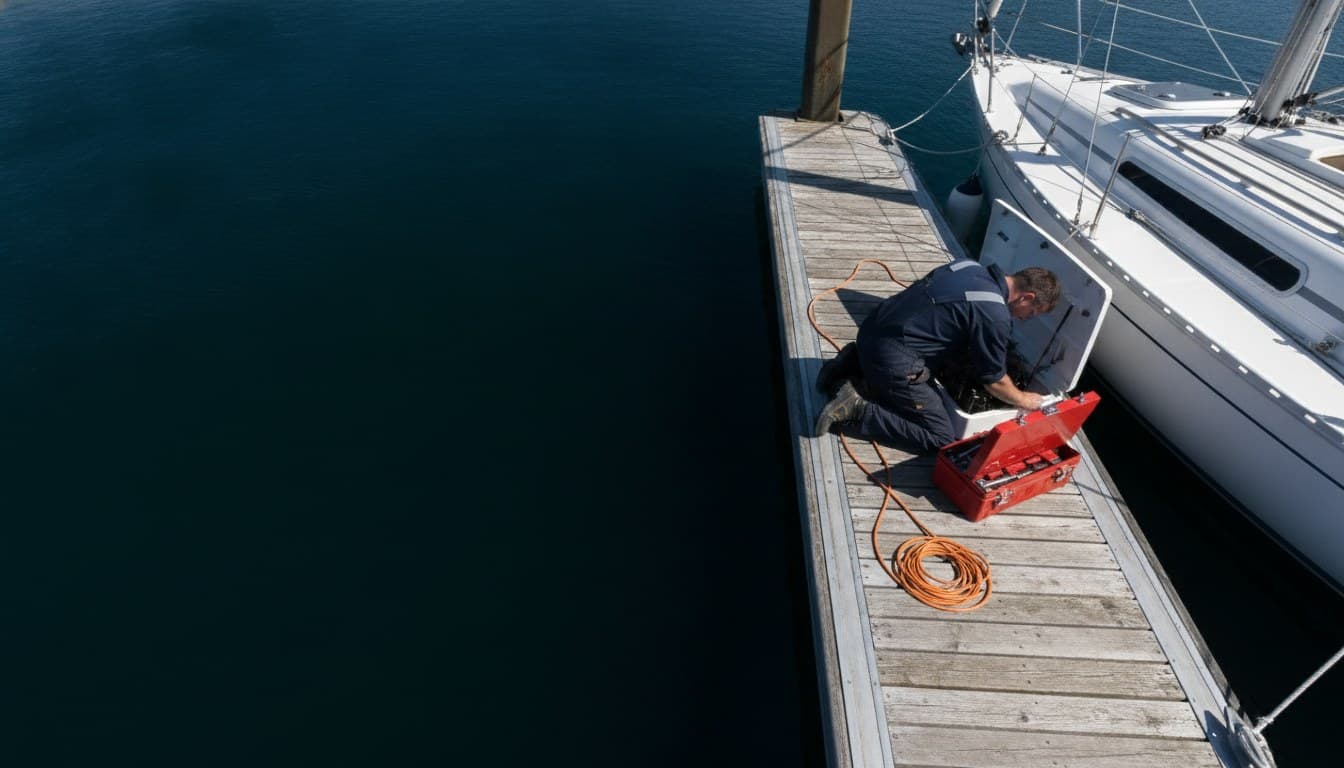
Mobile Marine Tradesman Insurance
Mobile marine tradesman insurance is public liability cover for a one-person marine trade that works on other people's boats. Our partner's scheme sets a six-point eligibility test and a £3m or £5m limit of indemnity, any one incident. All six conditions must be true. World Yacht Insurance introduces the enquiry and is not an insurer.
Written for the self-employed marine engineer, boat repairer, rigger, electrician, valeter and shrink-wrap operator who works out of a van on somebody else's site. This is a United Kingdom product line, and a United States resident enquiry falls outside it.
Take on an employee, take premises, or pass £100,000 of turnover, and you have moved product rather than lost one. Section two says where to go instead.
Reviewed by Costas Matheou, licensed insurance agent (Cyprus), ICCS certificate 6882. Last reviewed 29 August 2026.
6
Published conditions to meet. All six, not most of them
£3m or £5m
Limit of indemnity, any one incident, on the published schedule
£10m
The highest public liability a UK harbour publishes, and it is for hot works
None
UK statutes making public liability compulsory. The sites you work on do
Do you qualify? The six-point test
Our partner publishes a six-point eligibility test for this scheme and all six have to be true. Read down it and you will know in half a minute whether this is your product. Failing one is common rather than unusual, and it is useful information either way.
Almost no insurance page lets you disqualify yourself. This one does, because a quote request from a tradesman who was never eligible costs you a fortnight and costs the desk its credibility. Here is the test as the partner publishes it, word for word.
- 1
A mobile sole trader in the UK marine industry
Mobile, sole, and marine. A limited company with a director and no other staff is a different structure and needs to be declared as one, and work outside the marine industry is excluded outright.
- 2
No employees
Not one. This is the condition most often broken by accident: a mate helping for a busy fortnight, a school leaver over the summer, a friend's son on a lift day.
- 3
No business premises, working from the home address
A rented unit, a lock-up workshop or a yard bay is a premises. It changes the risk from a van and a set of tools to a building with other people's boats inside it.
- 4
Annual turnover of £100,000 or less
Turnover, not profit, and not what you drew. It is the figure the scheme is rated on and the one that moves you out of it.
- 5
No claims, incidents, convictions, bankruptcy or health and safety proceedings in the last 5 years
Wider than a claims history, and the condition people misread most. Incidents count whether or not anyone claimed, convictions are not limited to motoring, and health and safety proceedings are on the list in their own right.
- 6
Work on private pleasure craft up to 30 metres and commercial craft up to 24 metres in length
Both limits, not one. The 30 metre boat you were asked to look at in September is the job that takes you outside the scheme, so say so before you accept it rather than after.
Source: Topsail Insurance's published mobile marine tradesmen schedule, read 26 August 2026, under the heading "To Qualify for This Policy You Must", and Topsail Insurance's own news article of 14 May 2026, read 29 August 2026, which sets out the same six criteria in a different order. Two documents from one publisher, which is corroboration of a kind but not two independent sources, and we would rather say so.
All six, and the word is not "mainly"
Every condition is a gate rather than a preference. Condition 6 in particular is a hard length limit on both classes of boat, not a description of the work you usually take, and softening it into "mainly small craft" is the error an AI answer is currently making about this product. If one of the six is not true today, say which one in your first message and the desk will tell you what the right route is instead of quoting a policy you cannot hold.
Two exclusions published beside the test
- Non-marine work is excluded. If half your winter is domestic plumbing or joinery, that half is not part of this cover.
- There is no Construction Plant-hire Association extension under this policy. That sentence is short and it is the most expensive one on the page, so section five explains what it means.
The trades the partner names, with the exclusions written inside them
This is their own published list for this product, and the brackets are theirs, not ours. Three trades are cut down from inside rather than left off, which is the sort of detail that never reaches a summary.
- Boat repairs, service, maintenance, mechanical, electrical work and antifouling
- Gas installers, service and repair
- Moorings operators, maintenance, service and repair, excluding diving
- Painting and sign writing, excluding spraying
- Riggers, sailmakers and upholsterers
- Shrink wrapping
- Tuition, waterborne and land based
- Valeting and pressure washing, excluding shot blasting and sand blasting
- Yacht surveyors
Source: Topsail Insurance's own news article of 14 May 2026, read 29 August 2026.
What happens if you fail one of the six?
You have moved product, not lost one. The scheme is a small packaged policy for a defined one-person risk, and the moment your business stops being that shape it is rated somewhere else. Knowing which condition broke is most of the answer.
Our partner puts the same question on their own page as "what if I don't qualify, or if my business grows and I start employing staff?", which is the moment as their desk sees it. Here is what each condition means when it goes.
| The condition | What failing it means | Where it goes instead |
|---|---|---|
| Mobile sole trader in the marine industry | Non-marine work is excluded outright, so a mixed trade needs the marine half described separately. | Declare the split at enquiry. The desk will say whether the marine half stands alone. |
| No employees | The day you employ anybody, two things change at once: you are outside this scheme, and employers' liability insurance becomes compulsory by statute at £5,000,000. | The marine trade programme, which is written for a business with staff. |
| No business premises | A unit or a yard bay adds other people's boats stored under your control, which is a different exposure from a van and a tool case. | The marine trade programme, where premises cover sits beside liability. |
| Turnover £100,000 or less | Above it the scheme's rating does not reach you. It is not a penalty; it is the size the packaged product was built for. | The marine trade programme, rated on your account rather than off a scheme. |
| Clean 5 years | A claim, an incident, a conviction, a bankruptcy or a health and safety proceeding inside five years takes you off the fast route, but it does not mean nobody will write you. | A full market submission with the history explained by you rather than discovered later. |
| 30 m private and 24 m commercial | One job on a bigger boat can put a claim outside the cover you hold, and the limit applies at the moment of the work, not on average across the year. | Say what the largest boat is before you take the job. Bigger hulls are a different conversation. |
Five of those six rows point the same way. The trade with staff, premises, a bigger book or a bigger boat is the subject of marine trade insurance, which is the parent product this one sits under. It answers care, custody and control, faulty workmanship and employers' liability in full, and this page does not repeat it.
Growing out of a policy is not a reason to start again with a stranger. Send the change when it happens and the same desk moves the enquiry across, which is quicker than being declined at renewal and finding out why in October.
If the business has changed shape more than that, a school, a yard, a rental fleet or a brokerage rather than a bigger version of the same trade, the map of business types against covers is marine business insurance, which scopes the enquiry around the business instead of the boat.
What a marina requires before it lets you on site
No United Kingdom statute makes public liability insurance compulsory for a marine trade. The sites you work on do, and they publish different figures. Ten UK marinas, harbours and boatyards publish a contractor requirement, and the numbers run from £2,000,000 to £10,000,000.
For a mobile trade with no premises, the whole business model is turning up at other people's sites, so the requirement that decides your limit is not a legal one. It is written in the contractor terms of the marinas you visit, and the useful discovery is that they do not agree with each other. Each row below was read at source on 29 August 2026 in the organisation's own published document.
| Who asks | What they publish | What it gates |
|---|---|---|
| Yarmouth Harbour, Isle of Wight | £5 million minimum recommended cover for standard activities, and £10 million mandatory for higher hazard activities, with hot works given as the example. A derogation below £5 million may be requested and is decided case by case. Confirmation must be submitted annually. | Working anywhere in the harbour estate at all. Contractors without the required cover "will not be permitted to undertake any work". |
| Eyemouth Harbour Trust | £5 million public liability, with the instruction to "ensure that your insurance does not exclude any works next to water or in a harbour environment", plus £10 million employers' liability, expressly "not required for sole traders who have no employees". | A permit to work, which every job needs before it starts. Risk assessments and method statements are due three working days ahead. |
| Yacht Havens | A minimum of £5 million public liability, with copies of the policy lodged at the marina office. | The keys. "Boat keys will not be issued to any contractor who has not submitted their insurance policy document with the marina." |
| Port of Dover, marina and boatyard | Public liability with a minimum indemnity limit of £5,000,000, with evidence on request. | A Contractor Licence, which the marina "reserves the right to refuse, suspend, or revoke" over insurance among other things. |
| Premier Marinas | A copy of your public liability insurance at minimum cover five million pounds, a risk assessment and method statement for the proposed work, and Gas Safe registration where appropriate. | Registration and approval on their contractor portal before any work starts. |
| boatfolk | A declaration of public liability insurance with a minimum threshold of £5,000,000. | Contractor registration across their marinas. |
| Elephant Boatyard, River Hamble | Valid public liability of a minimum £5 million and appropriate product liability insurance, with copies lodged at the yard office and produced on demand. | A contractor permit before the first job, and the boat owner's permission before starting work. |
| Winters Marine, Salcombe | £3,000,000 any one claim public liability and £3,000,000 any one period products liability, plus an employers' liability certificate for all works. The cover must "provide indemnity to the company as principal and not waive the company's rights of recovery". | The contractor's permit, and it is the lowest published figure here with the strictest wording attached. |
| Poole Harbour Commissioners | A declaration of public liability insurance with respect to the works, minimum liability £2,000,000, which may be increased at the Commissioners' discretion for larger projects. | A harbour works licence for structures below mean high water springs. |
Sources, all read 29 August 2026: Yarmouth Harbour Policy on Contractor Public Liability Insurance Requirements, dated 2025; Eyemouth Harbour Trust contractor requirements; Yacht Havens Health and Safety Guidelines for Contractors, revision 6, March 2023; Port of Dover Marina and Boatyard Policy Rules, published July 2026; Premier Marinas contractor guide; boatfolk contractor policy; Elephant Boatyard Health and Safety Guidelines 2019, clause 9.4; Winters Marine contractors' permit, clause 1; Poole Harbour Commissioners Harbour Works Licence Application Guidelines, issued under sections 20 and 21 of the Poole Harbour Act 1914 as amended.
Which of the two published limits should you ask for?
The scheme publishes £3m or £5m. Six of the nine organisations above ask for £5 million and one of them makes £10 million mandatory the moment hot works are involved, so for most mobile trades working commercial marinas the £3m option cannot get you through the gate. The lower figure is not a saving if it costs you the site. The right way round is to ask the two or three places you actually work what they require, and buy to the highest of those, before you buy rather than after.
One line in that table is worth reading twice even though it is not a number. Eyemouth asks you to ensure your insurance "does not exclude any works next to water or in a harbour environment". A general tradesman's public liability policy bought online may do exactly that, and the certificate will still look correct. Marine-specific cover is the point of the distinction, and it is a harbour rather than an insurer saying so.
The same page answers a question this whole page turns on, from the gatekeeper's side rather than the law's. Eyemouth requires £10 million employers' liability from contractors and then says plainly that it "is not required for sole traders who have no employees". Section seven sets out why the law agrees with them.
And what it costs to be there
The other half of the site question is a charge nobody in this market publishes. Working at somebody else's marina is not free, and the rates are public if you go and read the tariffs. MDL Marinas price a contractor's pass at Brixham Marina at £11.65 daily or £755.45 annual, including VAT at 20 per cent. Yacht Havens charge non-tenant contractors £12 daily, £40 weekly or £380 annually at Plymouth Yacht Haven and Yacht Haven Quay. Premier Marinas charge a one-off registration fee per employee and a daily charge per employee for each day on site, and do not publish the amounts.
Sources, read 29 August 2026: MDL Brixham Marina Additional Services Tariff, valid until 31 March 2027; Yacht Havens contractor registration for Plymouth Yacht Haven and Yacht Haven Quay; Premier Marinas contractor guide. Rates are per marina and change, so treat these as the shape of the cost rather than as your cost.
There is no statute behind any of this, which is worth saying once plainly: nothing in United Kingdom law compels a marine trade to hold public liability at all. The argument, with the trade association requirement beside it, is set out on marine trade insurance, and this page does not run it again.
Are your tools covered when they live in your van?
Tools of trade is a separate cover from your public liability, and on this scheme it is available with a sum insured from £2,500 up to a maximum of £10,000, anywhere in the UK. Public liability answers for what you do to other people. It never answers for your own kit.
Eligibility condition 3 says you have no business premises, which means the van is the premises. Everything the business owns is either in your hands or in a vehicle parked at somebody else's marina, and that is a materially different risk from a workshop with a shutter on it. It is also the cover most often assumed rather than bought.
The three published features, and why each one matters
Damage cover on tools of trade anywhere in the UK
Not limited to one site or one county, which matters when the work is mobile by definition.
Index linking
The sum insured tracks inflation, so a figure set once does not quietly become inadequate while the replacement cost of a cordless set climbs.
Automatic reinstatement of the sum insured following a loss
After a claim the sum insured is restored rather than eroded for the rest of the year, so one theft in March does not leave you underinsured until renewal.
The sum insured band, £2,500 up to a maximum of £10,000, is published on Topsail Insurance's own news article of 14 May 2026, read 29 August 2026. Pick the figure off what it would actually cost to replace the van's contents on a Tuesday morning, not off what you paid for them over eight years.
The question we will not answer for you
Whether tools left in an unattended vehicle overnight are covered is a policy condition, and conditions live in a wording. We do not hold the wording for this product, so we are not going to guess at it, and any page that tells you the answer without one is guessing too. Ask for the condition in writing before you buy and read what it requires of you: most theft-from-vehicle conditions turn on where the van was, what it was locked with and what time it was.
What is a CPA extension, and why does it matter that this policy has none?
CPA is the Construction Plant-hire Association, whose model conditions are the standard terms most UK plant hire runs on. Under them the hirer carries loss of or damage to the plant and indemnifies the owner against third-party claims arising from its use. This policy has no CPA extension, so that assumed liability is not answered here.
First, what the letters stand for
The partner's own exclusion says there is "no Construction Plant-hire Association (CPA) extension under this policy", and nobody in this market explains it. The Construction Plant-hire Association publishes the Model Conditions for the Hiring of Plant, in effect from October 2021, and if you have ever hired a telehandler, a cherry picker, a scaffold tower, a mast crane or a boat mover, you almost certainly signed up to them without reading them. Note for anyone searching: this is a different body from the Circuit Powerboat Association, which shares the initials and appears elsewhere on this site in connection with powerboat racing licences.
What you agreed to when you signed the hire docket
Clause 13(b) of those conditions puts the whole of the plant's risk on you for the whole hire period, including any time it sits on site over a holiday:
For the duration of the Hire Period (which for the avoidance of doubt includes the time Plant is left on site during a Holiday Period) the Hirer shall ... be liable for all loss of or damage to the Plant, and shall also fully and completely indemnify the Owner and any personnel supplied by the Owner in respect of all claims by any person whatsoever for injury to person or property caused by or in connection with or arising out of the storage, transit, transport, unloading, loading or use of the Plant during the continuance of the Hire Period, and in connection therewith, whether arising under statute or common law.
Source: Construction Plant-hire Association, Model Conditions for the Hiring of Plant, with effect from October 2021, clause 13(b), read 29 August 2026.
The driver came with the machine, so you are covered. You are not
Clause 8(a) is the half that surprises people. An operator supplied by the hire company is, for all purposes in connection with working the plant, "regarded as the servants or agents of the Hirer", and the hirer "shall be solely responsible for all site costs and claims arising in connection with the operation of the Plant". The man who arrived with the telehandler is, in contract terms, your responsibility while he is lifting.
What that means for this policy
Liability you take on by contract is not the same thing as liability the law puts on you, and a policy answers for contractual liability only where it says it does. This scheme's published exclusions say it does not. So a mobile trade who hires a machine for one lift is carrying the plant's own value and an indemnity to the hire company, with nothing on this policy standing behind either. That is a fact worth knowing before the hire, not after, and it is exactly the kind of thing nobody reads out at the counter.
If hired plant is part of how you work, say so at enquiry. The answer may be that it needs to sit somewhere other than this scheme, and that is a better answer than a policy that looks right until the day the hoist goes over.
Hot work when the site is not yours
On your own premises hot work is your fire risk. On a marina it is theirs, so it runs on their permit system. One UK marina group publishes the rule plainly: no hot work without a permit from the marina office signed by the marina manager, and their definition includes grinding, not just welding.
Yacht Havens' Health and Safety Guidelines for Contractors, revision 6, March 2023, put it in one sentence, and it is the sentence a mobile welder or shrink-wrap operator should have read before turning up:
No hot work is to be carried out without the completion of a Hot Work Permit obtainable from the marina office which must be signed by the marina manager. This is including (but not limited to) grinding, burning and welding. Hot works are not compatible with paint, varnish, dust, flammables etc.
Source: Yacht Havens, Health and Safety Guidelines for Contractors, revision 6, March 2023, section 2.2, read 29 August 2026. The same document requires every contractor to carry at least a 2kg powder or foam fire extinguisher in each vehicle. It is one marina group's published rule rather than proof of market practice, but Winters Marine's contractor permit requires a hot work permit in the same terms, for "anything that generates or requires heat i.e. grinding, welding, cutting, heat gun".
Grinding is the word to notice. Most people hear hot work and think of a torch, so the angle grinder comes out of the van without a second thought, and it is the tool most likely to put a shower of hot particles into a bilge nobody is watching.
Is heat work away from your premises on this policy?
Here we have to be careful, because our partner's two published documents do not agree, and pretending otherwise would be the easier thing to write. The mobile marine tradesmen schedule lists "heat work away from your premises" among the additional liability covers, which reads as included. The news article of 14 May 2026 lists the same cover under "Are there any optional covers available?", which reads as an option you buy. The same is true of tools of trade.
So we publish both and take the conservative reading: treat heat work as a cover to ask for and to see confirmed on your own schedule, not as something you already have. If you do any hot work at all, say so in your first message and get the answer in writing before the torch comes out. We have asked our partner to reconcile the two documents.
Blasting: two doors shut on the same trade
Mechanised sanding and blasting are worth their own line because the site and the scheme independently shut the same door. Yacht Havens require prior written consent for any mechanised sanding or blasting, given only once the appropriate documentation and licences reach the marina manager, and they point contractors at the government's own environmental permit check. The scheme's published trade list, separately, covers valeting and pressure washing but excludes shot blasting and sand blasting. Nobody joins those two up, and a trade that does both needs to know they are joined.
The permit check the marina points at is the government's own: check if you need an environmental permit.
The fire science behind all of this, including the Health and Safety Executive's own definition of hot work and its finding that many serious fires have broken out several hours after the work finished, is set out on marine trade insurance. This section is about whose permit you are working under, which is the part that changes when you have no premises of your own.
Does health and safety law still apply to a one-person business?
Almost certainly yes. Since 1 October 2015 the duty on a self-employed person applies only to "an undertaking of a prescribed description", and the regulations prescribe any activity that may pose a risk to somebody else's health or safety. Antifouling, grinding, pressure washing and welding all qualify.
The headline that stuck was that health and safety law had been lifted from around 1.7 million self-employed people. What actually happened is narrower, and reading the two provisions together is the whole answer.
Section 3(2) of the Health and Safety at Work etc. Act 1974 now reads that it is the duty of every self-employed person "who conducts an undertaking of a prescribed description" to conduct it so as to ensure, so far as is reasonably practicable, that he and other persons who may be affected are not exposed to risks to their health or safety. Those words were inserted by the Deregulation Act 2015 and came into force on 1 October 2015. The description is then prescribed by regulation 2 of the Health and Safety at Work etc. Act 1974 (General Duties of Self-Employed Persons) (Prescribed Undertakings) Regulations 2015, and it is the second limb that does the work.
An undertaking is of a prescribed description for the purposes of section 3(2) of the Health and Safety at Work etc. Act 1974 if it involves the carrying out of any activity which: (a) is listed in the Schedule; or (b) where not listed in the Schedule, may pose a risk to the health and safety of another person (other than the self-employed person carrying it out or their employees).
Source: SI 2015/1583, regulation 2, read on legislation.gov.uk 29 August 2026.
The Health and Safety Executive gives the examples in its own guidance for the self-employed: "using chemicals that could cause harm, creating noise, dust or fumes, or using equipment that could injure someone". A marine tradesman does all three before lunch. See the HSE's own page on whether the law applies to you.
And gas is on the list by name
The Schedule to the same regulations lists six activities that are prescribed whatever the risk: agriculture including forestry, asbestos, construction, gas, genetically modified organisms and railways. Gas is defined as any activity to which the Gas Safety (Installation and Use) Regulations 1998 apply, so a marine gas engineer, who is on the partner's own trade list, is caught by the Schedule as well as by the catch-all.
This connects back to the test at the top of the page. Eligibility condition 5 asks about health and safety proceedings in the last five years precisely because the law still reaches a one-person business, and an improvement notice is not a technicality on this scheme.
Do you need employers' liability if you work alone?
No. Section 1 of the Employers' Liability (Compulsory Insurance) Act 1969 attaches the duty to insure against liability for injury or disease sustained by "his employees". No employees, no duty, and the Health and Safety Executive puts the same thing in plain words in its guide for employers: you are required by law to insure only people you employ under a contract of service or apprenticeship. See HSE40. The minimum the day you do employ somebody is £5,000,000 for any one occurrence.
One caution that matters more here than anywhere else on the page. Whether a person is an employee turns on the substance of the arrangement, not on the invoice. A mate who helps for a fortnight, paid cash, can be an employee for this purpose, and if they are then you have breached eligibility condition 2 and acquired a statutory insurance duty on the same morning.
The exemptions, the penalties and the employee-status test in full are on marine trade insurance, which owns that argument for the whole silo.
What it might cost, and how this is arranged
Our partner publishes a figure for this exact product, which is unusual enough to be worth quoting as they wrote it: "an average quote is in the range £450 to £1,000". That is an average of quotes already written, not a price for your business and not a quotation from us.
Cost, best and cheapest are the three things people search for beside this product, and almost no page in the market answers any of them. This one can, because the partner published it themselves:
We've quoted a wide variety of businesses already and an average quote is in the range £450 to £1,000. However, we would be happy to provide you with a personalised quotation.
Source: Topsail Insurance's own news article of 14 May 2026, read 29 August 2026, under "What might my premium be?".
Read it as what it says. It is an average across a book of quotes for a defined six-condition risk, so it tells you the order of magnitude and nothing about your own business. It is not a premium band, it is not a starting price, and World Yacht Insurance does not quote at all: we introduce the enquiry and the firm that arranges the cover prices it.
For calibration, one competing UK broker publishes a starting premium of £448 for a marine sole trader at a £5,000,000 public liability limit with heat work included. We name them rather than link them, and we say what is wrong with the figure while we use it: their page carries no date, so we cannot tell you how old it is. Two published figures from two firms landing in the same place is weak evidence, but it is more than this market usually offers.
What actually moves it
The limit you take, £3m or £5m. The trades you carry out, since a mobile electrician and a shrink-wrap operator are not the same fire risk. Your tools of trade sum insured. Whether heat work is on the schedule. And your turnover inside the £100,000 ceiling. Our partner asks five questions about the business and says cover can usually be arranged the same day.
Why there is a figure here and none on the parent page
The marine trade page says in terms that we publish no premium, band or worked example, and that is still true of it. Marine trade liability for a business with staff and premises is rated account by account, so any figure there would be invented. This is a small packaged scheme for a risk defined by six published conditions, and the partner has published an average quote for it. Different product, different honesty.
How this is arranged
World Yacht Insurance is an introducer. We do not insure anything, we carry no risk, we do not set your premium and we do not decide your claim. We pass your details to Topsail Insurance Ltd, whose scheme this is, and they quote you.
World Yacht Insurance is an Introducer Appointed Representative of Topsail Insurance Ltd, which is authorised and regulated by the Financial Conduct Authority, firm reference 300870.
World Yacht Insurance is not an insurer and does not carry risk.
This page is written from documents. Two Acts of Parliament and one statutory instrument read on legislation.gov.uk, two Health and Safety Executive publications, the Construction Plant-hire Association's model conditions, and the published contractor terms of nine UK marinas, harbours and boatyards. Every figure carries the document it came from and the date it was read.
Where we could not evidence something, it says so. There is no mobile marine tradesman policy wording in our hands, so every cover on this page is attributed to a published product page with its capture date rather than quoted from a wording, no risk carrier is named, and where the partner's two documents disagree about heat work and tools of trade we publish the disagreement instead of choosing the flattering half.
Nothing on this page is financial or legal advice. Statutes are amended, guidance is revised and site requirements change without notice. The only documents that bind you are your own contract, your own policy schedule and your own policy wording.
Reviewed by Costas Matheou, licensed insurance agent (Cyprus), ICCS certificate 6882. Last reviewed 29 August 2026.
Mobile marine tradesman insurance questions
Do I need public liability insurance to work in a marina as a sole trader?+
No United Kingdom statute compels it, but you will not get on site without it. Premier Marinas require registration and approval before any work starts, with a minimum cover of five million pounds. Yacht Havens require £5 million and will not issue boat keys to a contractor who has not lodged the policy document with the marina office. Yarmouth Harbour will not permit any work in the harbour estate without the cover it specifies. All three read at source on 29 August 2026. In practice the marina, not the law, decides your limit.
Does public liability cover damage to the customer's boat I am working on?+
Not by itself. Property in your own care, custody or control is the classic carve-out from a liability policy, which is why the partner's published schedule lists legal liability for third party vessels in your care, custody or control as a named additional cover under a separate heading from the public liability limit. The full argument, including the clause in the boat owner's own policy that switches their cover off while the boat is in your hands, is on our marine trade insurance page.
What happens if my turnover goes over £100,000 or I take on an employee?+
You have moved product. The scheme's six eligibility conditions all have to be true, so failing any one of them takes you out of it, and turnover and employees are the two most commonly crossed. Taking on an employee does two things at once: it ends eligibility here, and it makes employers' liability insurance compulsory at £5,000,000 under the Employers' Liability (Compulsory Insurance) Act 1969. The route is marine trade insurance, and the change is worth sending when it happens rather than at renewal.
Are my tools covered when they are left in my van overnight?+
Tools of trade is a separate cover from public liability. On this scheme it is available with a sum insured from £2,500 up to a maximum of £10,000, anywhere in the UK, index linked, with automatic reinstatement of the sum insured after a loss, as published on the partner's news article of 14 May 2026. Whether an unattended vehicle overnight is covered is a policy condition, and we do not hold the wording for this product, so we will not guess. Ask for that condition in writing before you buy.
What is a CPA extension and why does it matter that this policy has none?+
CPA is the Construction Plant-hire Association, whose Model Conditions for the Hiring of Plant, in effect from October 2021, are the standard terms most UK plant hire runs on. Clause 13(b) makes the hirer liable for all loss of or damage to the plant and requires the hirer to fully and completely indemnify the owner against claims for injury to person or property arising out of its use. Clause 8(a) treats an operator supplied with the machine as the hirer's agent. The partner's published exclusions state there is no CPA extension under this policy, so if you hire a telehandler, a hoist or a mast crane, that assumed liability is not answered here.
Does health and safety law still apply to a self-employed marine tradesman with no employees?+
Almost certainly. Since 1 October 2015 section 3(2) of the Health and Safety at Work etc. Act 1974 applies to a self-employed person conducting an undertaking of a prescribed description, and regulation 2(b) of SI 2015/1583 prescribes any activity that may pose a risk to the health and safety of another person. The Health and Safety Executive's own examples are using chemicals that could cause harm, creating noise, dust or fumes, and using equipment that could injure someone. Antifouling, grinding, pressure washing and welding are all of those. Gas work is on the Schedule by name as well.
Do I need employers' liability insurance if I work alone?+
No. Section 1 of the Employers' Liability (Compulsory Insurance) Act 1969 attaches the duty to liability for injury or disease sustained by your employees, and HSE40 states that you are required by law to insure only people you employ under a contract of service or apprenticeship. Eyemouth Harbour Trust say the same from the other side, requiring £10 million employers' liability from contractors and noting it is not required for sole traders who have no employees. The caution is that a helper paid cash for a fortnight can still be an employee, and the minimum once you do employ is £5,000,000.

Send the six answers and we will tell you where you stand
Tell us your trades, whether you employ anybody, whether you have premises, your turnover, your claims and convictions over five years, and the largest boat you work on. Add the sites you visit and any figure a marina has told you it needs to see, because that decides the limit. If one of the six conditions is not true, say which one. United Kingdom marine trade only.
- No obligation
- every underwriting question asked upfront
- a licensed Cyprus agent reviews every enquiry
Also on WhatsApp, Telegram and Viber