
Where to Leave Your Boat for Caribbean Hurricane Season
Where you leave your boat for Caribbean hurricane season changes which clause of your policy applies: hauling out moves your theft cover, staying afloat moves your hurricane-plan condition, and sailing south moves your navigational limits.
Hauling out means the boat is lifted ashore and stored on jackstands or a cradle. Staying afloat means it rides the season on a mooring or in a sheltered creek, the thing cruisers call a hurricane hole. Sailing south means moving the boat below the belt until November. All three are insurable, and each one moves a different clause.
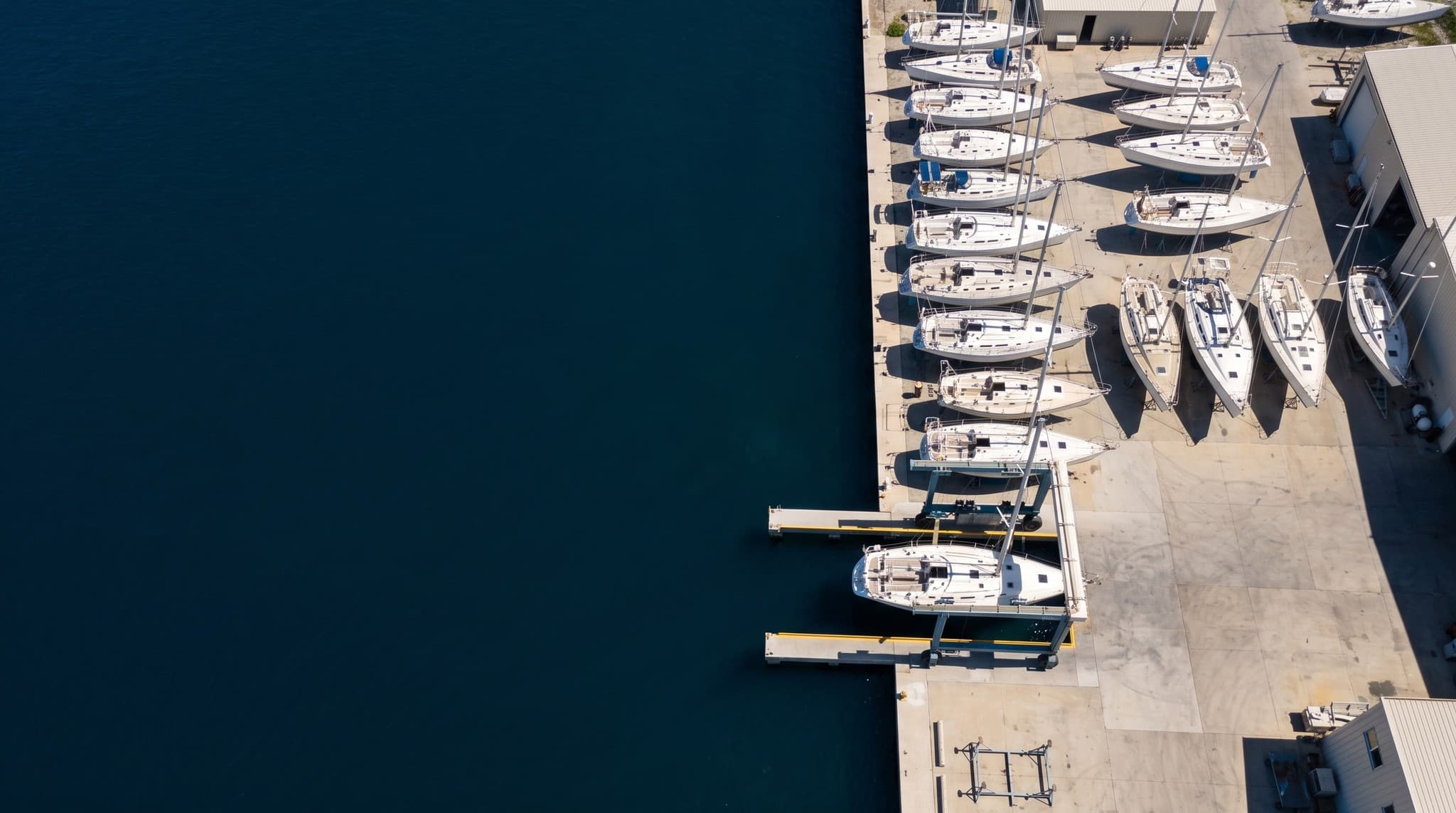
Three options
Haul out, stay afloat or sail south, and each one moves a different clause
1 June to 30 November
The Atlantic hurricane season, the window the whole decision sits inside
Four countries
Cuba, Colombia, Venezuela and Haiti are placeable, on modified terms
33 of 74
Regional yards that let you stay aboard, against a warranty that may not
What this page decides
Not which place is safest. That is seamanship, and the forums argue it well enough. This is the question underneath it: what each of the three options does to the policy you already hold.
Key takeaways
- The Atlantic hurricane season runs from 1 June to 30 November, and the decision has to be made before it starts rather than during it.
- Ashore, theft cover narrows to the entire vessel from a locked building or a storage place approved in writing. A named endorsement exists that restates it as if the boat were afloat, and it has to be asked for.
- Named-windstorm cover runs with a signed, dated hurricane plan agreed before cover is granted, and a 10% deductible of the hull value that applies to total losses too.
- Cuba, Colombia, Venezuela and Haiti are placeable on modified terms: all deductibles doubled, confiscation and piracy excluded, and theft excluded unless the boat is moored in a commercial marina agreed in writing beforehand.
- South of 12 degrees 40 minutes north, inside 85 to 55 degrees west, there are 31 boat yards, 68 marinas and 11 storm refuges, and Panama has more yards than Grenada or Trinidad.
The numbers this decision turns on
1 Jun to 30 Nov
The Atlantic hurricane season, the window every option is built around.
National Hurricane Center climatology$4,000
Haul-out plus six months ashore in Antigua, against under $1,000 to sail the same boat north. Same author, same season.
Cruising World, May 2025$12 and $20
Per foot per month, published yard storage against a marina slip on the US East Coast in 2020, with Charleston at $30 and $23.
Yachting World, 202031, 68 and 11
Boat yards, marinas and storm refuges south of 12 degrees 40 minutes north inside 85 to 55 degrees west, September 2026.
noForeignLand community map33 of 74
Regional boat yards that state you may stay aboard, against a lay-up warranty that bars using the boat as a residence.
noForeignLand map and the LMIS policy wording, warranty 25
Where should you leave your boat for Caribbean hurricane season?
There are three answers, and they are not three levels of safety. Haul out ashore, stay afloat in a sheltered refuge, or sail south out of the belt. What separates them on paper is which clause of your policy each one moves, and only one of the three is really about where the boat physically sits.
The season itself is fixed. The Atlantic hurricane season runs 1 June to 30 November, and NOAA states the same window in plain terms. Our guide to the Caribbean season and the box geography covers the month-by-month picture, so this page does not repeat it.
Each branch lands somewhere different in the policy. Storage is where the theft wording changes shape, so hauling out is really a theft-cover decision. Staying afloat turns on named-windstorm cover, and that runs on a document agreed before cover attaches. Sailing south is a navigational-limits question, with one of the usual southern destinations carrying its own clause.
Which option is safest for your boat is a seamanship question, and the forums argue it well enough. What your policy is written to accept is a different question, and it is the one below. If you are placing Caribbean yacht insurance for the first time, start there and come back here for the seasonal decision.
Written for owners keeping a boat in the Caribbean through the season. It is general information about how these clauses work, not financial advice, and your own schedule is what binds.
Haul out, stay afloat or sail south: what does each one change?
Each option moves a different clause, and the deductible behaves the same in all three. The comparison below comes straight off the policy wording and the clause schedule we hold.
| Haul out ashore | Stay afloat in a refuge | Sail south out of the box | |
|---|---|---|---|
| The clause it moves | Theft ashore, overland transport, and the lay-up warranty | The Hurricane Plan clause, a condition precedent | Navigational limits, which live on the Schedule |
| What the deductible does | 10% still applies if a named storm reaches the yard | 10% of hull value, total losses included | 10% still applies inside the belt; in Cuban, Colombian, Venezuelan or Haitian waters all deductibles are doubled |
| The condition you have to satisfy | Written approval of the storage place, or the theft extension, and no living aboard if a lay-up period is on the schedule | A signed, dated plan agreed by underwriters before cover is granted | Limits amended on the Schedule before you leave |
| The trap | Trucking inland past 150 miles from the customary place of storage | The plan, not the bay, is what gets agreed | Cartagena is in Colombia |
The 10% named-windstorm deductible never travels alone. It comes with the signed plan, and it applies to actual, constructive and compromised total losses, not only to partial damage. Our named-windstorm deductible guide works the arithmetic through, and the named storm deductible calculator runs it against your own agreed value.
The four-country clause is the other row that gets read wrongly. Cuba, Colombia, Venezuela and Haiti are not excluded. Cover is placeable in those waters on modified terms: every deductible is doubled while the boat is there, confiscation by any authority is excluded, piracy of or taking of the vessel is excluded, and theft is excluded absolutely unless the boat is moored in a commercial marina previously agreed in writing by underwriters. That matters here because the most-recommended southern haul-out on the forums is Cartagena, and Cartagena is Colombia. The full by-country picture is in sailing south of the hurricane box.

Most write-ups tell owners those four countries are simply off the map. The clause we hold says something different, so we publish the terms as they are written and let owners plan around them rather than around a rumour.
There is no latitude in the definition of a named windstorm. The wording defines it by naming, as done by NOAA or an equivalent government body, with no geography attached, and navigational limits are only the waters shown in the Schedule or amended by endorsement to it. Published boundaries circulate anyway, and they contradict each other. Yachting World reported cruisers working to 12 degrees 30 minutes north, others to 9 degrees north, and one insurer's clause running from 10 to 37 degrees north for 1 June to 30 November, Pantaenius being the insurer named there. The rectangle on our own quote questionnaire, 12 degrees 40 minutes to 23 degrees 30 minutes north and 55 to 85 degrees west for 1 July to 1 November, is a screening question asked at quote stage so the risk can be rated. It is not a limit. The Schedule binds.
Nothing says you have to pick one option for the whole season either. Owners routinely cruise the quiet end of it and haul for the peak. What matters is that the Schedule and the signed plan describe where the boat actually is at the time, because the limits are whatever the Schedule shows and the plan is agreed before cover is granted rather than adjusted afterwards.
Does hauling out narrow your theft cover, and can you get it back?
Yes, and yes. On the wording we hold, theft cover ashore is restricted to theft of the entire vessel including its equipment, from a locked building or from any other storage place given prior approval in writing. There is also a named endorsement that restates theft cover as if the vessel were afloat.
THEFT EXTENSION WHILST VESSEL STORED ON LAND ENDORSEMENT. It is hereby noted and agreed that whilst vessel stored on land, theft coverage is restated as if vessel afloat.
It does exactly what the title says. Our directory of what hauling out changes, clause by clause publishes the restriction. This is the half that gets you back out of it.
Restated as if afloat is not the same as unlimited, and the difference is worth knowing before you rely on it. Afloat, theft or mysterious disappearance of equipment or personal property on board is excluded unless it happens together with theft of the entire vessel, or there is evidence of forcible entry or removal. So the extension restores the afloat position, and the afloat position still has a shape. Our guide to what yacht insurance does not cover sets out the rest of it.
An endorsement is something asked for and agreed. It is not a default, and no yard's compound is approved in advance by anyone. If the plan is to leave the boat in a yard for six months, the storage place and the extension are two separate conversations to have before the season, not after a break-in.
One last thing on the haul-out branch, because it catches people who are being careful rather than careless. Hull cover excludes damage sustained while the vessel is transported over land more than 150 miles from its customary place of storage as advised to the insurer. Trucking a boat inland to somewhere that feels safer can cross that line without anyone meaning to.
One more document is in play once the boat is ashore, and it is not an insurance document at all. The yard's own storage agreement usually disclaims storm damage outright and asks the owner to hold the yard harmless, which is read clause by clause in what a boatyard's storage contract does to your own cover.
What the same wording asks while the boat sits with nobody aboard, in season rather than over a storm season, is on leaving your boat unattended.
Can you live aboard in the yard during a lay-up period?
A yard's permission to stay aboard and your policy's lay-up warranty are two different permissions, and only one of them is a warranty. This is the collision almost nobody sees coming, because both parties say yes to different questions.
Warranty 25. If a layup period is specified on the schedule, you warrant that the insured vessel will not be navigated or used in any manner whatsoever including as a residence whether permanent or temporary during the course of the specified layup period.
Now the yards. Of 74 boat yards in the region, 33 state that you may stay aboard, 20 state that you may not, and 21 do not say either way, on the noForeignLand community map as at September 2026. Split by latitude, the southern yards are more permissive: below 12 degrees 40 minutes north it is 18 yes, 6 no and 7 not stated, while inside the quote rectangle it is 13 yes, 13 no and 12 not stated. A yard that welcomes you aboard is not making a statement about your policy.
The instruction here is small and specific. Check whether a lay-up period is on your schedule at all, because the warranty only bites if one is specified. Owners who live aboard year round have a different conversation to have, and our liveaboard insurance page covers it.
The vocabulary problem runs both ways, which is worth saying out loud. Yachting World reports cruisers being coached to avoid the word liveaboard when booking a marina, because of what it triggers on the marina's side. The same word triggers something different on the policy side, and the two have nothing to do with each other.
One thing we cannot tell you is that hauling out earns a discount. Nothing in the wording, the clause schedule or the quote questionnaire we hold contains a lay-up credit, a storage discount or a return of premium for laying up. What the questionnaire does contain is a field for the main mooring, storage location and home port, which means storage location is a rating input rather than a rebate.
What does each option cost, and can you still book a slot?
Published figures exist for all three, and nobody has set them side by side. Haul out and store ashore in Antigua and you are looking at four figures for the season; sail the same boat north instead and the passage costs less than the storage would have. The catch is that these are published figures for the years shown, not quotes, and boat haul out cost varies by yard, beam and lift.
| Option | Published figure | Where and when |
|---|---|---|
| Haul out and store ashore | At least $4,000 for the lift plus six months | Antigua, Cruising World, May 2025 |
| Sail the boat north out of the belt | Under $1,000 for the delivery passage | Same author, same season, Cruising World, May 2025 |
| Yard storage against a marina slip | $12 per foot per month against $20, with Charleston at $30 and $23 | US East Coast, Yachting World, 2020 |
| One owner's disclosed policy | A $12,000 deductible on $595,000 of cover, for under $10,000 a year on a 56-footer | Caribbean, Sailing Britican, October 2022 |
That last row is one owner publishing their own terms, not a market rate, and it is useful precisely because it is specific. Two insurance brands appear in that account, and a second insurer in the same piece wanted the boat north of Jacksonville rather than hauled in the islands. Two insurers, two different branches forced, on the same boat. What cover itself costs is a separate question, and our guide to how much yacht insurance costs answers it.
When an owner asks us what a storage decision does to their terms, we go to the policy wording we hold and read the clause, rather than repeating what the market says about it. It is slower than quoting a rule of thumb and it is the only way to be sure the answer survives a claim.
Then the slot question, which every thread raises and nobody answers with a number. Yachting World reports Clarke's Court in Grenada storing 250 boats and hauling to 240 tons, busiest from August to October and capable of running near capacity all year. Bonaire, in the same report, does not permit anchoring at all, and its mooring balls are first come, first served and often unavailable. Book before the season rather than into it.
There is one further claim worth flagging rather than asserting. Some owners report their broker limiting how many vessels it will cover in a single named refuge. That comes from one forum post, we have not been able to verify it against any policy document, and we are not in a position to say whether it is common practice. Treat it as a question to put to whoever writes your policy, early enough that the answer can still change where the boat goes.
How much yard and marina capacity is there south of the hurricane belt?
More than the forums suggest, and not where you would expect. South of 12 degrees 40 minutes north, inside 85 to 55 degrees west, there are 31 boat yards, 68 marinas and 11 storm refuges on the noForeignLand community map as at September 2026, and Panama has more boat yards than Grenada or Trinidad.
| Country | Boat yards | Marinas | Storm refuges |
|---|---|---|---|
| Panama | 9 | 16 | 0 |
| Grenada | 6 | 9 | 7 |
| Colombia | 5 | 8 | 0 |
| Trinidad and Tobago | 4 | 7 | 3 |
| Costa Rica | 3 | 8 | 0 |
| Bonaire, Curacao and Aruba | 3 | 12 | 0 |
| Suriname | 1 | 2 | 1 |
| Venezuela | 0 | 4 | 0 |
| Elsewhere in the box (St Vincent and the Grenadines, Guyana) | 0 | 2 | 0 |
Travel-lift capacity follows the same pattern, and it is worth reading as a distribution rather than as a promise about any one yard: of the 31 southern yards, 24 state a lift capacity, with a median of 80 tonnes and a range from 11 to 500. A wide catamaran is a different conversation from a deep-keeled monohull of the same tonnage.
Three caveats ship with every number above, and none of them should be softened. A count is not a berth: everyone hauls in the same eight weeks, and a yard existing says nothing about a slot being free. The map is contributed by cruisers, so an absence is a gap in the record rather than evidence there is nothing there. A stated lift weight is unverified, and one yard's published 65-ton figure turned out on inspection to describe its crane rather than its haul-out capacity.
Place counts derived from the noForeignLand community map, September 2026. Last verified 19 September 2026.
Two of the countries in that table, Colombia and Venezuela, sit inside the four-country clause, which is the reason the southern option is a cover decision and not only a routing one. Grenada counts seven marinas and four boatyards in Yachting World's own survey, which is close enough to our count to be worth showing beside it. The community write-up that ranks highest on this question recommends Cartagena with no mention of the clause at all.
Which parts of this decision are already settled elsewhere?
Three of them, and each has its own page rather than a paragraph here.
What a hurricane plan has to demonstrate about a destination before underwriters agree it, including the warning window, capacity and who is authorised to act, is in which hurricane holes insurers accept. The clause-by-clause consequences of hauling out, and the four-country terms broken down by country, are in the hurricane holes and haul-out yard directory. The season dates, the month-by-month record and the box geography are in hurricane season in the Caribbean. When it comes to writing the document itself, the hurricane plan generator produces one.
Two failure modes cut across all three branches and are worth a line each. A crowded refuge is where boats destroy each other: Don Street's account in Caribbean Compass describes losing a 28-foot yawl to a 55-foot catamaran dragging down on it, and his own arithmetic explains why: wind pressure rises with the square of the wind speed, so the load at 120 knots is roughly sixteen times what it is at 30. Street also counts only two hurricanes striking the Eastern Caribbean in June and the first half of July between 1851 and 2020, from the NOAA hurricane database, which is why the shoulders of the season read differently from its peak. And a place with a good record is not a guarantee either. Grenada has been struck four times in a hundred years and is widely treated as a safe haven, yet Category 4 Hurricane Ivan destroyed hundreds of yachts there in 2004.
Frequently asked questions
1.Does hauling out for hurricane season change your insurance?
+
Yes, in a specific way. Ashore, theft cover narrows to theft of the entire vessel from a locked building or a storage place approved in writing. A named endorsement, the theft extension whilst vessel stored on land, can restate it as if the boat were afloat, but it has to be asked for and agreed. The 10% named-windstorm deductible and the signed hurricane plan still apply wherever the boat is.
2.What if you need to leave the boat for a couple of months?
+
That is a storage decision, and the yard's stay-aboard rule is not the one that governs you. If a lay-up period is specified on your schedule, warranty 25 bars using the vessel in any manner whatsoever, including as a residence permanent or temporary, for that period. Check the schedule before booking the yard.
3.How much does it cost to haul out a boat for hurricane season?
+
One published Caribbean figure, reported by Cruising World in May 2025, is at least $4,000 for the lift plus six months ashore in Antigua. On the US East Coast, Yachting World published yard storage at $12 per foot per month against $20 for a marina slip in 2020. Both are published figures for the years and places shown, not quotes.
4.Can you still get a yard slot for hurricane season?
+
Named southern yards run near capacity all year and are busiest from August to October. Yachting World reported one Grenada yard storing 250 boats and hauling to 240 tons, which is a count rather than an available berth. Book before the season starts, not once a storm is named.
5.Is Grenada or Trinidad outside the hurricane box?
+
It depends whose box. Yachting World reported published geometries at 12 degrees 30 minutes north, at 9 degrees north, and at 10 to 37 degrees north in one insurer clause. The rectangle on our own quote questionnaire is a screening question with a 1 July to 1 November window, not a limit. Your navigational limits are only what the Schedule shows.
6.Is the Caribbean off-limits in hurricane season?
+
No. Cover is placeable, on terms. Named-windstorm cover runs with a signed, dated hurricane plan agreed before cover is granted, and a 10% deductible. Cuba, Colombia, Venezuela and Haiti are placeable on modified terms: doubled deductibles, confiscation and piracy carve-outs, and theft coverable only in a commercial marina agreed in writing.
7.Does hauling out earn a discount on the premium?
+
Marine press reports that many insurers reward hauling out and that some reimburse haul-out costs, but that account carries no figure and names no clause. Nothing in the policy wording, the clause schedule or the quote questionnaire we hold contains a lay-up credit or a return of premium for storage. What the questionnaire does ask for is the storage location, which makes it a rating input.
Sources and documents
- London Marine Insurance Services yacht policy wording: definitions 7 and 16, hull exclusion 1, the theft provisions and warranty 25. Held on file, quoted by clause name.
- London Marine Insurance Services yacht and liability clauses and endorsements: the Hurricane Plan Clause, the Cuba, Colombia, Venezuela and Haiti exclusions and warranties, and the theft extension whilst vessel stored on land endorsement. Held on file.
- The quote questionnaire's Caribbean screening rectangle and storage-location field. Held on file.
- National Hurricane Center, Atlantic hurricane climatology and season dates. Read 19 September 2026.
- NOAA Ocean Service, when hurricane season is. Read 19 September 2026.
- NOAA Hurricane Research Division, HURDAT storm data. Read 19 September 2026.
- Cruising World, End-of-Season Options for Caribbean Cruisers, David H. Lyman, 2 May 2025. Read 19 September 2026.
- Yachting World, hurricane-season mooring from Maine to Grenada, 2020, pages 1 and 2. Read 19 September 2026.
- Caribbean Compass, sailing the Caribbean in hurricane season, January 2025. Read 19 September 2026.
- Sailing Britican, about hurricane season, October 2022. Read 19 September 2026.
- noForeignLand community map, place counts harvested 19 September 2026. Aggregate counts only.
World Yacht Insurance is a yacht-insurance introducer arranging hull and liability cover up to $5M for sail and motor yachts worldwide, including the Caribbean, placed in the London market through London Marine Insurance Services Ltd, a Lloyd's-accredited broker.
Reviewed by Costas Matheou, licensed insurance agent.
Last updated 19 September 2026. Clause quotations re-read against the policy wording and the clause schedule on that date.
Coverage terms, premiums and deductibles on this page are indicative and not financial advice. Cover is subject to underwriting, survey and the policy wording.
Decide the option, then place the cover around it
The three options are not equally easy to insure, and the differences sit in clauses rather than in brochures. Tell us where the boat will spend the season and we will come back with what the market asks for in that case.
- No obligation
- every underwriting question asked upfront
- a licensed Cyprus agent reviews every enquiry
Also on WhatsApp, Telegram and Viber