
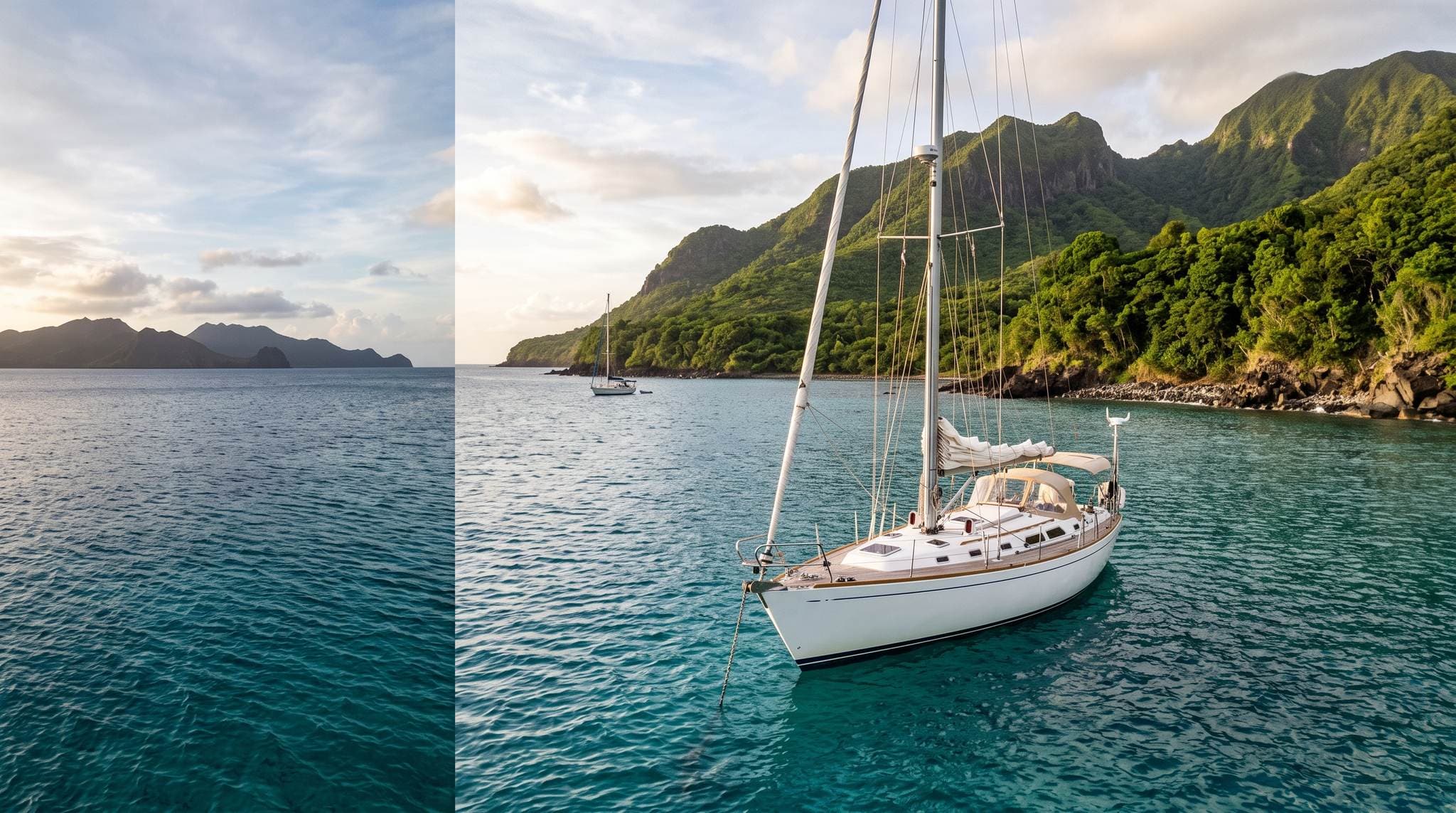
Caribbean Yacht Insurance
Caribbean yacht insurance is agreed-value hull and liability cover whose navigational limits extend into Caribbean waters, with named-windstorm terms attached. Typical premium runs 1 to 1.5% of agreed value a year. Named-windstorm claims carry a 10% deductible on the hull value shown on your schedule, and only where underwriters have agreed a signed hurricane plan first.
World Yacht Insurance arranges one Lloyd's-market policy for the sailboat, catamaran or motor yacht you are taking south, with the windstorm terms and the navigational limits stated in writing before you commit.
- Lloyd's of London
- Placed through a Lloyd's-accredited broker
- Up to $5M
- Hull and liability authority
- 1% to 1.5%
- Typical annual premium of agreed value
- ~24h
- Indicative quote turnaround
What Caribbean Yacht Insurance Actually Covers
Caribbean yacht insurance is an agreed-value marine policy whose navigational limits are written to include Caribbean waters. It covers hull, machinery and third-party liability, adds named-windstorm terms for the Atlantic hurricane basin, and states the waters it responds in on your Confirmation of Cover, the document that records the exact terms underwriters agreed.
This page is for the visiting cruiser and the US-domiciled owner heading south for a season, not the island resident whose boat lives in Antigua all year. Search results mix the two. We don't, because the underwriting questions differ.
Cover follows the cruising ground, not the vessel type. A sailboat, a catamaran or a motor yacht all sit on the same Lloyd's-market wording. Owners sometimes call it Caribbean boat insurance. Same cover.
World Yacht Insurance is a yacht-insurance introducer arranging hull and liability cover up to $5M for sail and motor yachts worldwide, including the Caribbean, placed in the London market through London Marine Insurance Services Ltd, a Lloyd's-accredited broker.
We are the introducer, not the insurer. The risk is placed in the London market through London Marine Insurance Services Ltd, a broker accredited at Lloyd's of London. The insurers behind the facility carry the risk and pay valid claims. World Yacht Insurance is not FCA-regulated, and firm reference 308599 belongs to London Marine Insurance Services Ltd, not to us. The full chain sits on how it works.
One thing before you read on. This page is about what your policy does when a storm comes, not about when storms come. Season dates and storm counts sit in our hurricane guide, linked below.
What Caribbean Yacht Insurance Costs
Caribbean yacht insurance typically runs 1 to 1.5% of the agreed value a year, so about $5,000 to $7,500 on a $500,000 yacht. The named-windstorm deductible is a separate figure: 10% of that agreed value, or $50,000 on the same yacht. We publish the method rather than hide it behind a quote form.
| Agreed value | Typical annual premium, 1 to 1.5% | 10% named-windstorm deductible |
|---|---|---|
| $150,000 | $1,500 to $2,250 | $15,000 |
| $500,000 | $5,000 to $7,500 | $50,000 |
| $1,000,000 | $10,000 to $15,000 | $100,000 |
| $2,500,000 | $25,000 to $37,500 | $250,000 |
Read the two right-hand columns together. The middle column is the number owners budget for. The right-hand one decides whether a storm claim is worth making at all.
What moves a Caribbean premium
- Where the yacht sits between roughly July and November, relative to the named-windstorm navigation limits
- Whether a hurricane plan is agreed
- Hull age and survey status
- Crew experience and the captain's résumé
- Whether the yacht is chartered out
Position is priced openly in this market. One Caribbean-focused broker advertises discounts for yachts kept outside specified latitudes between 1 July and 1 November, so spending the season south of the limits is a recognised way to change the rating rather than a loophole. Another advertises non-windstorm deductibles as low as 2% for specific perils. Both are numbers other markets publish. Neither is a term of the cover we arrange, and deductibles on a policy we place are set on your schedule.
We arrange cover up to $5M in-house. Above $5M the risk goes into the Lloyd's market. Either way you get an indication against your yacht's real details, not an average.
For a rough starting figure, use the yacht insurance cost calculator, or read how much yacht insurance costs.
Not every insurer will follow you into Caribbean waters, and the ones that do publish very different terms. Which insurers cover Caribbean cruising compares them on the numbers they publish.
Vessel-specific rating sits on our sailboat, motor yacht and superyacht pages.
This is general information, not financial advice, and the table above is not a quote. Nothing here binds an underwriter. Every figure on this page comes from the policy wording we hold or from the issuing authority named beside it, and we correct anything shown to be wrong: tell us and we will fix it and re-date the page.
What a Caribbean Policy Covers, and What It Does Not
The two lists below come straight from the London Marine Insurance Services policy wording we hold. That document is what decides a claim, so we publish it rather than talk around it.
| Covered as standard | Not covered, or subject to conditions |
|---|---|
| Agreed-value hull and machinery, insured for 100% of the agreed value, with no depreciation on partial losses | War, capture, seizure and detainment |
| Third-party liability | Piracy, and the taking of the insured vessel |
| Named-windstorm damage, subject to an agreed hurricane plan and the 10% deductible | Kidnap and ransom costs; a specialist K&R policy is recommended |
| Salvage charges | Confiscation by any Authority in Cuban, Colombian, Venezuelan or Haitian waters |
| Pollution liability | Any loss outside the navigational limits on your schedule |
| Passenger and crew liability | Single-handed operation, unless agreed in writing |
| Lay-up cover, subject to the navigation and use warranty | Trimarans, ferro-cement hulls and cigarette boats, which we cannot place at all |
Three of those rows have mechanics a table cannot carry. The four-country clause, the theft warranty and kidnap and ransom are set out below under Cuba, Colombia, Venezuela and Haiti. How navigational limits work, and how to widen them before you go, is the next section.
A survey, recent photos, a captain's résumé and a signed hurricane plan are eligibility conditions rather than exclusions: they decide whether cover starts at all. We ask about them at the quote stage, not at renewal. The deadlines are listed under how to get covered.
This is general information, not financial advice. Your own policy wording and schedule set the exact terms.
Does Caribbean Boat Insurance Cover Hurricane Damage?
Yes, Caribbean boat insurance can cover hurricane damage, on two conditions. Underwriters must have agreed a signed hurricane plan before cover is granted, and the deductible for that peril is 10% of the hull value shown on your schedule. Not 10% of the claim, and not your ordinary deductible.
Our wording does not leave the trigger to opinion. It defines named-windstorm damage as damage resulting from "any named or numbered windstorm or weather pattern as defined by the National Oceanic and Atmospheric Agency, or any equivalent government organisation". That quoted phrase is the policy’s own wording; the body it refers to is the National Oceanic and Atmospheric Administration, NOAA. The National Hurricane Center is the NOAA body that names Atlantic storms, so the official storm list flips the switch, not an underwriter's judgement after the fact.
The geography is less tidy. Public sources do not agree on where the named-windstorm navigation limits run, so here is the spread rather than one rectangle.
| Boundary | Commonly quoted | Where sources disagree |
|---|---|---|
| Southern limit | 12°40'N | Some insurers use 12°30'N, per Yachting World. The quote questionnaire asks whether the vessel will be between 12°40' and 23°30'N from 1 July to 1 November, a screening question that rates the risk before terms are offered rather than a navigational limit. |
| Northern limit | 23°30'N | Consistent across the sources we checked. |
| Longitude | Roughly 55°W to 85°W | Varies by insurer. |
| Restriction window | Roughly 1 July to 30 November | Start dates of 1 June or 1 July, and end dates of 1 November or 30 November, are all on record. We quote the widest. |
| What actually governs | Your Confirmation of Cover | There is no industry-standard box, so no published rectangle binds your policy. |
Never plan a season off a table like this one. It shows the spread in public sources. Your Confirmation of Cover is the only document that decides.
This regime is Caribbean-specific. The Mediterranean is not an Atlantic hurricane basin, so a Med policy carries no named-windstorm deductible and no hurricane-plan requirement, which is why the same yacht is rated differently on each side of the Atlantic.
Timing is a separate question and we answer it elsewhere. The Atlantic hurricane season runs 1 June to 30 November and peaks around 10 September. For the month-by-month picture, the per-island storm counts and the NOAA climatology, read our Caribbean hurricane season guide. It is also the page that sets out when hurricane season starts and ends in the Caribbean. This page stays on the policy side of the line.
More on how the peril deductible sits against your ordinary one goes into named-windstorm deductible explained. If you live aboard through the season, read liveaboard insurance too, because the lay-up warranty below applies to you.
What a Signed Hurricane Plan Has to Contain
A hurricane plan is a signed, dated document that underwriters agree before cover is granted. It says what happens to the yacht when a storm is named: where she goes, who moves her, and by when. Our wording makes it a condition precedent to liability, so named-windstorm cover does not exist without one.
What underwriters check
- 1Where the yacht goes: hauled out and secured ashore with tie-downs and the mast unstepped, or moved clear of the forecast track.
- 2Who is named responsible, plus a named alternate for when you are off the island.
- 3The trigger time, in hours before forecast arrival, at which the plan starts.
- 4The specific yard or marina, which underwriters approve on quality and track record.
We will not rebuild the document here. Our hurricane plan generator produces it in an insurer-ready format with the staged countdown filled in. This section is about the plan as an eligibility condition: no signed plan, no named-windstorm cover, whatever the premium.
Yards fill early, and the yard you name is part of what gets approved. Cruising World reports that insurers assess a marina's quality, technology and track record when they approve a storm plan. One Caribbean specialist advertises paying half the haul-out cost up to $5,000. That is market practice published elsewhere, not a term of the cover we arrange.
Then the clause that catches liveaboards. If a lay-up period is on your schedule, the wording warrants that the insured vessel will not be navigated or used in any manner whatsoever, including as a residence, whether permanent or temporary, for the whole of that period. Sleeping aboard during lay-up breaks the warranty. If you plan to live aboard through the season, say so before the schedule is issued, not after.
Which of those applies depends on a decision made before the season starts. Where to leave the boat for hurricane season sets hauling out, staying afloat and sailing south side by side, with the clause each one moves.
Cuba, Colombia, Venezuela and Haiti: Cover on Modified Terms
Cover can be arranged for Cuban, Colombian, Venezuelan and Haitian waters. It is not excluded there. The terms change instead, and they run all year: nothing to do with the named-windstorm season or the hurricane navigation limits. The same itinerary prices the same in February as in September.
Colombia is the fourth country. Our clause is headed exactly that: Cuba, Colombia, Venezuela and Haiti exclusions and warranties. Shorthand that drops Colombia understates what applies to you.
The US-flag variant
A second, narrower clause is headed Colombia and Haiti exclusions and warranties (USA Flag / Insured). Same four sub-terms, two countries instead of four, and it attaches to US-flag vessels and US-domiciled insureds. For a US owner the modified terms may bite only in Colombian and Haitian waters, where a non-US owner carries them across all four. So we ask for your flag and your country of domicile at the quote stage.
How theft cover is won back
Theft is the one term you can win back, and almost nobody explains how. It is excluded absolutely in these waters, with one carve-back: unless the insured vessel is moored within a commercial marina previously agreed in writing by the underwriters. Take that literally: a commercial marina, not a mooring field or a fisherman's dock, named to underwriters and accepted in writing before you arrive. So send the marina name with your itinerary, keep the written confirmation, and stay inside that marina for theft cover to respond. Move to the anchorage for a night and theft is uncovered while you are there. A second marina is a fresh request.
Two further points sit outside the four-country clause. The policy carries no cover for costs associated with the kidnap for ransom of any person, and the wording recommends a specialist kidnap and ransom policy where that risk exists. We do not arrange those. War, capture, seizure and detainment sit in a separate exclusion that applies wherever you cruise. Read both alongside superyacht insurance and what yacht insurance does not cover.
The four consequences, for reference
- All deductibles are doubled whilst in Cuban, Colombian, Venezuelan or Haitian waters.
- Confiscation by any Authority is excluded.
- Piracy of, and the taking of, the insured vessel is excluded.
- Theft cover is excluded absolutely, unless the insured vessel is moored within a commercial marina previously agreed in writing by the underwriters.
US owners also answer to their own government on Cuba. Check the current position with OFAC before you commit to an itinerary. We take no view on it.
Island by Island: Bahamas, BVI, USVI, Grenada and Trinidad
Entry formalities and underwriting boundaries are two different things, and cruisers pay for confusing them. A cruising permit gets you into a country. Your navigational limits and windstorm terms decide whether a claim gets paid once you are there.
| Territory | Entry or permit requirement | Insurance-relevant note |
|---|---|---|
| The Bahamas | A cruising permit is required for foreign pleasure vessels, priced by length AND duration: a 12-month permit is $500 up to 50 ft, $1,000 from 50 to 100 ft and $3,000 above 100 ft; a 6-month permit is $300, $750 and $2,000 on the same bands; a 30-day permit is $150 up to 30 ft, $250 from 30 to 50 ft, $350 from 50 to 100 ft and $600 above 100 ft. The fee covers Customs and Immigration attendance and transport. Passenger tax of $20 applies to each non-resident passenger beyond three, aged six or over. | Bahamas Customs guidance does not state an insurance requirement. Whether your own policy reaches the Bahamas is the question to check. |
| British Virgin Islands | Cruising permits are governed by the Cruising and Home Port Permit Act, 2021, as amended in 2024 and 2025. The statutory rates are charged per person per day and set by vessel category rather than by hull length, and recreational sailing vessels under 26 ft are exempt, so confirm the category that applies to you with the BVI Government. | Charter use changes both the permit position and the endorsement your policy needs. |
| USVI and Puerto Rico | US waters, so there is no foreign entry formality for a US vessel. | The live question is the reverse one: do your own navigational limits already reach the US Virgin Islands and Puerto Rico? A US coastal policy written to 75 nautical miles offshore may not. |
| Grenada and Trinidad | Standard regional clearance on arrival. | The traditional refuges south of the named-windstorm limits, and the reason a latitude appears on so many schedules. |
Now the counterweight, because a latitude line is an underwriting boundary, not a weather forecast. Yachting World reported that some yacht insurance companies have historically specified 12°30'N as the official limitation, and that Hurricane Beryl reached Category 4 on 30 June 2024, the earliest major Atlantic hurricane in over 58 years, after taking just 42 hours to strengthen from a tropical depression. Over 100 yachts and other vessels evacuated Grenada. Grenada sits below the line on a great many schedules. The line did not stop the storm.
Salvage, haul-out and repair logistics on a remote island cost more than they do at home, and the yard queue after a regional storm is long. That is why the placement network behind your policy matters more here than it does in Florida.
Cruising further west, or wintering stateside? We are building pages on yacht insurance in Mexico and Florida yacht insurance. For an Atlantic crossing into the islands, see offshore and bluewater cover.
If the Bahamas is the crossing you are actually planning, our guide to taking your boat to the Bahamas covers the permit, the Click2Clear sequence and what to settle with your insurer before you leave.
Comparing grounds before you commit to a route? Our table of cruising permits and entry fees by country carries the published fee, the issuing authority and a last-verified date for each one, so you can see which countries publish a price and which publish only a procedure.
Chartering Your Yacht in the Caribbean
Charter your Caribbean yacht out and loss-of-charter-hire cover indemnifies the net charter fees you lose while she cannot earn, up to €600 per day for a maximum of 67 days in respect of any one accident.
The three conditions competitors do not publish
- It applies only to losses under a signed charter agreement for which a binding deposit was paid before the date of the casualty, and only above the first seven days of hire lost.
- No claim attaches where the accident makes the yacht an actual or constructive total loss. The hull claim answers in that case instead.
- It is subject to cruising confined to policy limits, which puts you straight back into the navigational-limits question above.
The bareboat trap needs stating flatly. Our wording requires a written bareboat charter agreement containing a hold-harmless provision in favour of insurers. Failing to use one is grounds for a claim under the policy to be avoided. A handshake and a payment link is not a charter agreement.
The commercial side of running a charter yacht sits on charter yacht insurance and bareboat charter cover. This section covers only what changes when the charter happens in the Caribbean: the windstorm terms above, the signed hurricane plan, and the yard that plan names.
How to Get Covered
Three steps, and you see the windstorm terms in writing before you commit to anything.
Conditions to plan for: a marine survey received and approved within 45 days of inception, with recommendations complied with inside 30 days; a captain's résumé and loss record; and a satisfactory signed proposal within 14 days of attachment. Single-handed operation is not covered unless we agree it in writing.
World Yacht Insurance is not an insurer, is not a broker and does not carry risk. Firm reference 308599 belongs to London Marine Insurance Services Ltd. The insurers behind the facility carry the risk and pay valid claims. The full chain is on how it works.
- 1
Tell us the yacht and the itinerary
Agreed value, hull age, cruising area, and where she will be between July and November.
- 2
We introduce the risk
Cover is arranged and placed in the London market through London Marine Insurance Services Ltd, a Lloyd's-accredited broker authorised and regulated by the UK Financial Conduct Authority, firm reference 308599.
- 3
Terms back within 24 hours
With the named-windstorm deductible, the hurricane-plan requirement and the navigational limits all stated on the Confirmation of Cover, so you read them before you buy.
Caribbean Yacht Insurance FAQ
Does boat insurance cover hurricane damage in the Caribbean?+
Yes, where named-windstorm cover has been granted. It is only granted against a signed, dated hurricane plan agreed by underwriters beforehand, which our wording makes a condition precedent to liability. The deductible for that peril is 10% of the hull value shown on your schedule, not 10% of the claim. Named windstorm is defined by reference to naming by the National Oceanic and Atmospheric Administration (NOAA), so the trigger is the official storm list rather than an underwriter's opinion. This is general information, not financial advice.
What is not covered by Caribbean yacht insurance?+
War, capture, seizure, detainment and confiscation; piracy and the taking of the vessel; and kidnap and ransom costs, for which the wording recommends a specialist policy. In Cuban, Colombian, Venezuelan and Haitian waters all deductibles are doubled and theft is excluded unless the yacht is moored in a commercial marina agreed in writing beforehand. Trimarans, ferro-cement hulls and cigarette boats are not written at all. Single-handed operation needs written approval.
Will my US boat policy cover me in the Bahamas or the Caribbean?+
Usually not without an extension. Motor Boat & Yachting reports one published coverage territory of 75 miles offshore of the Lower 48, with a Bahamas option raising it to 150 miles offshore of a contiguous United States or Bahamian shore. A loss outside your scheduled limits is not covered, though limits can normally be extended by agreement before you leave. Several Caribbean marinas also ask for proof of insurance before they let you enter or moor.
How do I claim on a Caribbean yacht policy from a remote island?+
Notify straight away, with your position, the damage and an estimate of repair time. Act as a prudent uninsured owner would and stop the loss getting worse, which is standard practice across the marine market. Expect written correspondence and a surveyor where the severity warrants one. Remote-location salvage and haul-out logistics run slower and dearer than they do at home, which is why the placement network behind the policy matters on this coast.
Is medical evacuation covered by yacht insurance?+
No. Hull and liability cover is not health cover, and we do not arrange medical or repatriation policies. NoonSite documents a cruiser's air-ambulance flight from Bonaire to Miami at $28,000, against separate repatriation membership costing under $200 a year. Arrange that cover separately, before you leave.
Reviewed by Costas Matheou, licensed insurance agent. Verify his licence and credentials
Last updated August 2026. Policy terms are read from the London Marine Insurance Services wording we hold, and cruising-permit fees are re-checked against the issuing authority each season.
Coverage terms, premiums and deductibles on this page are indicative and not financial advice. Cover is subject to underwriting, survey and the policy wording.
Get Caribbean Terms Before You Head South
Agreed-value hull and liability for your Caribbean season, placed in the London market through London Marine Insurance Services Ltd, a Lloyd's-accredited broker. Send the yacht's details and where she will be between July and November, and an indicative quote reaches you by email, usually within 24 hours.
- No obligation
- every underwriting question asked upfront
- a licensed Cyprus agent reviews every enquiry
Also on WhatsApp, Telegram and Viber