
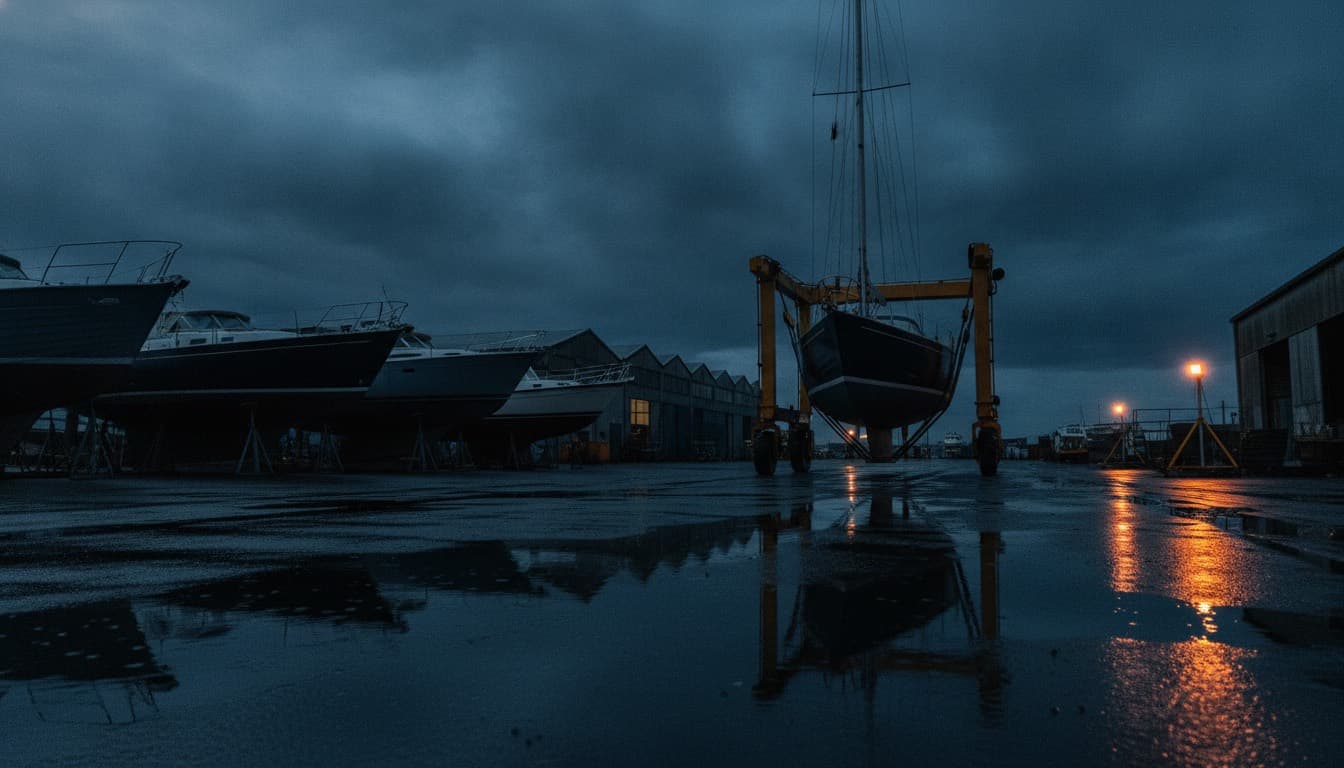
Marina Insurance
Marina insurance is commercial cover for a marina or boatyard operator, and its centre is liability for boats that belong to somebody else. Marina operators legal liability answers for boats in your care; ship repairers legal liability answers for boats you work on. World Yacht Insurance introduces; cover is placed in the London market through London Marine Insurance Services Ltd.
Marina liability insurance for operators holding other people's boats. The two legal liability lines are separate covers, and we explain them separately.
If you own a boat kept at a marina and your marina has asked for proof of insurance, you want owner-side cover rather than this page.
London market
Where the cover is placed, through a Lloyd’s-accredited broker
FCA 308599
London Marine Insurance Services Ltd, the broker that places it
24 hours
Quote terms in writing
Introducer
We introduce and carry no risk
Care, custody and control: your largest exposure belongs to somebody else
A marina's biggest risk is not the property it owns. It's the boats it holds for other people. That exposure has a name, care, custody and control, and the general liability policy most operators lean on does not answer for it.
General liability answers for the person who trips on your dock. It does not answer for the hull you lifted out of the water, carried across the yard, blocked ashore, or splashed in April. From the moment a customer's boat is in your hands, it sits in a gap most operators don't know they have.
The moments that create it are ordinary working ones:
- Travel-lift and crane movements
- Hauling out and blocking ashore
- Repositioning boats ahead of a storm
- Sea trials and yard-to-slip moves
- Winter storage, under cover or on the hard
Competitor pages describe marina cover as a package and stop there. Almost none separate the two legal liability covers inside it, which is why operators so often carry one and assume it does the work of both. One more thing worth knowing, because it cuts the other way and almost nobody publishes it. The indemnity clause in your dock agreement may be worth less than it looks. Marine policy wordings commonly exclude liability the insured has taken on by contract, and the wording we work from does it in two separate sections: liability assumed by you under any contract or agreement is excluded from third-party liability cover, and responsibility assumed under any agreement or contract is excluded from medical payments. So when a boat owner signs your hold-harmless, their own yacht policy may not stand behind it, and you are left recovering from the owner personally rather than from an insurer. Which wording applies is the owner's business and not ours, so treat this as a question to put to your broker rather than a statement about any particular policy. Source: London Marine Insurance Services policy wording LMI18M0136-5.
Marina operators legal liability vs ship repairers legal liability, and why one is not the other
Marina operators legal liability answers for customers' boats in your care. Ship repairers legal liability answers for customers' boats you're working on. They are separate covers with separate triggers, and holding only one leaves a real hole.
| Marina operators legal liability | Ship repairers legal liability | |
|---|---|---|
| Answers for | Boats in your care, custody or control | Boats you are working on |
| Typical trigger | Lifting, moving, berthing, storing ashore | Repair, refit, systems work, dismantling |
| Who carries it | Marinas, boatyards, storage yards, dry stacks | Yards, repairers, marine trades |
| The usual gap | Assumed to sit inside general liability | Assumed to sit inside the operators cover |
A yard that lifts a boat and then works on it can touch both covers in an afternoon. A storage-only operation may need the first and none of the second. Which you need turns on what your staff actually do, not on what the business calls itself.
What sits inside a marina programme, and what doesn't
| In scope | Not this page |
|---|---|
| Marina operators legal liability, for boats in your care | Ocean cargo, which the London-market facility does not arrange |
| Ship repairers legal liability, for boats you work on | Inland marine, a US property line for movable land-based property, unrelated to boats |
| Marine general liability and premises cover for the shore base | Hull cover for a boat you own yourself and keep at a marina |
| Property cover for docks, buildings, lifts and hardstanding, written as piers, wharves and docks | Personal watercraft and jet ski fleets |
| Pollution exposure from your own fuel and waste-oil handling | Charter, rental and dealer operations, which have their own pages |
| Marine excess liability, sold in some markets as a bumbershoot, which sits above the primary limits rather than rebuying them |
If you are the trade working on the boats rather than the operator holding them, a boat builder, repairer, rigger, marine engineer, chandlery or surveyor, then marine trade insurance takes the same exposure from the workmanship side and is written for a United Kingdom trade. If your work sits closer to brokerage or sales than to berthing and lifting, boat dealer insurance is the better fit. For the full map of business types against covers, start at the marine business insurance hub.
The numbers we won't publish
We publish no fleet minimum, no territory, no per-line limit and no commercial premium band, because we haven't been given them and we won't invent them. Commercial marine is rated account by account rather than off a table. The 1% to 1.5% of agreed value figure used elsewhere on this site is a private-yacht indication and does not apply to a marina programme or to any liability business.
One boundary is settled. The vessel classes the London-market facility reaches are yachts, sailboats, catamarans, motor boats and superyachts. Personal watercraft and jet skis fall outside it, so a dry stack full of skis is not something we can place.
Who arranges it, and who pays the claim
World Yacht Insurance is a yacht-insurance introducer arranging hull and liability cover up to $5M for sail and motor yachts worldwide, including the Caribbean, placed in the London market through London Marine Insurance Services Ltd, a Lloyd's-accredited broker.
That describes our yacht business, and the $5M in it is private-yacht underwriting authority rather than a limit for a marina programme.
The chain in full:
World Yacht Insurance introduces the business. We are not an insurer and we carry no risk.
AKD Insurance (A.K. Demetriou Insurance Brokers Ltd, Cyprus) is the contracted broker we introduce to.
London Marine Insurance Services Ltd, a Lloyd's-accredited broker authorised and regulated by the UK Financial Conduct Authority, firm reference 308599, arranges and places the cover.
The insurers behind the facility carry the risk and pay valid claims. Larger risks, above the facility’s authority, are placed in the wider Lloyd’s market.
Not one competitor page in this market tells a reader who actually pays. That's the first thing an operator should be told.
Surplus lines, said plainly
Worth saying before you ask: cover placed in the London market for a US business is generally non-admitted, written on a surplus lines basis, and surplus lines paper is generally not backed by a state guaranty fund. Eligibility is administered state by state, so we won't claim a position in yours.
Lloyd's of London · the FCA register
Read the full chain on how it works, or about the licensed agent behind the business.
USL&H, the Longshore Act, and the marina exclusion nobody cites
Which compensation regime covers an injured worker depends on what that worker touches. Three regimes, and they do not overlap.
| The worker | The regime | What it is |
|---|---|---|
| Crew of a vessel | Jones Act, 46 U.S.C. 30104 | A fault-based civil claim against the employer, with a right to jury trial. Not workers' compensation. |
| Shore-side maritime workers | Longshore and Harbor Workers' Compensation Act, 33 U.S.C. 901 and following | No-fault compensation, and compulsory: 932 says every employer shall secure the payment of compensation |
| Everyone else | State workers' compensation | The default, and the condition that makes the federal exclusions work at all |
There's a marina exclusion written into the Longshore Act, and no competitor page in this market cites it. Under 33 U.S.C. 902(3)(C) the Act does not cover “individuals employed by a marina and who are not engaged in construction, replacement, or expansion of such marina (except for routine maintenance)”. The exclusion only bites where those workers are covered by a state workers' compensation law.
Read the carve-back, because that's the part that catches people:
- Routine marina work sits outside the Act. Berthing, fuelling, cleaning, ordinary maintenance.
- Construction, replacement or expansion sits inside it. A crew building new docks, replacing a seawall or expanding the basin is covered by the Longshore Act. Adding capacity is not routine maintenance.
- Any commercial-vessel work sits inside it too. Section 902(3)(F) excludes workers employed to repair any recreational vessel, or to build one under 65 feet, but a worker who does any work at all on a commercial vessel needs Longshore cover even if recreational work fills the rest of their week. One commercial job on the schedule pulls that employee back in.
The Department of Labor takes the same view of the mixed-work case in its own guidance on the recreational vessel exclusion.
It's worth getting right. Failing to secure Longshore cover where it applies is a misdemeanour under 33 U.S.C. 938, carrying a fine of up to $10,000, imprisonment of up to one year, or both. Where the employer is a corporation, the president, secretary and treasurer are severally liable to the same penalty and personally liable for the compensation owed.
One storm, every boat
A private owner's storm exposure is one boat. Yours is the whole basin at once, plus your docks, plus every hull you're holding for somebody else, plus whatever those hulls do to each other when the lines part.
The named-windstorm terms published elsewhere on this site, including the 10% deductible and the signed hurricane plan, are yacht hull terms from the policy wording we hold. They belong to an owner's cover, and we won't restate them here as though they were yours. Worldwide yacht insurance covers that side.
The law is worth publishing instead, because in one state it runs against the instinct. A Florida marina may not adopt, maintain or enforce a policy requiring vessels to be removed after a hurricane watch or warning. Florida Statute 327.59(1) puts the safety of vessel owners ahead of the protection of property, so the evacuation clause many operators think they have may be unenforceable.
There is a route through it. Section 327.59(3) lets a marina contract for the right to remove or further secure a vessel when the owner doesn't, and charge a reasonable fee, provided the contract carries the prescribed notice in type of at least 10 points. Section 327.59(4) then holds the marina harmless for storm damage to a vessel, though not for its own intentional acts or negligence.
Your hurricane procedure is a contract-drafting question before it's an insurance one, and underwriters will want to see both.
When oil goes in the water
Liability follows the source of the discharge, not the dock it happened at.
Under the Oil Pollution Act, the responsible party for a vessel is “any person owning, operating, or demise chartering the vessel”, at 33 U.S.C. 2701(32)(A). Liability attaches to the responsible party for the vessel or facility “from which oil is discharged”, at 33 U.S.C. 2702(a). A customer's boat leaking at your slip makes that customer the responsible party, not you.
You'll read elsewhere that a wet-slip customer without pollution cover leaves the marina liable for the clean-up. As a statement of law that isn't right, and the real shape of the risk is more useful.
Your own exposure comes from two directions. You're a facility in your own right wherever you store, handle or transfer oil, which is what 2701(9) describes and what a fuel dock, a tank farm or a waste-oil station is. And you're the party most likely to front the clean-up when a customer can't or won't, which private parties can recover under 2702(b)(1)(B). Add your own negligence, and that is why pollution cover sits in a marina programme.
A marina's pollution exposure is its own facilities, its own negligence, and fronting the clean-up when a customer cannot.
What a marina programme is rated on
There's no honest single figure for this, and we won't invent one. Underwriters build the rate from your operation.
| What underwriters ask for | Why it moves the rate |
|---|---|
| Wet slips, dry stack racks and hardstanding spaces | The count of boats in your hands at once |
| Peak aggregate value of boats in your care | The real limit question for the operators cover |
| Haul-out equipment and lift capacity | Lift movements are where custody claims come from |
| Whether you carry out repair work, and on what | Decides whether ship repairers liability is needed at all |
| Any commercial-vessel work on the schedule | Pulls staff back inside the Longshore Act |
| Payroll and staff count | The employee layer |
| Fuel dock, waste-oil and pump-out facilities | Pollution exposure in your own right |
| Storm exposure and your written hurricane procedure | Concentration risk |
| Loss runs | Frequency history counts for more than any single hull value |
We checked, and this is not us being cagey. Across the five largest commercial marine carrier and broker pages reviewed on 19 August 2026, not one published a premium figure of any kind. Asked the cost question directly on its own page, one answers that each policy is rated on exposures including payroll, revenue, property value, location and claims history. That is the honest answer, and it is the same one underwriters give from the other side of the desk. The quote form asks for the items above, which is why a complete first submission comes back quicker.
A fleet schedule builder is on the way for operators with a lot of hulls to list.
This is general information about how commercial marine cover is arranged, not financial advice.
Is this page yours?
Three readers land here, and two want a different page.
You operate a marina, boatyard, storage yard or dry stack. This page is yours.
You own a boat kept at a marina and your marina asked for proof of insurance. You want owner-side cover: worldwide yacht insurance, sailboat insurance or motor yacht insurance.
You run a different marine business. Start at the marine business insurance hub, which maps seven business types against the covers each one carries, and links through to boat rental insurance and charter company insurance.
One naming trap while you're here. Inland marine is a US property line for movable land-based property such as tools and goods in transit, and has nothing to do with boats. Ocean marine is the family that covers vessels, marine liability and waterfront operations. That's the one you want.
Marina insurance questions, answered
What does marina insurance cover?+
It isn't one policy. A marina programme is assembled from what the operation is exposed to: legal liability for customers' boats in your care, marine general liability, premises cover for the shore base, property cover for docks, buildings and lifts, pollution cover where you handle fuel or waste oil, and employers cover for staff. Which you need depends on whether you berth boats, store them, lift them or work on them.
What is marina operators legal liability?+
It answers for damage to customers' boats while they're in your care, custody or control, including hauling, lifting, moving, berthing and storing. It is separate from general liability, which answers for injury to people and damage to third-party property but leaves out the hulls you're holding. That gap is the one most often described wrongly.
Is ship repairers legal liability the same thing?+
No. Marina operators legal liability follows custody: the boat is in your care. Ship repairers legal liability follows the work: the boat is on your bench. A storage yard that never opens a toolbox may need only the first. A yard that lifts boats and then refits them can touch both in a day, and carrying one on the assumption it does both is how operators find the hole after a claim.
Do marina employees need Longshore (USL and H) cover?+
Usually not, but the exception matters. 33 U.S.C. 902(3)(C) excludes “individuals employed by a marina and who are not engaged in construction, replacement, or expansion of such marina (except for routine maintenance)”, and only where state workers' compensation covers them. So routine marina staff sit outside the Longshore Act, while a crew building, replacing or expanding the marina itself sits inside it. Where it applies, securing the cover is compulsory under 33 U.S.C. 932.
Who is responsible if a customer's boat spills oil at my dock?+
The customer, in the first instance. Under 33 U.S.C. 2701(32)(A) the responsible party for a vessel is the person owning, operating or demise chartering it, and 2702(a) attaches liability to the responsible party for the vessel or facility the oil came from. Your own exposure is separate: you are a facility in your own right where you store, handle or transfer oil, you may end up fronting the clean-up if the owner can't pay, and you answer for your own negligence.
Reviewed by Costas Matheou, licensed insurance agent.
Coverage terms, premiums and deductibles on this page are indicative and not financial advice. Cover is subject to underwriting, survey and the policy wording.

Tell us about your marina
Send your slip and rack count, your lift capacity, whether you carry out repair work and on what, and your loss runs. We introduce the submission to the broker chain and come back with quote terms in writing within 24 hours.
- No obligation
- every underwriting question asked upfront
- a licensed Cyprus agent reviews every enquiry
Also on WhatsApp, Telegram and Viber