
Med Mooring Damage and Your Deductible
Med mooring damage usually costs less than your deductible, so the question is rarely whether your insurer will pay and almost always whether there is anything for them to pay.
What a stern-to scrape actually costs, which section of the policy answers for what you hit, and the three clauses that decide the answer before the arithmetic even matters.
1% to 5%
hull deductible, set by endorsement, on each and every claim
$4,000
the 1% deductible on a $400,000 agreed value
Excluded
marring, scratching or denting, at item 3 of the hull section
Doubled
every deductible while the yacht is in Croatian waters
Insuring a yacht of your own?
Tell us the boat, its value and where it cruises. We come back with Lloyd's-market terms, usually inside 24 hours.
Med mooring, defined
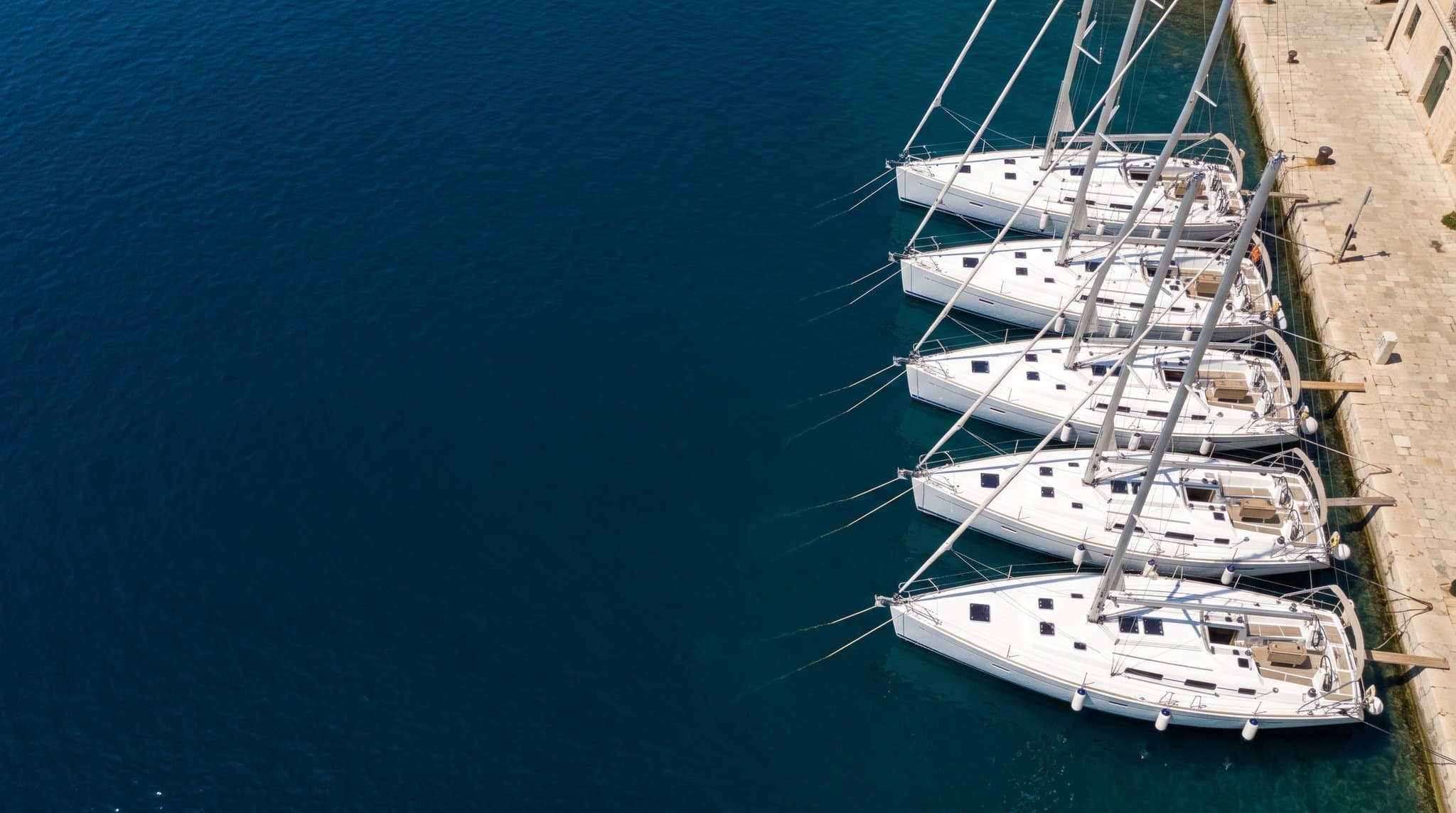
Med mooring, also called Mediterranean or stern-to mooring, is berthing a boat with its stern or bow against a quay rather than alongside it, held off by its own anchor or by a marina lazy line running to a seabed block. It is the standard berthing method across Mediterranean town quays and marinas.
Key takeaways
- The hull deductible is endorsed at 1%, 2%, 3%, 4% or 5% of the hull value, on each and every claim, and most stern-to contact damage lands below it.
- On a $400,000 agreed value that is $4,000 at 1% and $12,000 at 3%, which is more than most berthing contact costs to put right.
- Cover is the first question and the deductible the second: the hull section excludes marring, scratching and denting at item 3, unless it was agreed in writing before the loss.
- What you hit decides which section answers. Another vessel runs through the hull section, a quay or a pontoon through third party liability, your own anchor and chain back to hull.
- Duty 6 says you must not admit liability without written consent, so the quayside handshake belongs after the estimate and the notification, never before them.
- In Croatian waters every deductible doubles, so the same yacht at 2% carries $16,000 rather than $8,000.
Is a Med mooring scrape worth claiming on your yacht insurance?
Usually not, and the reason is arithmetic rather than coverage. Most stern-to contact damage, a scuffed topside, a scraped rub rail, a bathing platform that kissed the stone, lands below the ordinary deductible on a typical agreed value. The practical question is whether anything is left to pay once your own share comes off.
That leaves three remedies: prevent the contact, settle it directly with the boat next door, or report it to your insurer without claiming on it. Each carries a constraint, and all three live in the policy wording rather than in common sense.
Some cases invert that answer. Damage to someone else's boat, injury to a person on the quay or on a lazy line, and anything that reaches the drive train belong in a claim. A bent shaft, a damaged saildrive or a rudder that met a ground block is a different order of money.
The phrase itself is overloaded, so one clarification first. This page is about the Mediterranean berthing method, not about renting a permanent or residential mooring in a US harbour. The RYA explains stern-to berthing if you want the manoeuvre itself. We are interested in what the damage does to your policy. The value your percentage multiplies is the agreed value on your schedule, which is set when the policy is written.
What does a stern-to mooring deductible actually cost in dollars?
The hull deductible is set by an endorsement on your policy, and the London-market clause set we hold carries five of them: 1%, 2%, 3%, 4% and 5% of the hull value, on each and every claim. Which one binds you is whichever is endorsed on your own schedule, so the dollar figure follows your scheduled value rather than the size of the accident. That is the same band published on our guide to the ordinary hull deductible band, and the numbers below are that percentage multiplied out.
| Scheduled hull value | 1% | 2% | 3% | 5% |
|---|---|---|---|---|
| $150,000 | $1,500 | $3,000 | $4,500 | $7,500 |
| $250,000 | $2,500 | $5,000 | $7,500 | $12,500 |
| $400,000 | $4,000 | $8,000 | $12,000 | $20,000 |
| $750,000 | $7,500 | $15,000 | $22,500 | $37,500 |
| $1,500,000 | $15,000 | $30,000 | $45,000 | $75,000 |
Worked example
Take the $400,000 row. Even at the most generous 1%, the owner carries $4,000 before the policy pays anything, and very little berthing contact costs $4,000 to put right. At 3%, which is unremarkable on a cruising yacht, the figure is $12,000.
There is a second deductible, and it is easy to miss. The wording applies the deductibles shown in the liability section of the schedule to the aggregate of each third party liability claim arising from one event, and that is a different figure from the hull deductible on the same schedule. Which one applies depends on what you hit, and two sections below take that up.
The 10% named-windstorm deductible is a different instrument again, applies to Atlantic hurricane exposure, and runs with a signed hurricane plan agreed by underwriters in advance. It has nothing to do with a berthing scrape. To work the arithmetic against your own numbers, work it against your own value, and see what the premium itself runs to. This is general information and not financial advice. Your own schedule governs.
What does stern-to mooring damage actually cost to repair?
Honestly, nobody knows, and the disagreement is the finding. Published estimates for functionally the same gelcoat repair differ by five to ten times, which means any single number you read is close to meaningless as a planning figure.
On r/boating in June 2024, the same damage drew a professional quote of about $4,000 and was then repaired by the owner with a patch and gelcoat for about $450. On the YBW forums in February 2011 a boat gelcoat repair was quoted at £500. The Hull Truth put full-panel work at $2,200 to $2,500 in 2013, while a 2026 regional guide put the same job at $3,000 to $5,500, and a full re-gelcoat runs beyond $15,000. A YBW thread from September 2022 put the material alone for a rubbing strake at over £1,000 on some boats. Those are reports from owners and vendors at particular dates, not quotations, and no dated Mediterranean yard rate card exists to settle them. We publish them as a spread because the spread is what an owner actually faces.
What the wording asks of you on the day is not uncertain at all. Two duties decide what you do before you call anyone:
- Afford underwriters the opportunity to inspect the damaged property prior to any repair or removal. Repairing first can cost you the claim, however reasonable the repair was.
- Substantiate the claim with a minimum of two repair estimates. One quote is not a claim file.
So the sequence is photograph, get two estimates, give notice, and only then decide. The estimates tend to come back asymmetric. A cosmetic scuff is a few hundred; a bent shaft or a damaged saildrive is an order of magnitude more, and only the second reliably clears a deductible at all.
Does a yacht policy even cover a gelcoat scuff from the quay?
Often it does not, and this is the clause that decides it. The hull section of the London-market wording lists “Marring, scratching or denting” among its exclusions, at item 3, alongside wear and tear and gradual deterioration. So for the commonest stern-to outcome the deductible is the second question. The first is whether there is a covered loss at all.
“Unless agreed by us in writing prior to any loss … Marring, scratching or denting.”
Two things stop that being a dead end, and both are in the same document. The exclusion list is prefaced “Unless agreed by us in writing prior to any loss”, which means the carve-out carries its own cure. Cover for it can be agreed, in writing, beforehand. That is a conversation for the day the policy is written, not for the quay afterwards. And the exclusion bites the cosmetic outcome, not structural damage that happens to look cosmetic from the pontoon. Pre-repair inspection is what separates the two.
Time matters here as well. A rub rail degraded by a season of quay contact is not one accident, it is wear, and section 55(2)(c) of the Marine Insurance Act 1906 puts the same principle in statute: the insurer is not liable for ordinary wear and tear. None of that makes gelcoat damage uninsurable. The clause, the cure and the boundary have to be read together, and the full list is in our guide to what yacht insurance does not cover.

We hold the London Marine wording, the clause set and the endorsements at this desk, so when an owner asks whether a scuff is covered we open the exclusions page and read the marring clause back to them rather than paraphrasing what the market says about it. It is a short conversation and an unwelcome one, and it is still better had before the season than after the fender slipped.
Who pays when you back into the boat next door?
Your own policy does, and through a section most owners would not expect. Boat-on-boat contact does not run through the third party liability section. It runs through a paragraph inside the hull section: if the insured vessel comes into collision with another vessel and you become liable to pay damages to a third party, the insurer reimburses you up to the hull limit shown on the schedule, and pays defence costs where liability has been contested with written consent.
The two sections interlock; they do not overlap. The liability section carves out damage to another vessel already covered under the hull section at its own exclusion 13, so there is one route, not two, and the hull deductible is the one that applies.
Where both boats are at fault, which is ordinary at a crowded quay in a crosswind, the claim settles on the principle of cross liabilities: as if the owners of each vessel had been compelled to pay the other a proportion of their damages. It is not a coin toss and not an automatic 50/50.
Uninsured Boaters Cover does not rescue you in this scenario, and it is the section owners reach for first. It pays bodily injury to an insured person and requires physical evidence of direct contact. It is not hull cover for an unwitnessed overnight bump. For how the liability side works in general, see third party liability cover. This is general information and not financial advice; your own schedule and wording govern.
What if you hit the quay rather than a boat?
Then you have left the hull section altogether. The collision paragraph says plainly that there is no cover under that section for damages to any fixed or floating object other than another vessel. A quay, a pontoon, a marina finger and a lazy-line ground block are all fixed objects. So backing into stone is not a collision claim at all. It routes to the third party liability section, which answers for sums you become legally liable to pay as a result of your ownership and operation of the vessel, and it carries that section's separate deductible.
The liability section also excludes “Liability assumed by you under any contract or agreement”, and that is where cover can quietly stop. A marina berthing contract that makes the berth-holder answerable for damage to marina property is capable of being exactly that kind of assumed liability. Liability you incur at law is one thing; liability you took on by signing at the office is another, and the policy treats them differently.
None of that means marina contracts void your cover. Read the berthing terms before you sign them, and ask whether the liability they put on you is the liability your policy actually follows. If you cruise the region regularly, our Mediterranean yacht insurance page sets out how cover works across the basin. The same exclusion read against a boatyard storage agreement, where what the owner assumes can reach the blocking and the strap placement itself, is set out in what a boatyard's storage contract does to your own cover.
Fouled and crossed anchors: whose problem is the ground tackle?
Start with whose gear it is. That single distinction resolves most of the argument, and the open web has left it to a 2009 forum thread whose own posters disagreed with each other.
| What you hit or what failed | Whose gear | Which section answers | Which deductible |
|---|---|---|---|
| Another vessel | theirs | Hull section, collision paragraph, to the hull limit | Hull |
| The quay, pontoon or finger | the marina's | Third party liability, fixed objects being carved out of the hull head | Liability |
| Your own anchor and chain | yours | Hull, subject to the marring exclusion | Hull |
| The marina's lazy line or ground block | the marina's | Your hull cover answers first, then recovery is pursued | Hull, then subrogation |
| A person on the quay or a lazy line | not applicable | Third party liability, bodily injury | Liability |
A fouled anchor is routine in Greek and Croatian harbours and is usually a seamanship problem rather than an insurance one. It turns into an insurance problem when lifting someone else's chain damages their gear or yours, or when a diver has to be paid to sort it out. Where both boats are at fault, the cross-liabilities principle above is how it settles. The convention that the last boat to arrive keeps clear of existing ground tackle is a convention among cruisers, not a rule of law, and it will not decide a claim on its own.
A failed marina lazy line is a different question, because you are pursuing a third party rather than claiming on your own hull. Lazy line mooring puts the marina's gear in the load path, which is what changes the answer. That means proving the gear failed and that the marina was responsible for it, and the documented experience is that collecting is hard even after your own insurer has paid you and taken over the claim under section 79(2) of the Marine Insurance Act 1906. The RYA describes the lazy-line arrangement, a heavy ground line pre-attached to a concrete block on the seabed.
Can you settle it privately with the boat next door?
Not without care, and the constraint sits in the wording, not in quayside etiquette. Owners reach for the quayside handshake precisely because the damage sits under the deductible, and the wording restricts exactly that move. Duty 6 reads “You must not admit liability or assume obligation without our written consent.”
Paying your neighbour for a dent while apologising for it is an admission, and it is made before anyone knows whether the repair is £300 or £3,000. Damage that looks cosmetic across two fenders at dusk is usually the damage that turns out to be more.
What to do instead is unglamorous and takes ten minutes.
- 1Exchange details.
- 2Photograph both boats, including the parts that are undamaged.
- 3Agree nothing about fault.
- 4Give notice to your insurer.
- 5Once there is an estimate and a real figure, settle privately if that is still the sensible answer, which it often is.
Insurers care about this beyond their own liability. Under section 79(2) of the Marine Insurance Act 1906, an insurer who pays a partial loss is subrogated to your rights against whoever caused it, and the wording says the same at duty 12: you must preserve your rights of recovery from others. A private settlement can extinguish the mechanism that would have pursued the other owner or the marina. Recovery from a marina frequently fails in practice, which is itself an argument for a sensible private settlement, made in the right order. This is general information, not financial or legal advice.
Do you have to tell your insurer about damage you are not claiming for?
Yes, and the two acts are separate, which is the part the market runs together. Our claims page sets out the process itself. Giving notice attaches to the occurrence: the wording asks you to give written notice of the occurrence as soon as possible, including its location and circumstances. Making a claim is a separate decision you take afterwards, once you know the figure and have compared it with the table above. Notifying is not claiming.
The practical sequence:
- 1Minimise the damage first. That is a statutory duty as well as a policy one.
- 2Give notice, with the location and circumstances.
- 3Preserve the evidence and leave the damage uninspected and unrepaired until underwriters have had their opportunity.
- 4Get two estimates.
- 5Then decide whether to claim.
The duty to minimise is statutory as well as contractual: section 78(4) of the Marine Insurance Act 1906 requires the assured to take reasonable measures to avert or minimise a loss.
We will not pretend notification is consequence-free. A notified incident is on the record whether or not it becomes a claim, and no-claims years are an input to how a risk is rated at quotation. What happens at any individual renewal depends on that owner's history and the underwriter's view, and we cannot tell you what yours will do. Not financial advice.
Croatia: what a doubled deductible does to a routine scrape
The wording we hold doubles every deductible while the yacht is in Croatian waters. We will not re-explain the rule here, because Croatia's doubled deductibles are set out in full on that page, including the four conditions that travel with them.
Worked example
Take the $400,000 yacht from the table above at a 2% hull deductible. In Greece the owner carries $8,000. In Croatian waters the same policy, the same yacht and the same scrape leave the owner carrying $16,000. A claim that was already marginal is not a claim at all, and an owner who budgeted on the schedule figure alone has budgeted wrong for half the Adriatic season.
This is not an edge case for a Mediterranean cruiser. Croatia holds 92 of the 956 marinas we count in the Mediterranean, with place counts derived from the noForeignLand community map, September 2026. Cover is entirely placeable there: the clause doubles the deductible, it does not restrict or exclude the cruising ground.
Frequently asked questions
1.I am chartering, not an owner. Does any of this apply to me?
+
Only partly. On a bareboat charter the yacht is insured by the base, not by you, and your exposure is the damage deposit or waiver in the charter agreement, which behaves nothing like a policy deductible. The wording described here is an owner's policy. Ask your base what the waiver caps at and what it excludes.
2.A boat dragged its anchor into mine overnight. Do I claim on mine or chase theirs?
+
Your own hull cover answers first, by the same route as any boat-on-boat contact: the collision paragraph inside the hull section, up to the hull limit and subject to your hull deductible, not third party liability. Pursuing the other owner is then your insurer's job, since your right of recovery becomes theirs once they pay. Do not settle at the scene; admitting liability without written consent is a breach.
3.Someone else's boat damaged mine and they have no insurance. Am I covered?
+
Your own hull cover answers first, subject to your hull deductible. Uninsured Boaters Cover is not the answer here: it pays bodily injury to an insured person rather than hull damage, and it requires physical evidence of direct contact, which rules out an unwitnessed overnight bump. Your insurer's route against the other owner is subrogation.
4.Will a small berthing claim cost me my no-claims discount?
+
Notifying and claiming are different acts, and a notified incident is on the record either way. No-claims years are an input to how a risk is rated rather than a published discount table, so the honest answer is that we cannot say what any individual renewal will do. Compare the repair against your deductible first.
5.How much does it cost to moor a boat in Greece?
+
That is a separate question from damage and deductibles, and we will not publish a tariff without a dated source, because berthing fees vary by length, season, town quay and marina. Ask the harbour or marina directly. For context on scale, Greece holds 91 of the 956 Mediterranean marinas on the community map.
6.What are the three types of mooring?
+
Alongside a quay or pontoon, stern-to or bow-to in the Mediterranean style, and swinging on an anchor or a buoy. Only stern-to concentrates several boats' ground tackle in the same patch of water, which is what creates the fouled-anchor exposure described above.
7.Can I get the boat repaired before telling my insurer?
+
Not if you intend to claim. The wording requires you to afford underwriters the opportunity to inspect the damaged property prior to any repair or removal, and to substantiate a claim with a minimum of two repair estimates. Photograph the damage, get the estimates, give notice, and repair afterwards.
Sources and how we verified this
- Policy clauses: the London Marine Insurance Services yacht policy wording, clause set and endorsements held at this desk, cited by section name so you can find the same words in your own document. The hull deductible band comes from the five HULL DEDUCTIBLE endorsements in that clause set.
- Statute: Marine Insurance Act 1906, sections 55(2)(c), 78(4) and 79(2), linked inline to legislation.gov.uk.
- The manoeuvre and the lazy-line mechanism: the Royal Yachting Association.
- Repair-cost reports: owner and vendor posts on r/boating (June 2024), the YBW forums (February 2011 and September 2022), The Hull Truth (2013) and a 2026 regional repair guide. Published as a disputed spread, never as a planning figure.
- Place counts derived from the noForeignLand community map, September 2026.
World Yacht Insurance is a yacht-insurance introducer arranging hull and liability cover up to $5M for sail and motor yachts worldwide, including the Caribbean, placed in the London market through London Marine Insurance Services Ltd, a Lloyd's-accredited broker.
We are not an insurer and we carry no risk. Nothing here is financial advice, and your own policy schedule and wording decide what applies to your boat. For the full chain and who does what, see how it works.

Cruising the Med this season?
Tell us the boat, the agreed value and where it will be based, and we will come back with an indicative quote and the deductible you would actually carry.
- No obligation
- every underwriting question asked upfront
- a licensed Cyprus agent reviews every enquiry
Also on WhatsApp, Telegram and Viber