
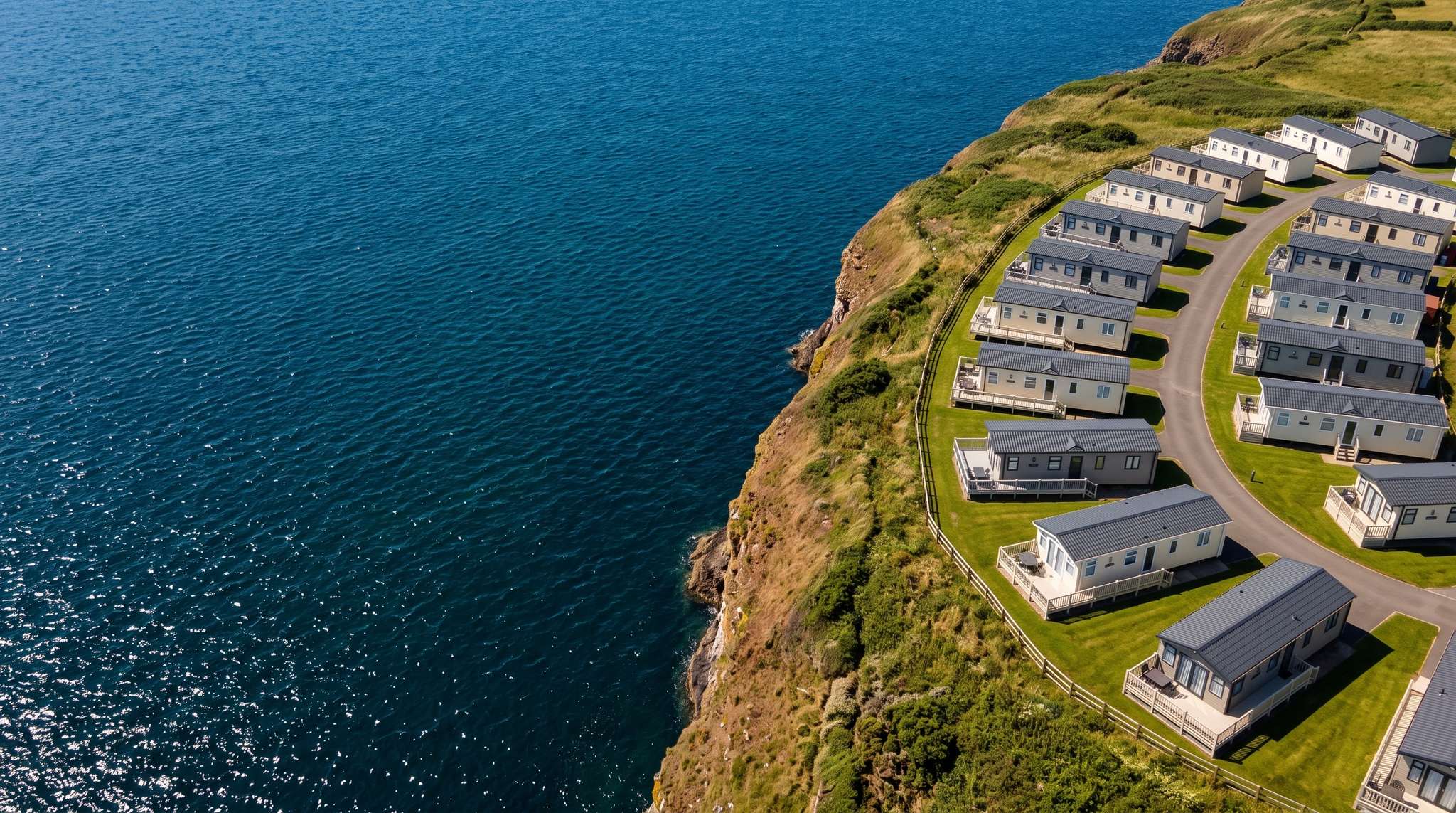
Static Caravan Insurance
Static caravan insurance covers your holiday home, its fixtures, decking and contents against fire, storm, flood, theft, subsidence and accidental damage, with public liability up to £5,000,000 and alternative accommodation up to 20% of your sums insured. It is not required by law. Your holiday park's pitch agreement is what requires it. Cover is arranged for UK and Channel Islands residents.
UK and Channel Islands residents, holiday use only.
Reviewed by Costas Matheou, licensed insurance agent (Cyprus), ICCS certificate 6882. Last reviewed 31 August 2026.
£5,000,000
Public liability limit on the IPID (wording cl. 3.1.11)
48 hours
Not slept in for longer than this and your caravan is defined as Unoccupied
1 Nov to 31 Mar
The winter water precautions window on this wording (cl. 1.4.2)
20% / 30 days
Alternative accommodation: up to 20% of your total sums insured, maximum 30 days
What does static caravan insurance cover?
The governing document here is the FreeTime Leisure Home Policy Wording (GS_LEI_SC_PW_v05.21, read 31 August 2026). It does not lead on the phrase static caravan. It insures "Your Static Caravan, Chalet, Lodge, Log Cabin, Twin Unit or Holiday Home", with the fixtures, fittings and equipment supplied with it.
The definition reaches further than most owners expect. It takes in domestic outbuildings, garages, porches, sheds and fixed storage chests; sewer tanks, pipes, cables, solar panels and aerials; steps, balconies, decking, verandas, patios, paths, drives, terraces, walls, hedges, gates and fences; and "hot tubs excluding soft tubs". All of it must sit inside the Land, the plot named in your site agreement and shown on your Schedule.
Eleven perils are insured under Section 1, each with its own carve-outs, so the two columns below belong together.
| Insured peril (Section 1) | What the same clause takes back out |
|---|---|
| Fire, lightning, explosion, smoke or earthquake (1.1) | Damage from repeated exposure or any gradually operating cause (1.1.1) |
| Aircraft, other flying devices, or items dropped from them (1.2) | Pressure waves from aircraft at sonic or supersonic speed (6.3) |
| Storm, flood, weight of snow (1.3) | Drives, patios, terraces, gates, fences, hedges, fixed fuel tanks and property in the open; hot tubs damaged by ground water rising; frost damage |
| Escape of water, LPG or oil (1.4) | Damage to the installation or appliance itself (1.4.3); loss while Unoccupied between 1 November and 31 March unless the winter condition is met (1.4.2) |
| Theft or attempted theft (1.5) | Theft while Unoccupied without forcible or violent entry (1.5.1.1); theft while let out unless Endorsement 3 is on the Schedule (1.5.1.2); theft while lent to family or friends without violent and forcible entry (1.5.1.3) |
| Collision by a vehicle or animal (1.6) | Damage by domestic pets or insects (1.6.2) |
| Riot, violent disorder, strike or malicious acts (1.7) | Loss while the caravan is not furnished for immediate use (1.7.1); loss without violent and forcible entry (1.7.2) |
| Wilful and deliberate acts (1.8) | Acts by a hirer, occupant or user of the caravan unless Endorsement 4 is on the Schedule (1.8.2) |
| Subsidence, landslip or heave (1.9) | Hot tubs, drives, patios, terraces, walls, gates, fences and fuel-oil tanks unless the caravan is damaged at the same time by the same event (1.9.1); coastal or river bank erosion (1.9.5) |
| Falling trees, utility poles or lamp posts (1.10) | Gates, fences and hedges (1.10.2); removing a fallen tree that damaged nothing (1.10.3) |
| Accidental loss or damage (1.11) | Hot tubs, drives, patios, terraces, walls, gates, fences and fuel tanks (1.11.15); frost, damp, rot and mould (1.11.9); mechanical or electrical breakdown (1.11.12); damage while not furnished for immediate use (1.11.17) |
Five exclusions apply across the whole of Section 1: Valuables (1.30), the excess on your Schedule (1.23), loss outside the Land (1.24), previous unrepaired damage on a total loss (1.28), and any loss while the caravan is let for hire and reward without Endorsement 3 (1.25).
Smaller limits decide ordinary claims: trace and access £2,500 (cl. 1.18.1), emergency access by the fire, police or ambulance service £1,000 (cl. 1.19.1), garden re-landscaping £750 with £50 for any one tree, shrub or plant (cl. 1.20), replacement door locks after lost or stolen keys £250 (cl. 1.21.1), and freezer contents £250, though not for a cabinet over 10 years old (cl. 1.22.3). Personal belongings are capped at £500 for any one unspecified item (cl. 1.37). Valuables are not insured at all: jewellery, watches, gold, silver, antiques, pictures and furs sit outside the policy.
Public liability runs to £5,000,000 (GS_SC_IPID 01.22, read 31 August 2026; wording cl. 3.1.11). Alternative accommodation pays up to 20% of your total sums insured, for no more than 30 days (cl. 4.1.1, 4.1.2). Two restrictions are published up front: flood cover is not available in certain areas, and theft of an item left in an unlocked caravan is not covered (GS_SC_IPID 01.22).
Is static caravan insurance a legal requirement?
No UK statute requires you to insure a static caravan. The obligation is contractual, and it comes from the pitch agreement you signed with your holiday park.
Two documents get merged constantly. The site licence is issued by the local council to the park operator, not to you. Section 5 of the Caravan Sites and Control of Development Act 1960 sets out what a council may attach to it: caravan numbers and siting, types and sizes, the amenity of the land, fire precautions and fire-fighting equipment, and sanitary facilities. Insurance is not in the list, and the GOV.UK guidance on caravan site licences does not mention it either. That list is not exhaustive, so this is not a condition a council could never impose. It is simply not one the Act names.
The figure your park asks for is not standardised. Two sets of published park rules read on 31 August 2026 differ. Coastdale Parks requires third-party liability "in such reasonable sum as we will inform you from time to time (not less than £5 million)", plus a copy of the cover before each season. Homing Park rule 3 requires cover "to a level of at least Two Million Pounds (£2M)". Read your own agreement rather than assuming a standard. The £5,000,000 limit on this scheme meets the higher of the two.
Then read what else the agreement puts on you. General exclusion 6.10 says the policy does not pay "any liability which arises only because You have entered into a contract which makes You legally liable", and cl. 3.1.7 repeats it inside the liability section. A duty your pitch agreement creates sits outside this cover.
Some parks offer their own block insurance. Compare it on limits and conditions, not only on price. If you are unsure what your agreement asks for, talk to us about your park's requirement.
What does "unoccupied" mean on a static caravan policy?
Unoccupied is a defined term, and it is stricter than the everyday word. It means "When Your Leisure Home has not been slept in for a period in excess of forty eight (48) consecutive hours or when Your Leisure Home site is closed or when Your Leisure Home is not furnished for immediate use" (GS_LEI_SC_PW_v05.21, definitions, read 31 August 2026).
Work that against how a holiday caravan is really used. Two nights away and it is Unoccupied. The park shuts for the winter and it is Unoccupied, whether or not anyone slept there the week before. Strip the bedding out in October and it stops being furnished for immediate use. For most owners the caravan is Unoccupied for the larger part of the year.
Several clauses change while it is. Theft and attempted theft are not covered while the caravan is Unoccupied unless there was forcible or violent entry to or exit from it (cl. 1.5.1.1). A break-in with no forced entry is also outside cover while friends or family are using it (cl. 1.5.1.3). Malicious damage under peril 1.7 needs violent and forcible entry (cl. 1.7.2), and it is excluded outright while the caravan is not furnished for immediate use (cl. 1.7.1). Accidental damage is excluded on the same ground (cl. 1.11.17). Theft of an item left in an unlocked caravan is not covered at all (GS_SC_IPID 01.22, read 31 August 2026).
None of that is a reason not to insure. It is a set of conditions to manage. Lock up, keep the caravan furnished for immediate use where you can, and read the winter condition below, because the same defined term triggers it.
Do I have to drain down my static caravan in winter?
On this wording the winter water precautions apply only while the caravan is Unoccupied, and only from 1 November to 31 March (cl. 1.4.2). A static caravan drain down is not compulsory, but it is one of only three ways to keep the escape-of-water peril alive inside that window. Two things must both be true before the condition bites: the caravan has to be Unoccupied, and the date has to fall between 1 November and 31 March (cl. 1.4.2, GS_LEI_SC_PW_v05.21, read 31 August 2026). Outside those two limbs the winter condition does not apply.
While both are true, the wording sets out three compliant routes:
- 1
The park is closed.
The water must have been "turned off at the mains and all equipment fully drained down", unless you have a self-contained central heating system containing antifreeze that was professionally installed and maintained to the manufacturer's specification.
- 2
The park is open, and you drain.
The water is "turned off at the mains stopcock, all taps left open and plug holes left unobstructed".
- 3
The park is open, and you heat.
An "automatically operating central heating system is used to maintain a minimum temperature of 15 degrees" inside the caravan at all times.
Two further points rarely make a product page. Antifreeze in the heating system is not a general answer to frost. Frost damage to fixed water tanks, apparatus, pipes and interior fixed domestic heating installations is insured under peril 1.4, but frost is excluded under the storm peril (1.3) and again under accidental damage (1.11.9). And even where the escape of water is paid, damage to the installation or appliance that leaked is not (cl. 1.4.3). Finding the leak is often the larger bill, and trace and access is capped at £2,500 for any one claim (cl. 1.18.1).
Winter windows are not standardised, and the gaps are wide enough to leave an owner uncovered for a March freeze.
| Scheme | What counts as unoccupied | Date window | What discharges the condition |
|---|---|---|---|
| This wording (GS_LEI_SC_PW_v05.21, cl. 1.4.2, read 31 August 2026) | Not slept in for more than forty eight (48) consecutive hours, or the site is closed, or the caravan is not furnished for immediate use | 1 November to 31 March | Park closed: water off at the mains and all equipment fully drained down, unless a professionally installed and maintained self-contained heating system contains antifreeze. Park open: water off at the mains stopcock with all taps open and plug holes unobstructed, or automatic central heating holding a minimum of 15 degrees at all times |
| Another UK holiday-park scheme, published summary read 31 August 2026 | "Not in use". No period published | 31 October to 1 March | The main stop cock turned off |
| A second insurer's published condition, read 31 August 2026 | "Whilst unoccupied". No period published | 1 November to 31 March, both days inclusive | Water supply off at the mains and all systems drained, except sealed central heating systems professionally fitted and containing antifreeze |
| A third insurer's published condition, read 31 August 2026 | Not stated in the published extract | 1 November to 31 March | Water off at the mains and the entire water system drained down, or a gas or oil-fired central heating system set to run continuously 24 hours a day with the thermostat at not less than 10 degrees Celsius |
This wording is the strictest of the four on two rows. It is the only one that publishes the unoccupancy trigger as a number of hours. Its heating alternative asks for 15 degrees, where the third scheme accepts a thermostat set at not less than 10 degrees Celsius. Its window also runs to 31 March, a month later than the holiday-park scheme's 1 March. The three comparison rows come from published pages read on 31 August 2026, and we do not name competing insurers. Work to the dates in your own policy, not to a market summary.
Are decking, verandas and hot tubs covered?
Yes, and that is only half the answer. Publishing the first half on its own is how owners end up surprised.
The first half: the definition of Leisure Home expressly names "Steps, balconies, decking, verandas, patios, paths drives, terraces, walls, hedges, gates and fences" and "Hot tubs excluding soft tubs", plus domestic outbuildings, garages, porches, sheds, fixed storage chests and solar panels, all inside the Land (GS_LEI_SC_PW_v05.21, definitions, read 31 August 2026). A soft tub falls outside the definition entirely, so it is not insured property here.
The second half: three separate perils carve much of that list back out.
Storm, flood and weight of snow (1.3)
do not pay for drives, patios, terraces, gates, fences, hedges, fixed fuel tanks or property in the open. They do not pay for hot tubs damaged by ground water rising, or for frost damage.
Subsidence, landslip or heave (1.9.1)
does not pay for hot tubs, drives, patios, terraces, walls, gates, fences or fuel-oil tanks unless the caravan is damaged at the same time by the same event. A £1,000 excess applies to each subsidence claim (GS_SC_IPID 01.22, read 31 August 2026).
Accidental damage (1.11.15)
does not pay for hot tubs, drives, patios, terraces, walls, gates, fences or fuel tanks at all.
So the list splits in two. Hot tubs, drives, patios, terraces, walls, gates and fences are insured property that all three of the perils most likely to damage them step around. Decking, verandas, steps, balconies and paths are named in none of those three exclusion lists, so they keep the cover the definition gives them.
Can I let my static caravan out for hire?
Only with Endorsement 3 on your Schedule, and the endorsement takes cover away as well as adding it.
Without it, cl. 1.25 removes the whole of Section 1 while the caravan is let out for hire and reward, and general exclusion 6.9.2 removes cover across the policy for hiring or letting out. Endorsement 3 switches that exclusion off, then does six other things (GS_LEI_SC_PW_v05.21, Endorsement 3, read 31 August 2026):
- Section 5 Personal Accident is deleted.
- The excess rises to £250, or the figure on your Schedule if that is greater, and applies to all claims under the policy including a total loss.
- Theft of contents or personal belongings is paid only where there are visible signs of forcible or violent entry or exit.
- Contractual liability attaching because of the hire or lease agreement is not covered.
- Loss arising from the hirer failing to comply with that agreement is not covered.
- Three conditions attach to the letting itself, with two different consequences.
Read those conditions slowly. All necessary or relevant licences and certificates must be in force before and during any hiring, and the endorsement says that if they are not, "all cover under Your Policy will be inoperative" (End. 3(f)(i)). Separately, you must obtain and keep the hirer's proof of identity and address, and the payment "is not made in cash" and has cleared before the hire starts (End. 3(f)(ii), 3(f)(iii)). Break those two and the insurer may cancel the policy, refuse to handle the claim, or reduce what it pays (End. 3(f)).
A cash booking is not an administrative slip. It breaches a condition on the same page that grants the letting cover, and the wording lets the insurer decline or cut the claim that follows.
Endorsement 4 is separate. It covers wilful and deliberate damage by a hirer, which Endorsement 3 leaves excluded under cl. 1.8.2, so letting cover and vandalism cover while let are two questions of your Schedule. Cl. 7.1.1 also gives you fourteen days to report "Any change in the way that Your Leisure Home is used".
The policy is not the only document that has to say yes. One published set of park rules read on 31 August 2026 states: "We do not allow the commercial sub-letting of holiday caravans on any of our Parks". An arrangement the insurer will endorse can still breach your pitch agreement.
How much does it cost, and how will a claim be settled?
We publish no premium figure for this scheme, because none is evidenced from a document we hold. Figures on comparison pages are averages built from other schemes, and quoting one here would tell you nothing about your own caravan. Six things set the price on this wording:
- the sum insured for the caravan
- whether contents and personal belongings are insured
- whether settlement is New for Old or Market Value
- the excess on your Schedule
- whether flood cover is available at your postcode
- whether Endorsement 3 for letting is needed
Settlement is the more useful answer, because two questions come up constantly and the real answer is not an age.
New for Old does not turn on how old the caravan is. This wording sets no age limit. It turns on the sum insured. Cl. 1.33.1 requires an accurate, up to date brand new value when you take out the policy and at every renewal. If the sum insured "does not represent the full replacement value as new, at the time of the loss or damage", cover reverts to Market Value. Index linking adjusts the sum insured monthly in line with the Government's General Index of Retail Prices, and only where New for Old is selected.
Underinsurance is applied proportionately. Cl. 1.38.2 gives the wording's own example: if your sum insured covers half the cost of rebuilding the caravan, the insurer pays half the cost of repair or replacement.
Two settlement conditions rarely reach a product page. The caravan must have been in a good state of repair immediately before the loss, and the insurer may deduct an amount reflecting the difference if it was not (cl. 1.34, 1.35). Previous damage you have not repaired is deducted on a total loss (cl. 1.28).
Can I live in my static caravan?
Not on this policy. The wording is short and clear: "unless it is shown in Your Schedule or amended by Endorsement You are not insured if You use Your Leisure Home ... as Your main or permanent residence" (cl. 6.9.1, GS_LEI_SC_PW_v05.21, read 31 August 2026). Cl. 6.9.3 adds that you are not insured for "anything except Your own private and pleasure purposes". A holiday-home policy stops being the right policy the moment the caravan becomes somebody's home, and cl. 7.1.1 gives you fourteen days to report a change of use. Where the caravan is a permanent residence, park home insurance is the product to ask about, and it is a different product from this one.
The legal position explains why the question keeps coming up. A pitch whose planning permission or site licence is "expressed to be granted for holiday use only" is not a "protected site" under section 1(2) of the Caravan Sites Act 1968. The Mobile Homes Act regime that protects residential park-home owners does not reach a holiday caravan. What governs your pitch agreement instead is ordinary contract law, together with the unfair-terms provisions of the Consumer Rights Act 2015.
How many months you may use the caravan is a question for your park, not for the policy. Season length comes from the site licence and your pitch agreement. Council tax, planning enforcement and whether a particular contract term is enforceable sit outside what an insurance page can answer.
Static caravan insurance questions
How much does it cost to insure a static caravan?+
There is no single figure worth quoting, because the premium is built from your own caravan and your own choices. It is set by the sum insured, whether settlement is New for Old or Market Value, the excess on your Schedule, whether contents and personal belongings are insured, whether flood cover is available at your postcode, and whether the letting endorsement is needed. Ranges published on comparison sites are averages taken from other schemes. Send us the details through the quote form and the figure comes back priced against the wording, not against an average.
What insurance do I need for a static caravan?+
You need cover for the caravan itself and public liability at the level your pitch agreement demands. On this scheme that means the caravan, its fixtures, fittings and equipment, the decking and outbuildings inside the Land, and contents if you insure them, with public liability up to £5,000,000 (GS_SC_IPID 01.22, read 31 August 2026). Personal accident pays £20,000 for ages 16 to 70 and £1,000 for under-16s, capped at £60,000 in any one period of insurance, with no benefit for anyone aged over 70 at the time of the incident (GS_LEI_SC_PW_v05.21, cl. 5.1.1, 5.2, 5.3). Contents, personal belongings, freezer contents and letting are arranged as options.
What is the 10 year rule for static caravans?+
There is no ten-year rule in this wording. New for Old settlement turns on the sum insured, not on the caravan's age: if the sum insured does not represent full replacement value as new at the time of the loss, cover reverts to Market Value (cl. 1.33.1, GS_LEI_SC_PW_v05.21, read 31 August 2026). Age limits owners do meet in practice come from park agreements and from other insurers' own rules, and not from any statute.
Can my daughter live in a static caravan in my garden?+
Whatever the planning position, a holiday-home policy is not the right policy for it. Cl. 6.9.1 excludes use as a main or permanent residence and cl. 6.9.3 excludes anything except private and pleasure purposes (GS_LEI_SC_PW_v05.21, read 31 August 2026), and cl. 7.1.1 requires you to report a change of use within fourteen days. Planning permission and council tax are separate questions that an insurance page cannot answer for your address.
How many months a year can you live in a static caravan?+
From the insurance side, none: this is holiday cover, and a caravan used as a main or permanent residence is not insured under it (cl. 6.9.1). Season length is set by your park's site licence and your pitch agreement, not by the policy. A pitch granted for holiday use only is not a protected site under section 1(2) of the Caravan Sites Act 1968, so the residential park-home protections do not apply to it.
Start your static caravan enquiry
Tell us about your caravan, your park's liability requirement and how you use it, and we will introduce your enquiry to the right desk.
- No obligation
- every underwriting question asked upfront
- a licensed Cyprus agent reviews every enquiry
Also on WhatsApp, Telegram and Viber